
What Is the Exterior Angle of a Polygon?
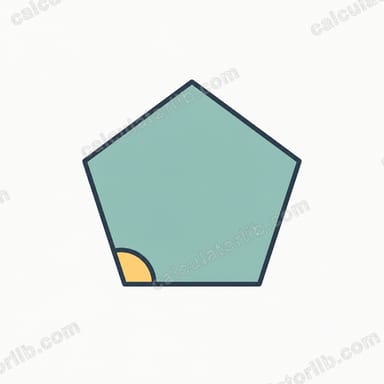
An exterior angle is formed between one side of a polygon and the extension of an adjacent side. For a regular polygon — one where all sides and all angles are equal — every exterior angle is identical. A remarkable fact of geometry is that the exterior angles of any convex polygon always add up to exactly 360°, no matter how many sides it has. This calculator uses that property to give you each exterior angle, the matching interior angle, and the total.

How to Use This Calculator
Simply enter the number of sides (n) of your regular polygon — for example 3 for an equilateral triangle, 4 for a square, 5 for a pentagon, or 6 for a hexagon. The tool instantly returns the exterior angle, the interior angle, and confirms that the exterior angles sum to 360°. The number of sides must be at least 3.
The Formula Explained
Because the exterior angles of a regular polygon are equal and total 360°, each one is found by dividing 360° by the number of sides:
$$\text{Exterior Angle} = \frac{360^{\circ}}{\text{Number of Sides (n)}}$$
The interior angle at each vertex is the supplement of the exterior angle, so:
$$\text{Interior angle} = 180^{\circ} - \frac{360^{\circ}}{n}$$

Worked Example
Consider a regular hexagon, which has 6 sides. The exterior angle is $$360^{\circ} \div 6 = 60^{\circ}.$$ The interior angle is then $$180^{\circ} - 60^{\circ} = 120^{\circ}.$$ As expected, six exterior angles of \(60^{\circ}\) each add up to 360°.
Frequently Asked Questions
Do exterior angles always add up to 360°? Yes — for any convex polygon, the sum of the exterior angles (one per vertex) is always 360°, regardless of the number of sides.
What is the exterior angle of a square? A square has 4 sides, so each exterior angle is \(360^{\circ} \div 4 = 90^{\circ}\).
Does this work for irregular polygons? The 360° sum applies to all convex polygons, but the simple "360 ÷ n" formula for each individual angle only works when the polygon is regular (all angles equal).