
What This Calculator Does
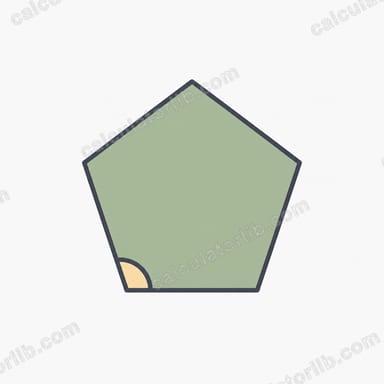
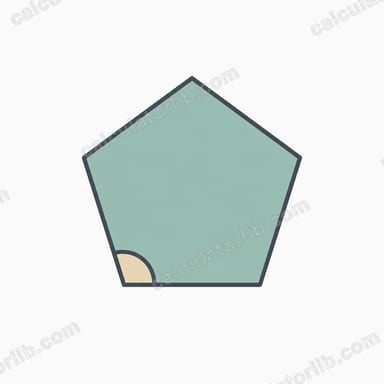
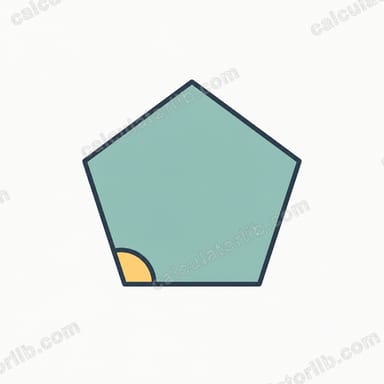
The Polygon Interior Angle Calculator finds the total sum of the interior angles of any polygon, the measure of each interior angle (for a regular polygon), and each exterior angle. Just enter the number of sides n, and the tool applies the standard polygon angle formulas instantly. It works for triangles, quadrilaterals, pentagons, hexagons, and on up to any many-sided polygon.
How to Use It
Enter the number of sides (n) — it must be 3 or more, since a polygon needs at least three sides. Click calculate, and you'll see the sum of interior angles plus the size of each interior and exterior angle, assuming a regular polygon (all sides and angles equal). For an irregular polygon, only the sum figure is universally valid; individual angles will vary.
The Formula Explained
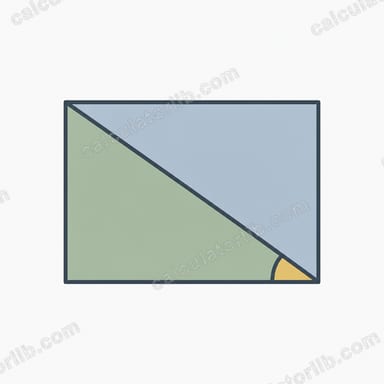
Any polygon can be split into (n − 2) triangles, and each triangle contributes 180°. So the sum of all interior angles is:
$$\text{Sum} = \left(\text{Sides }(n) - 2\right) \times 180^{\circ}$$
In a regular polygon, every interior angle is equal, so each one measures the sum divided by n:
$$\text{Each Interior} = \frac{\left(\text{Sides }(n) - 2\right) \times 180^{\circ}}{\text{Sides }(n)}$$
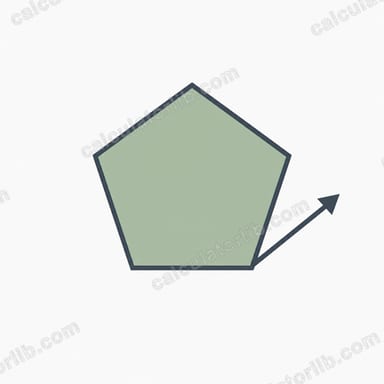
Because interior and exterior angles are supplementary along each side, each exterior angle of a regular polygon is simply \(\frac{360^{\circ}}{\text{Sides }(n)}\), and all exterior angles always add up to 360°.

Worked Example
For a hexagon, n = 6. The sum of interior angles is $$(6 - 2) \times 180 = 4 \times 180 = 720^{\circ}.$$ Each interior angle is \(720 \div 6 = 120^{\circ}\). Each exterior angle is \(360 \div 6 = 60^{\circ}\). Check: \(120^{\circ} + 60^{\circ} = 180^{\circ}\), confirming they are supplementary.

FAQ
Does this work for irregular polygons? The sum of interior angles is correct for any polygon, regular or not. The "each angle" results assume a regular polygon with equal angles.
What is the smallest polygon? A triangle, with n = 3, whose interior angles always sum to 180°.
Why do exterior angles always total 360°? As you walk around any convex polygon once, you turn through a full circle, so the exterior turns add up to 360° regardless of the number of sides.