
What is a power function?
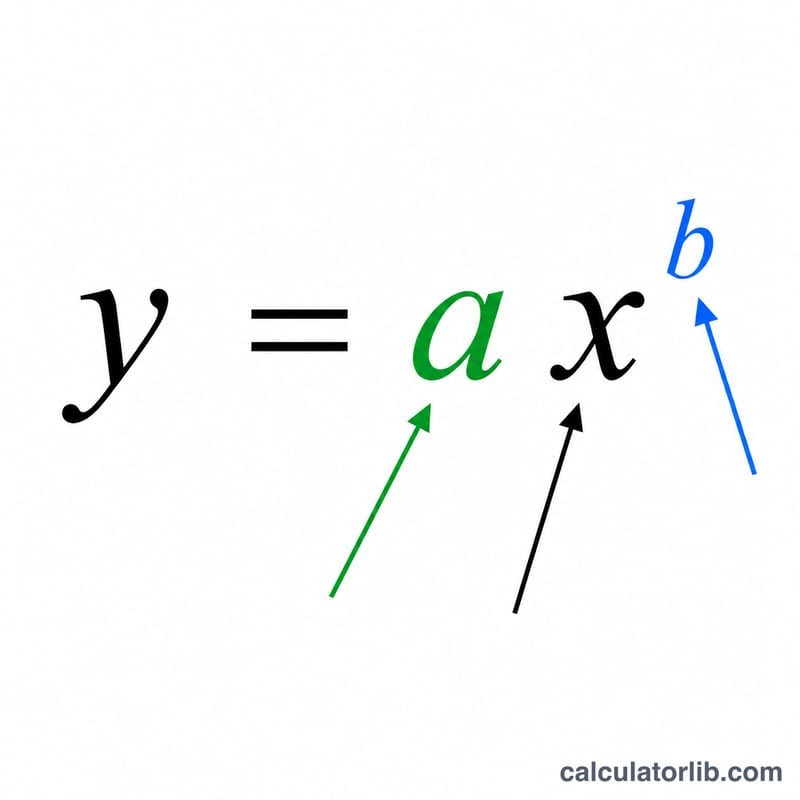
A power function has the form \(y = a \cdot x^{b}\), where a is a constant coefficient (the scale factor), x is the input variable, and b is a fixed exponent. Power functions describe a huge range of real-world relationships — from the area of a square (b = 2) to the volume of a sphere, gravitational force, and allometric scaling laws in biology.
How to use this calculator
Enter three values: the coefficient a, the variable x, and the exponent b. The calculator raises x to the power b and multiplies by a to produce y. It also shows the intermediate value \(x^{b}\) so you can see each step. Decimals and negative numbers are supported for all three inputs.
The formula explained
The result is computed in two steps. First the base is raised to the exponent: \(x^{b}\). Then that result is multiplied by the coefficient:
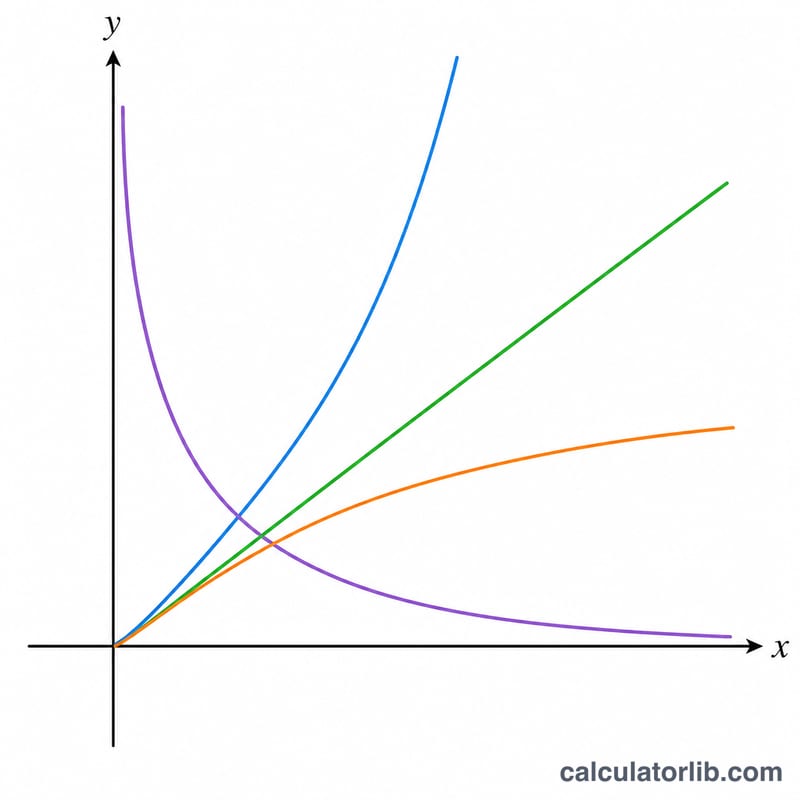
$$y = a \cdot x^{b}$$When b = 1 the function is linear (\(y = a \cdot x\)); when b = 2 it is quadratic; fractional exponents give roots (b = 0.5 is a square root), and negative exponents give reciprocals (b = −1 gives a/x).
Worked example
Suppose a = 2, x = 3, and b = 2. First compute \(x^{b} = 3^{2} = 9\). Then
$$y = a \cdot 9 = 2 \cdot 9 = 18$$So the power function evaluates to 18 at x = 3.
FAQ
Can I use a negative exponent? Yes. A negative exponent gives a reciprocal — for example \(x^{-2} = 1/x^{2}\). Just keep x non-zero to avoid division by zero.
What if x is negative and b is fractional? Raising a negative number to a fractional power may not yield a real number (e.g. the square root of a negative). In those cases the result may be undefined.
Is this the same as exponential growth? No. In a power function the exponent is constant and the base varies. In an exponential function (\(y = a \cdot b^{x}\)) the base is constant and the exponent varies.