What this calculator does
This trigonometric function calculator evaluates all six standard trig functions — sine, cosine, tangent, cosecant, secant and cotangent — for any angle you enter. You can supply the angle in degrees or radians, and the tool converts internally before computing each value.
How to use it
Enter your angle, choose whether it is in degrees or radians, and submit. The headline result shows \(\sin\theta\), and the table below lists cos, tan, and the three reciprocal functions csc, sec and cot. Values are shown to six decimal places. Where a function is undefined (for example tan at 90° or csc at 0°), the value is reported as 0 to avoid an infinite result.
The formulas explained
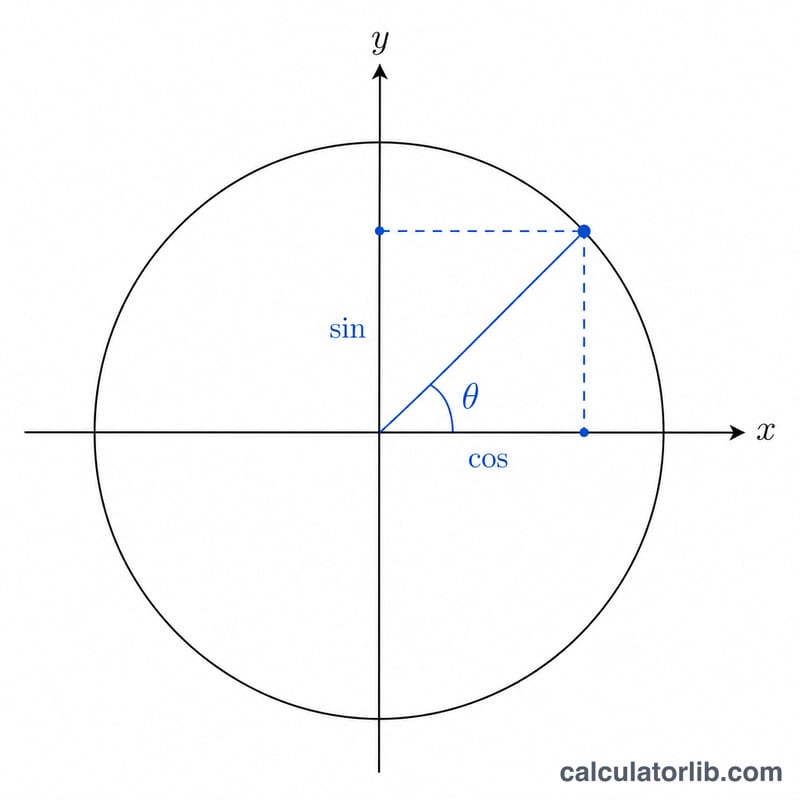
The three primary functions come directly from the unit circle: \(\sin\theta\) is the vertical coordinate, \(\cos\theta\) the horizontal coordinate, and \(\tan\theta = \sin\theta/\cos\theta\) is their ratio. The reciprocal functions are simply inverses:
$$\csc\theta = \frac{1}{\sin\theta},\quad \sec\theta = \frac{1}{\cos\theta},\quad \cot\theta = \frac{1}{\tan\theta} = \frac{\cos\theta}{\sin\theta}$$Worked example
For \(\theta = 30°\), convert to radians (\(\pi/6 \approx 0.523599\)). Then
$$\sin(30°) = 0.5,\quad \cos(30°) \approx 0.866025,\quad \tan(30°) \approx 0.577350$$The reciprocals are
$$\csc(30°) = 2,\quad \sec(30°) \approx 1.154701,\quad \cot(30°) \approx 1.732051$$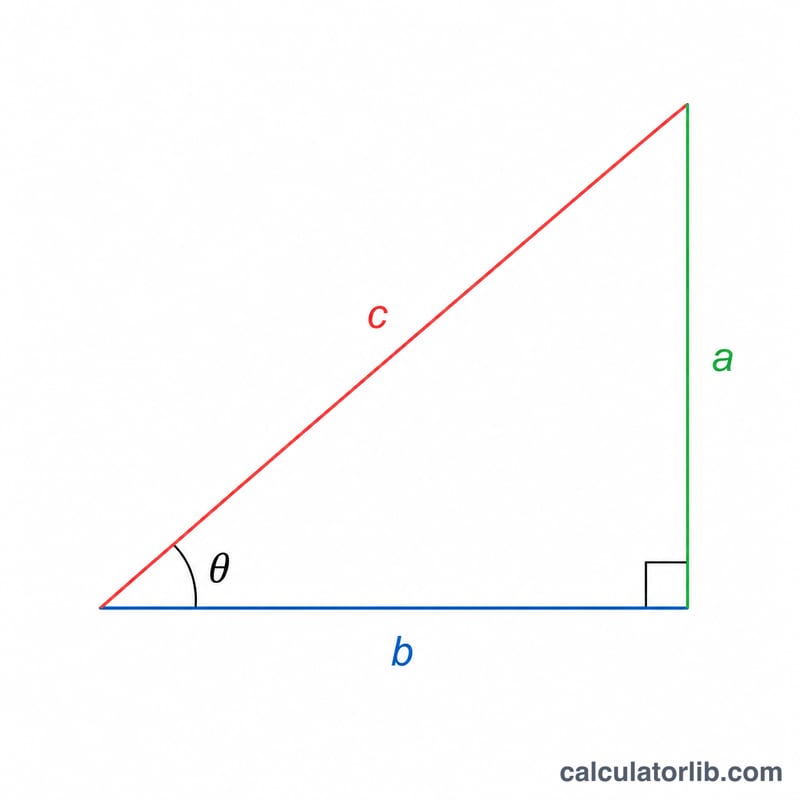
Exact Values of Trig Functions at Standard Angles
The table gives the exact value and a four-decimal approximation for all six functions at the most common angles. They follow from the 30°–60°–90° and 45°–45°–90° triangles and from the unit circle, where \(\cos\theta\) is the x-coordinate and \(\sin\theta\) is the y-coordinate. The other four functions come from these two: \(\tan\theta = \sin\theta / \cos\theta\), \(\cot\theta = \cos\theta / \sin\theta\), \(\sec\theta = 1/\cos\theta\) and \(\csc\theta = 1/\sin\theta\). When the denominator is zero, the function is undefined, not zero.
| Degrees | Radians | sin | cos | tan | csc | sec | cot |
|---|---|---|---|---|---|---|---|
| 0° | \(0\) | 0 | 1 | 0 | undefined | 1 | undefined |
| 30° | \(\tfrac{\pi}{6}\) | \(\tfrac{1}{2}\) = 0.5 | \(\tfrac{\sqrt{3}}{2}\) ≈ 0.8660 | \(\tfrac{\sqrt{3}}{3}\) ≈ 0.5774 | 2 | \(\tfrac{2\sqrt{3}}{3}\) ≈ 1.1547 | \(\sqrt{3}\) ≈ 1.7321 |
| 45° | \(\tfrac{\pi}{4}\) | \(\tfrac{\sqrt{2}}{2}\) ≈ 0.7071 | \(\tfrac{\sqrt{2}}{2}\) ≈ 0.7071 | 1 | \(\sqrt{2}\) ≈ 1.4142 | \(\sqrt{2}\) ≈ 1.4142 | 1 |
| 60° | \(\tfrac{\pi}{3}\) | \(\tfrac{\sqrt{3}}{2}\) ≈ 0.8660 | \(\tfrac{1}{2}\) = 0.5 | \(\sqrt{3}\) ≈ 1.7321 | \(\tfrac{2\sqrt{3}}{3}\) ≈ 1.1547 | 2 | \(\tfrac{\sqrt{3}}{3}\) ≈ 0.5774 |
| 90° | \(\tfrac{\pi}{2}\) | 1 | 0 | undefined | 1 | undefined | 0 |
| 120° | \(\tfrac{2\pi}{3}\) | \(\tfrac{\sqrt{3}}{2}\) ≈ 0.8660 | \(-\tfrac{1}{2}\) = −0.5 | \(-\sqrt{3}\) ≈ −1.7321 | \(\tfrac{2\sqrt{3}}{3}\) ≈ 1.1547 | −2 | \(-\tfrac{\sqrt{3}}{3}\) ≈ −0.5774 |
| 135° | \(\tfrac{3\pi}{4}\) | \(\tfrac{\sqrt{2}}{2}\) ≈ 0.7071 | \(-\tfrac{\sqrt{2}}{2}\) ≈ −0.7071 | −1 | \(\sqrt{2}\) ≈ 1.4142 | \(-\sqrt{2}\) ≈ −1.4142 | −1 |
| 150° | \(\tfrac{5\pi}{6}\) | \(\tfrac{1}{2}\) = 0.5 | \(-\tfrac{\sqrt{3}}{2}\) ≈ −0.8660 | \(-\tfrac{\sqrt{3}}{3}\) ≈ −0.5774 | 2 | \(-\tfrac{2\sqrt{3}}{3}\) ≈ −1.1547 | \(-\sqrt{3}\) ≈ −1.7321 |
| 180° | \(\pi\) | 0 | −1 | 0 | undefined | −1 | undefined |
| 270° | \(\tfrac{3\pi}{2}\) | −1 | 0 | undefined | −1 | undefined | 0 |
| 360° | \(2\pi\) | 0 | 1 | 0 | undefined | 1 | undefined |
To convert degrees to radians, multiply by \(\pi/180\). For example, \(120° \times \tfrac{\pi}{180} = \tfrac{2\pi}{3} \approx 2.0944\). The forms \(\tfrac{\sqrt{3}}{3}\) and \(\tfrac{1}{\sqrt{3}}\) are the same number, and so are \(\tfrac{2\sqrt{3}}{3}\) and \(\tfrac{2}{\sqrt{3}}\). Textbooks usually write the version with no root in the denominator.
Interpreting Your Result: Signs, Ranges and Undefined Values
Signs by quadrant (ASTC)
The sign of each function depends on which quadrant the angle's terminal side falls in. A common memory aid is ASTC ("All Students Take Calculus"):
- Quadrant I (0° to 90°): All six functions are positive.
- Quadrant II (90° to 180°): only Sine and its reciprocal, cosecant, are positive.
- Quadrant III (180° to 270°): only Tangent and its reciprocal, cotangent, are positive.
- Quadrant IV (270° to 360°): only Cosine and its reciprocal, secant, are positive.
A reciprocal always has the same sign as its partner function. For example, at 150° (Quadrant II), sin = 0.5 and csc = 2 are positive, while cos, sec, tan and cot are all negative. Angles outside 0°–360°, including negative angles, repeat every 360° (\(2\pi\)). So 390° gives the same values as 30°, and −30° gives the same values as 330°.
Range of each function
| Function | Possible values |
|---|---|
| sin, cos | \(-1 \le y \le 1\) |
| csc, sec | \(y \le -1\) or \(y \ge 1\) (never strictly between −1 and 1) |
| tan, cot | any real number |
These ranges work as a quick check. A sine or cosine above 1 in absolute value, or a secant or cosecant such as 0.4, means the input or unit setting is wrong. The most common mistake is entering degrees while the calculator is set to radians, or the reverse.
Undefined values: a 0 here does not mean zero
Tan and sec divide by \(\cos\theta\). Cot and csc divide by \(\sin\theta\). If that denominator is exactly zero, the function has no value; it is undefined. On a graph, these are the angles where vertical asymptotes appear.
- \(\tan 90° = \sin 90° / \cos 90° = 1/0\): undefined. The same holds for sec 90°, tan 270° and sec 270°.
- \(\csc 180° = 1/\sin 180° = 1/0\): undefined. The same holds for cot 180°.
- \(\cot 0° = \cos 0° / \sin 0° = 1/0\): undefined. The same holds for csc 0° and csc 360°.
If the calculator shows 0, or leaves the field blank, for csc, sec, tan or cot at one of these angles, read it as "undefined". In general, tan and sec are undefined at 90° + k·180°, and cot and csc are undefined at k·180°, where k is any integer.
Very large or very tiny numbers come from rounding
Computers store π only approximately, so an angle like 90° converted to radians is not exactly \(\pi/2\). Because of this, \(\cos 90°\) may come out as about \(6.1 \times 10^{-17}\) instead of 0, and \(\sin 180°\) as about \(1.2 \times 10^{-16}\). Dividing by those tiny leftovers gives huge values: tan 90° may show something like \(1.6 \times 10^{16}\), and csc 180° may show a value near \(\pm 10^{16}\). These are floating-point rounding artifacts. Treat a value around \(10^{-16}\) as 0, and a value around \(\pm 10^{16}\) at one of these angles as undefined.
FAQ
Degrees or radians? Calculators and geometry usually use degrees; calculus and physics typically use radians. Pick the matching unit so your result is correct.
Why is tan undefined at 90°? Because \(\cos(90°) = 0\) and dividing by zero is undefined; the tangent grows without bound there.
What range of angles can I enter? Any real number — angles beyond 360° or negative angles are handled correctly thanks to the periodic nature of trig functions.