
What this calculator does
This tool evaluates any of the six trigonometric functions — sine, cosine, tangent, cotangent, secant and cosecant — for a single angle. You choose the function, type the angle, and pick the unit the angle is measured in (degrees, radians, gradians or turns). The calculator converts the angle to radians, applies the chosen function, and returns the numeric value together with a readable expression such as sin(30 deg) = 0.5.
How to use it
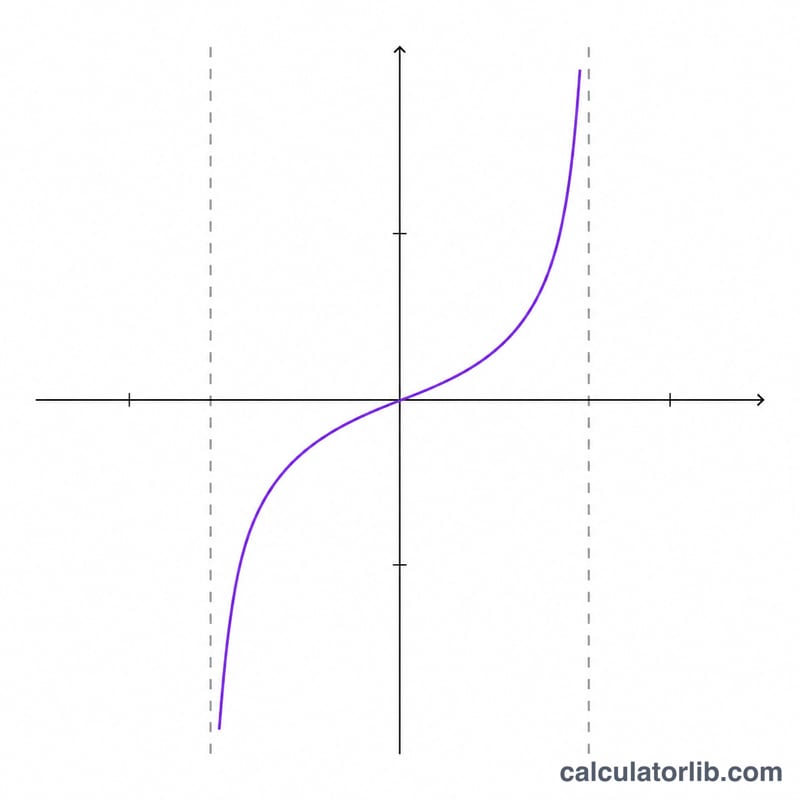
1) Select the trigonometric function from the dropdown. 2) Enter the angle value. 3) Choose the angle unit. The result updates immediately. If you pick tangent or secant at 90 deg, or cotangent or cosecant at 0 deg, the calculator reports undefined because the function has a pole (a division by zero) there.
The formula explained
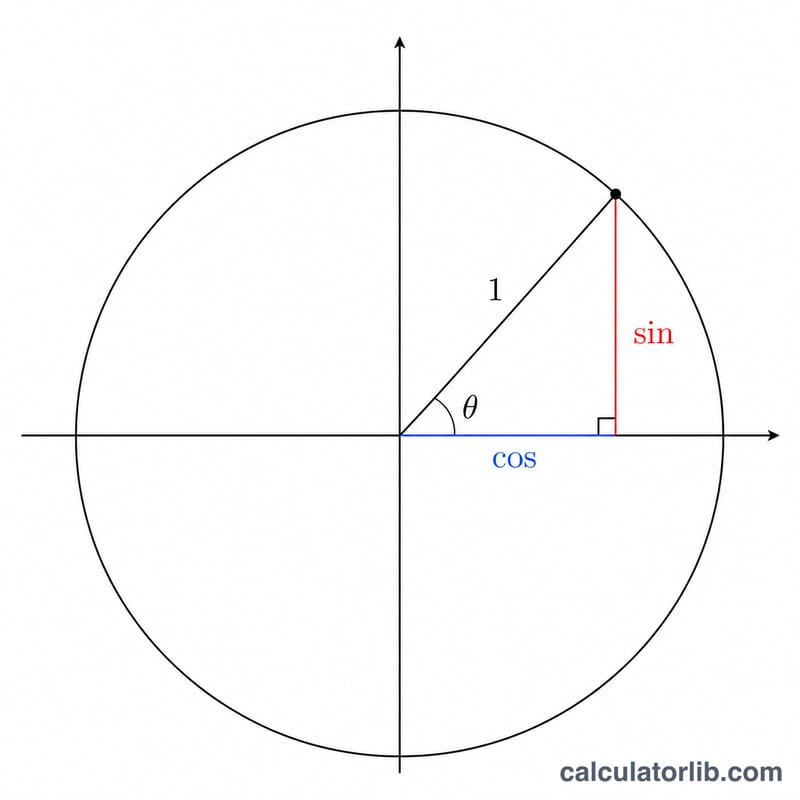
Every function is built from sine and cosine. First the angle is converted to radians: multiply by \(\frac{\pi}{180}\) for degrees, by 1 for radians, by \(\frac{\pi}{200}\) for gradians, or by \(2\pi\) for turns. Then \(\sin\theta\) and \(\cos\theta\) are computed. From those: $$\tan\theta=\frac{\sin\theta}{\cos\theta},\quad \cot\theta=\frac{\cos\theta}{\sin\theta},\quad \sec\theta=\frac{1}{\cos\theta},\quad \csc\theta=\frac{1}{\sin\theta}$$ Because floating-point cosine never returns exactly zero, the tool flags any value where \(|\cos\theta|\) or \(|\sin\theta|\) is smaller than 1e-12 as a pole and reports "undefined".
Worked example
Evaluate tan(45 deg). Convert: $$\theta = 45 \times \frac{\pi}{180} = 0.7853981634 \text{ rad}$$ Then $$\tan\theta = \frac{\sin\theta}{\cos\theta} = \frac{0.7071067812}{0.7071067812} = 1$$ So tan(45 deg) = 1. Similarly $$\csc(30\text{ deg}) = \frac{1}{\sin(30\text{ deg})} = \frac{1}{0.5} = 2$$
FAQ
What range can each function take? sin and cos always fall between -1 and 1. sec and csc have absolute value at least 1. tan and cot can be any real number.
Why does it say undefined? Tangent and secant blow up where cosine is zero (90 deg, 270 deg, ...); cotangent and cosecant blow up where sine is zero (0 deg, 180 deg, ...). At those poles the function has no finite value.
What is a turn? One turn is a full revolution, equal to 360 degrees or \(2\pi\) radians. It is handy for rotational and frequency work.