
What this calculator does
This tool evaluates any of the six trigonometric functions — sine, cosine, tangent, cotangent, secant and cosecant — at a single angle. The angle can be entered as a multiple of pi radians (the native mode of the original gallery page), as plain radians, as degrees, or as gradians. It is a pure-math tool with no country or jurisdiction restrictions.
How to use it
Pick a function from the dropdown, type the angle magnitude, and choose the angle unit. In "pi radians" mode the value you type is multiplied by pi, so entering 0.5 means \(0.5\pi = \pi/2\). The calculator returns the function value plus the angle converted to both radians and degrees so you can verify the conversion.
The formula explained
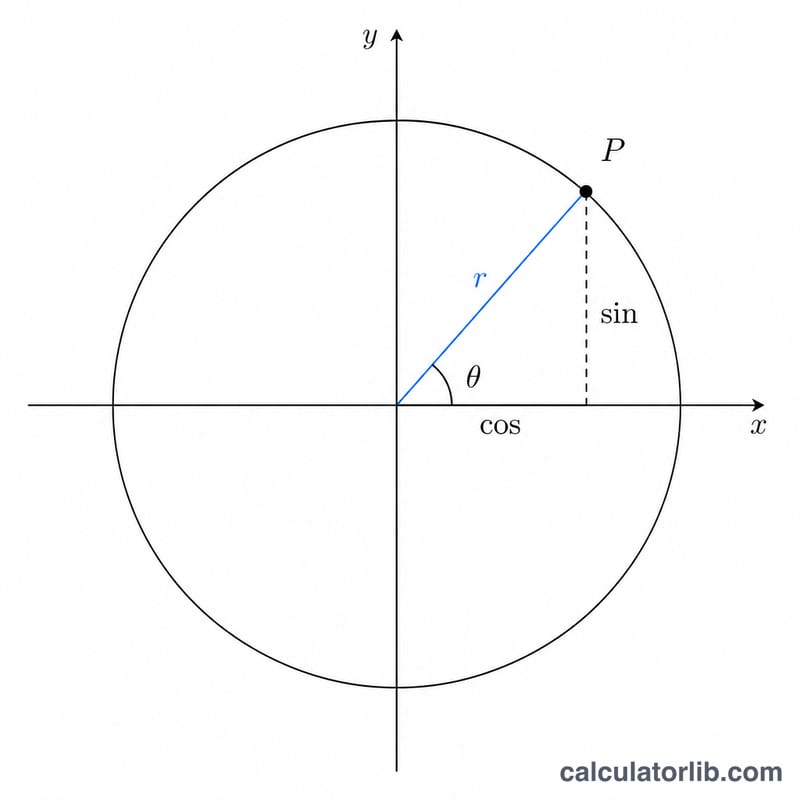
Every function is derived from sine and cosine of the radian angle theta. First the angle is normalized:
$$\theta = \text{angleValue} \times \text{factor}$$where factor is \(\pi\), \(1\), \(\pi/180\) or \(\pi/200\) for pi-radians, radians, degrees and gradians respectively. Then sin and cos are computed, and
$$\tan\theta=\frac{\sin\theta}{\cos\theta},\quad \cot\theta=\frac{\cos\theta}{\sin\theta},\quad \sec\theta=\frac{1}{\cos\theta},\quad \csc\theta=\frac{1}{\sin\theta}.$$Where the denominator is zero the function has a vertical asymptote and is reported as undefined. Because floating-point sin and cos almost never return exactly zero, a tolerance of \(10^{-12}\) is used to detect these asymptotes cleanly.
Worked example
Choose Cosine, angle value 0.5, unit "pi radians". Then
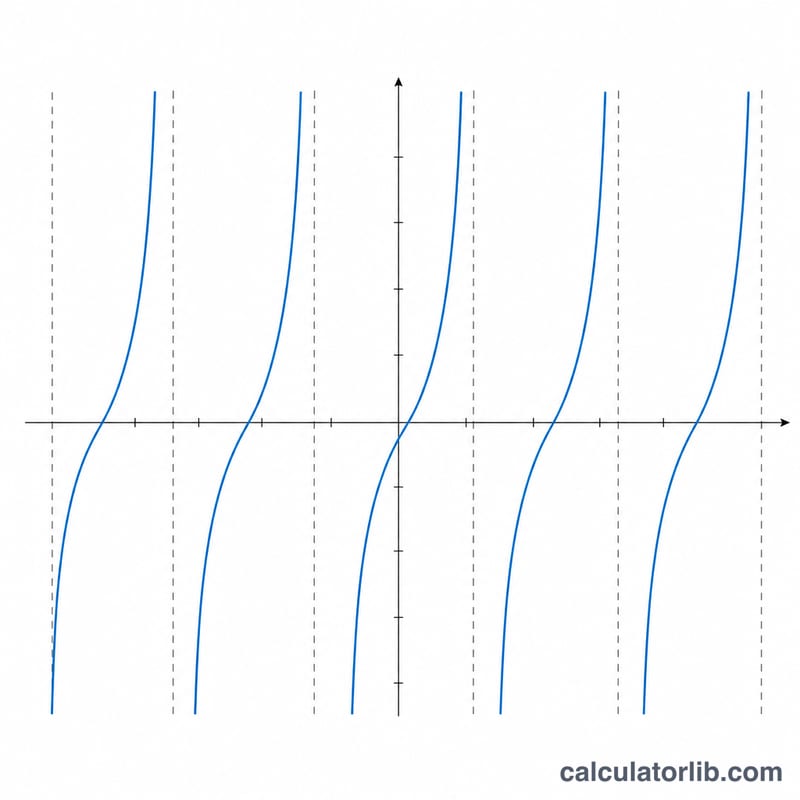
$$\theta = 0.5 \times \pi = 1.570796 \text{ rad} = 90^\circ,\quad \cos(90^\circ) = 0.$$The Function Value reads 0. Switch the function to Tangent with the same angle and \(\cos\theta\) is zero, so the tool reports "undefined (asymptote)" — matching the vertical line you would see on the tangent graph at \(\pi/2\).
FAQ
Why does it say undefined? Tangent and secant blow up where cosine is zero (\(\theta = \pi/2 + k\cdot\pi\)); cotangent and cosecant blow up where sine is zero (\(\theta = k\cdot\pi\)). At those exact angles the function value is infinite, so we report it as an asymptote.
What range are the results in? Sine and cosine always lie in \([-1, 1]\); secant and cosecant always have magnitude at least 1; tangent and cotangent can be any real number.
Can I enter negative angles? Yes. The standard graphs are drawn over \(-2\pi\) to \(2\pi\), and the evaluator accepts any real angle in any of the supported units.