
What this calculator does
The Inverse Trigonometric Function Calculator returns the angle whose sine, cosine, tangent, cotangent, secant or cosecant equals a value you provide. Choose one of the six inverse functions (arcsin, arccos, arctan, arccot, arcsec, arccsc), enter the argument x, and pick whether you want the answer in degrees or radians. The tool also reports the valid input domain and the principal-value range so you know exactly which branch of the function is being used.
How to use it
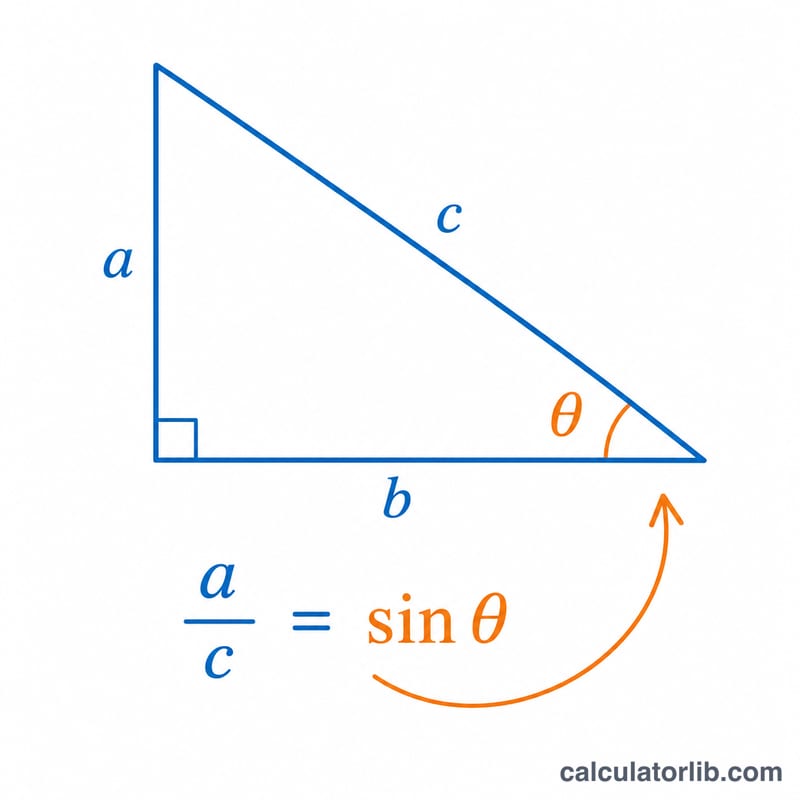
1. Select the inverse function from the dropdown. 2. Enter the value of \(x\). 3. Choose the result unit (degrees or radians). The calculator computes the angle and shows the expression, the domain of \(x\), and the output range. If \(x\) falls outside the function's domain it returns a clear message instead of an invalid number.
The formula explained
All values are computed internally in radians using the standard library functions, then converted to degrees with the factor \(180/\pi\) if needed. For arccotangent we use the continuous convention $$\theta = \frac{\pi}{2} - \arctan(x),$$ which gives a range of \((0, \pi)\) and avoids division by zero at \(x = 0\). Secant and cosecant inverses use the reciprocal identities $$\operatorname{arcsec}(x) = \arccos\frac{1}{x}, \quad \operatorname{arccsc}(x) = \arcsin\frac{1}{x},$$ valid only when \(|x| \ge 1\).
Worked example
For \(\arcsin(0.5)\) in degrees: \(\arcsin(0.5) = 0.5235987756\) rad, and $$0.5235987756 \times \frac{180}{\pi} = 30°.$$ For \(\arctan(1)\) in radians the answer is \(\frac{\pi}{4} \approx 0.7853981634\) rad (45°). For \(\operatorname{arccot}(-1)\) with the \((0, \pi)\) convention: $$\frac{\pi}{2} - \arctan(-1) = 135°.$$
FAQ
Why is arcsin of 2 undefined? Sine never exceeds 1, so arcsin and arccos only accept \(x\) between \(-1\) and \(1\).
Why does arccot(−1) give 135° and not −45°? This calculator uses the \((0, \pi)\) range convention, which keeps arccot continuous over all real \(x\).
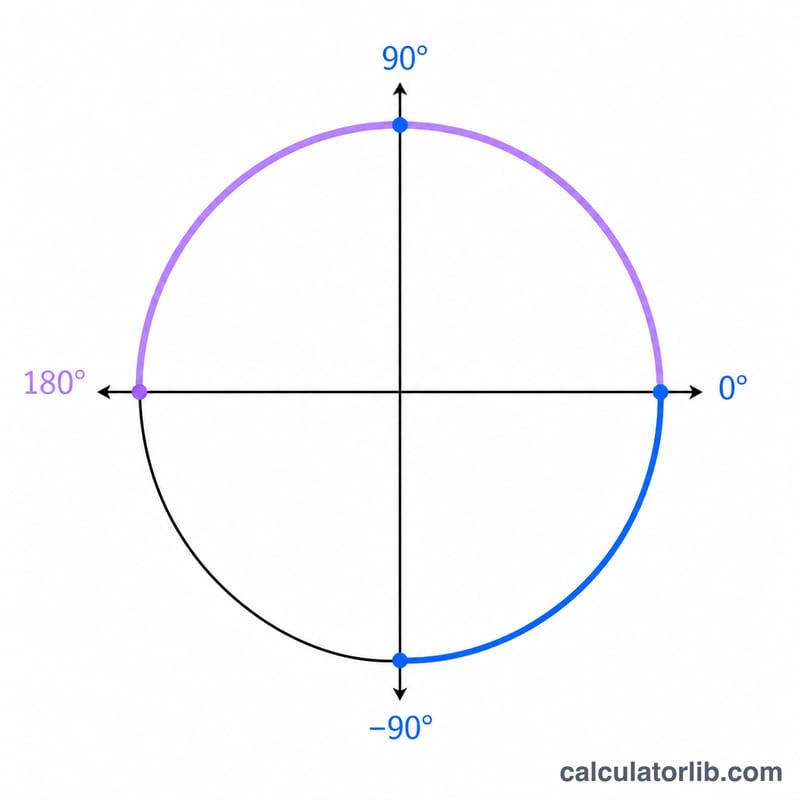
What are principal values? Inverse trig functions are multi-valued, so each returns a single standard branch (the principal value) shown in the range row.