
What this calculator does
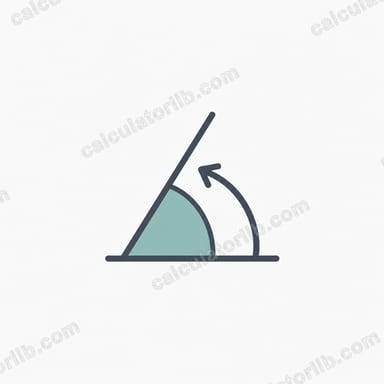
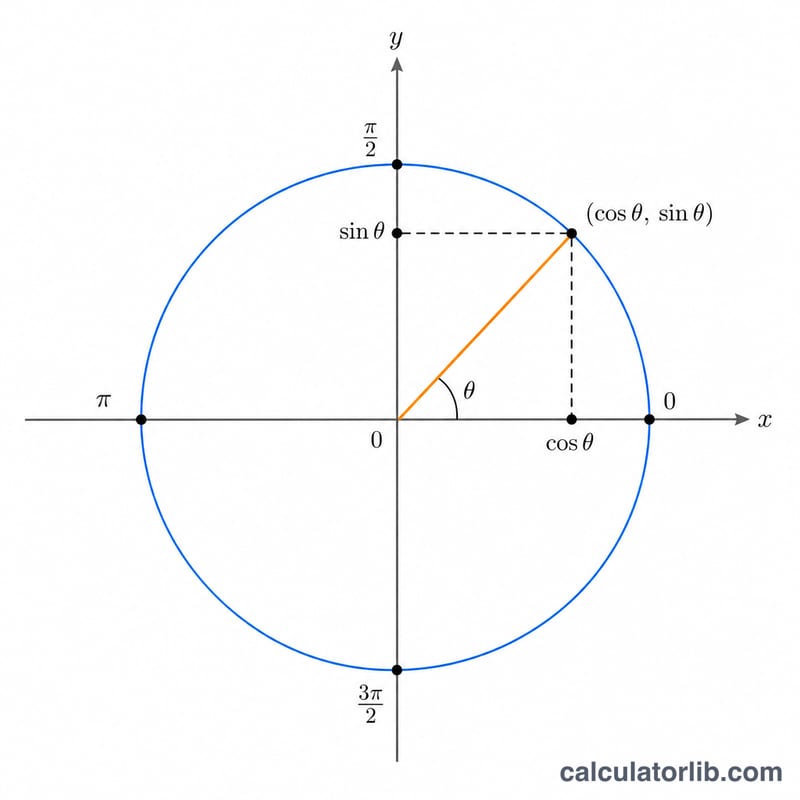
This tool evaluates any of the six circular (trigonometric) functions — sine, cosine, tangent, cotangent, secant and cosecant — for an angle that you express as a multiple of pi radians. Instead of typing an awkward decimal like 1.0471975512, you simply enter n and the calculator evaluates the function at the angle theta = n times pi. So n = 1 means pi radians (180 degrees), n = 0.5 means pi/2 (90 degrees), and n = 1/3 means pi/3 (60 degrees).
How to use it
Pick the function you want from the find: dropdown, then type your value of n in the for angle: field. Negative values are allowed, which is handy because sine, tangent, cotangent and cosecant are odd functions while cosine and secant are even. Press calculate to see the value, the angle restated in plain radians, and a note of which function was used.
The formula explained
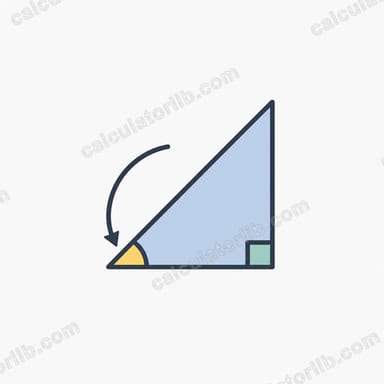
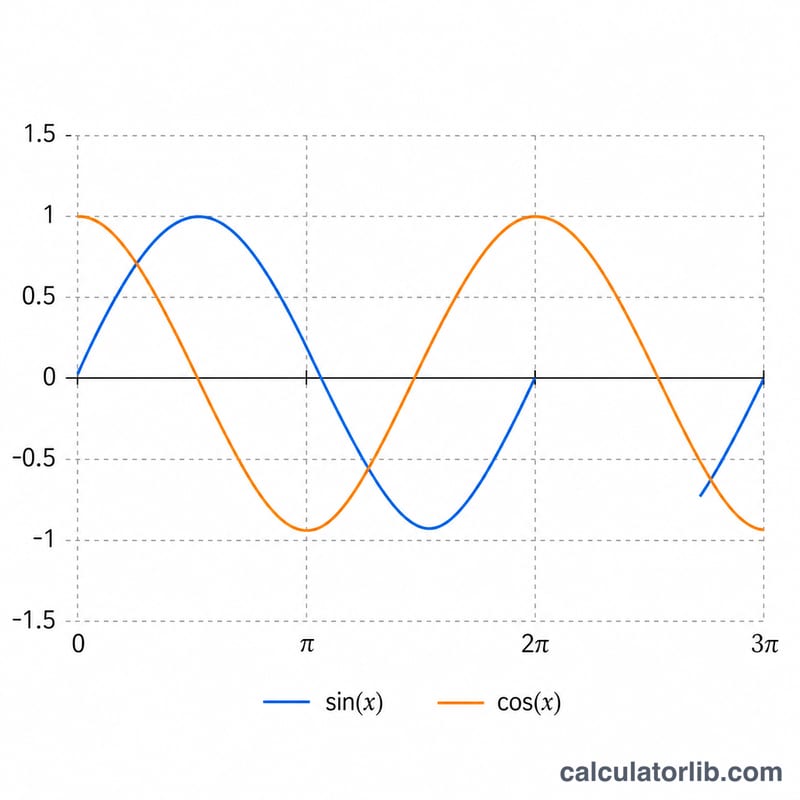
First the angle is converted: $$\theta = n \cdot \pi$$ Then sine and cosine are computed directly. The remaining four functions are derived: $$\tan\theta=\frac{\sin\theta}{\cos\theta},\quad \cot\theta=\frac{\cos\theta}{\sin\theta},\quad \sec\theta=\frac{1}{\cos\theta},\quad \csc\theta=\frac{1}{\sin\theta}$$ Because computers cannot store pi exactly, values such as \(\sin(\pi)\) come out as a tiny number like \(1.2\times 10^{-16}\) rather than a clean 0. The calculator snaps any magnitude below \(10^{-12}\) to exactly 0, which also lets it correctly report results as undefined when a denominator hits zero — for example tan and sec at odd half-integers of n, or cot and csc at integer values of n.
Worked example
Choose cos and enter n = 0.333333 (one third). The angle is \(\theta = \pi/3\), and $$\cos\left(\frac{\pi}{3}\right) = 0.5$$ so the result is 0.5. Choose csc with n = 0.166667 (one sixth): \(\theta = \pi/6\), \(\sin = 0.5\), so $$\csc\left(\frac{\pi}{6}\right) = \frac{1}{0.5} = 2$$
FAQ
Why use multiples of pi? Angles in trigonometry are most naturally written in radians, and the "nice" angles are simple fractions of pi. Entering n directly avoids rounding the angle yourself.
When is the answer undefined? Whenever the function divides by zero: tan and sec where \(\cos = 0\) (\(n = k + 0.5\)), and cot and csc where \(\sin = 0\) (n is an integer).
Does it handle very large n? Yes, but floating-point error in the argument grows with magnitude, so extreme values lose precision. It is intended as a teaching and quick-check tool.