
What is the Trig Triangle Calculator?
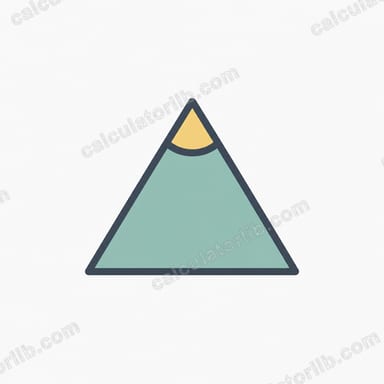
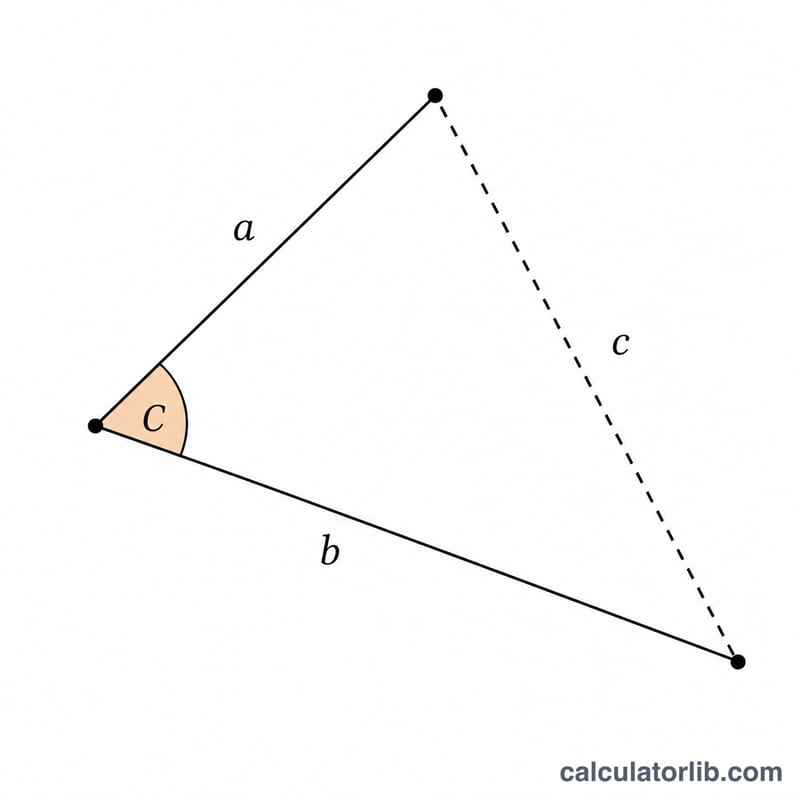
This tool solves a triangle given two sides and the angle between them — the classic SAS (side-angle-side) case. From those three inputs it computes the unknown third side, the two remaining interior angles, the area, and the perimeter. It works for any triangle, making it useful in geometry, trigonometry homework, surveying, engineering, and construction layout.
How to Use It
Enter the lengths of two sides (a and b) in any consistent unit, then enter the included angle C in degrees — this is the angle formed where sides a and b meet. Press calculate. The result shows side c (opposite angle C) plus angles A and B and the triangle's area and perimeter.
The Formulas Explained
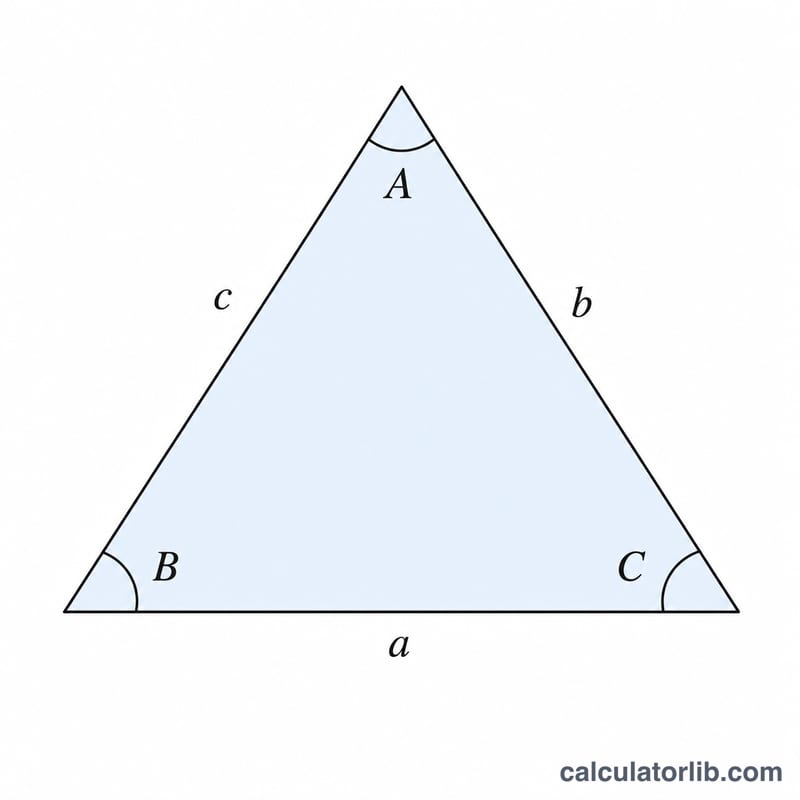
The law of cosines directly gives the third side: $$c^{2} = a^{2} + b^{2} - 2ab\cos(C)$$ Once c is known, the law of sines (\(a/\sin A = c/\sin C\)) lets us solve for angle \(A = \arcsin(a\cdot\sin C / c)\). The final angle follows from the fact that interior angles sum to 180°: \(B = 180^{\circ} - C - A\). The area uses the trig form \(\tfrac{1}{2}\cdot a\cdot b\cdot\sin(C)\).
Worked Example
Suppose a = 5, b = 7, and the included angle C = 45°. Then $$c = \sqrt{25 + 49 - 2\cdot 5\cdot 7\cdot\cos 45^{\circ}} = \sqrt{74 - 70\cdot 0.70711} = \sqrt{74 - 49.497} = \sqrt{24.503} \approx 4.9501$$ Angle \(A = \arcsin(5\cdot\sin 45^{\circ} / 4.9501) = \arcsin(0.71415) \approx 45.58^{\circ}\), so \(B = 180 - 45 - 45.58 \approx 89.42^{\circ}\). The area is \(\tfrac{1}{2}\cdot 5\cdot 7\cdot\sin 45^{\circ} \approx 12.374\).
FAQ
What is the included angle? It is the angle located between the two sides you entered (a and b). It must be greater than 0° and less than 180°.
Can I use other known values? This version is optimized for the SAS case. For other cases (such as ASA or SSS) the same laws apply but with different rearrangements.
Why is the law of sines used for angle A and not B? Side a opposite angle A is always smaller than or equal to c (the side opposite the largest possible angle here), so the arcsine for A is unambiguous, avoiding the SSA ambiguous case.