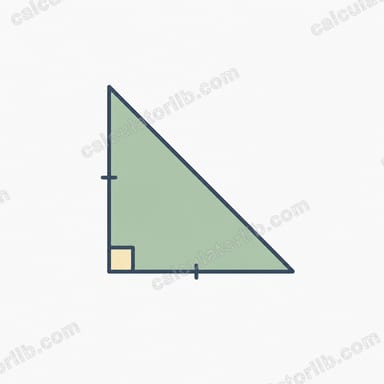

What is a 45-45-90 triangle?
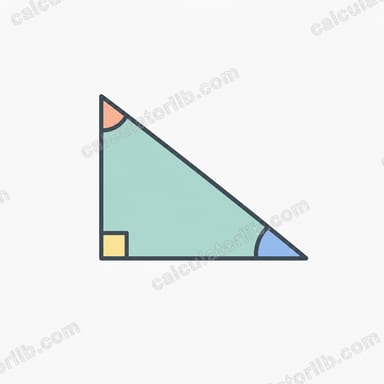
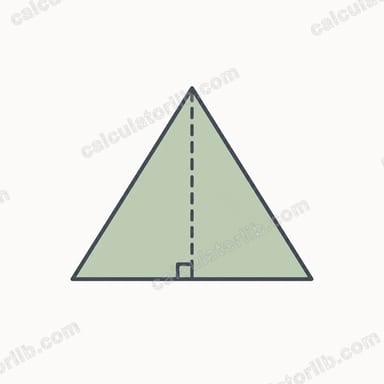
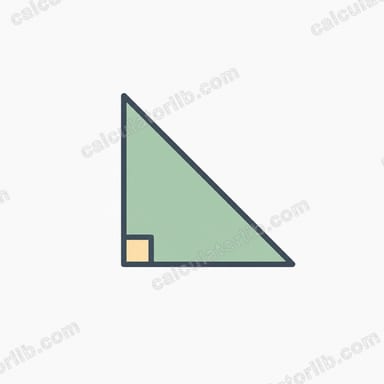
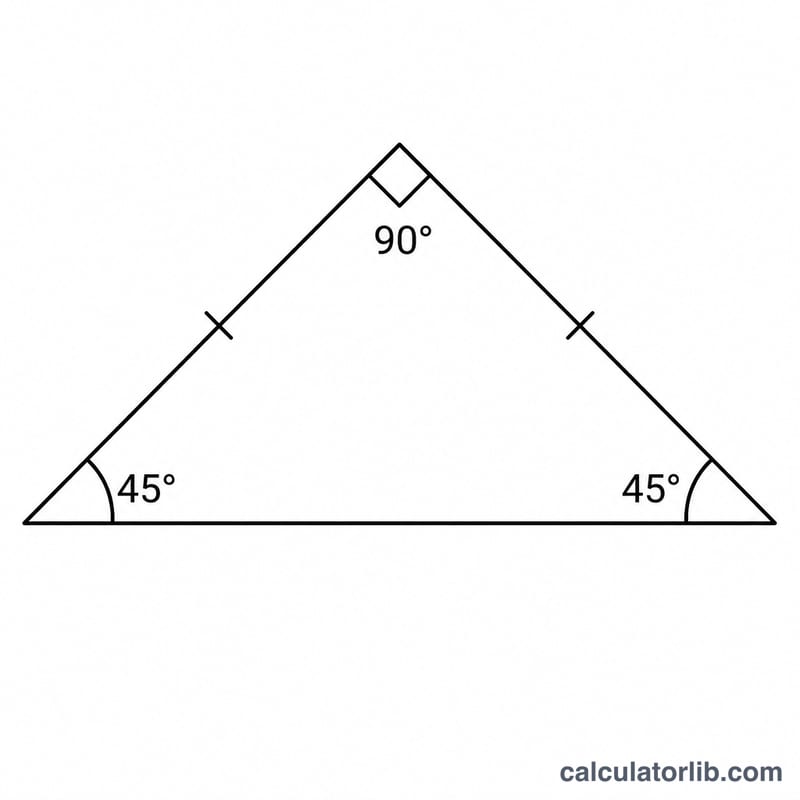
A 45-45-90 triangle is a special right triangle whose angles measure 45°, 45° and 90°. Because two angles are equal, it is also an isosceles right triangle: the two legs (the sides next to the right angle) are exactly the same length. This fixed shape means all 45-45-90 triangles are similar, and their sides always follow the ratio \(x : x : x\sqrt{2}\).
How to use this calculator
Pick whether you know a leg (one of the two equal sides) or the hypotenuse (the longest side, opposite the right angle), then enter its length. The calculator instantly returns the missing side, the area and the perimeter — all in the same units you typed.
The formula explained
If a leg has length \(x\), the hypotenuse is \(x\sqrt{2}\) (about \(1.41421 \times x\)). Going the other way, a leg is the hypotenuse divided by \(\sqrt{2}\). The area of any triangle is \(\frac{1}{2} \times \text{base} \times \text{height}\); here both legs serve as base and height, so the area simplifies to \(\frac{x^2}{2}\). The perimeter is the sum of the three sides: \(2x + x\sqrt{2}\). The core relationships are:
$$\text{hypotenuse} = \text{leg} \times \sqrt{2}, \quad \text{Area} = \frac{\text{leg}^2}{2}$$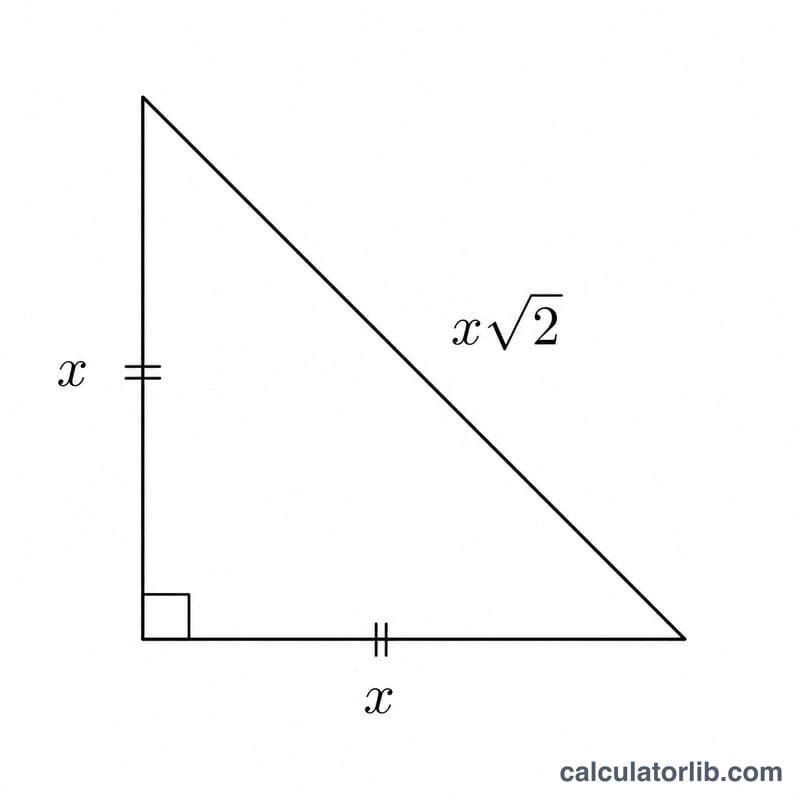
Worked example
Suppose a leg = 5. The hypotenuse is
$$5 \times \sqrt{2} \approx 7.0711$$The area is
$$\frac{5^2}{2} = 12.5 \text{ square units}$$The perimeter is
$$2 \times 5 + 7.0711 = 17.0711 \text{ units}$$FAQ
Why is the hypotenuse √2 times a leg? By the Pythagorean theorem, \(\text{hyp}^2 = x^2 + x^2 = 2x^2\), so \(\text{hyp} = x\sqrt{2}\).
Can I enter the hypotenuse instead of a leg? Yes — select "Hypotenuse" and each leg is computed as \(\text{value} \div \sqrt{2}\).
What units does it use? The tool is unit-agnostic; outputs share the units of your input (length for sides, those units squared for area).