
What is a circumscribed circle?
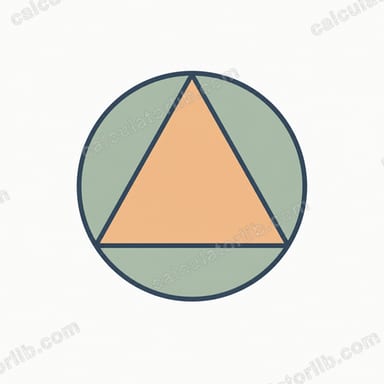
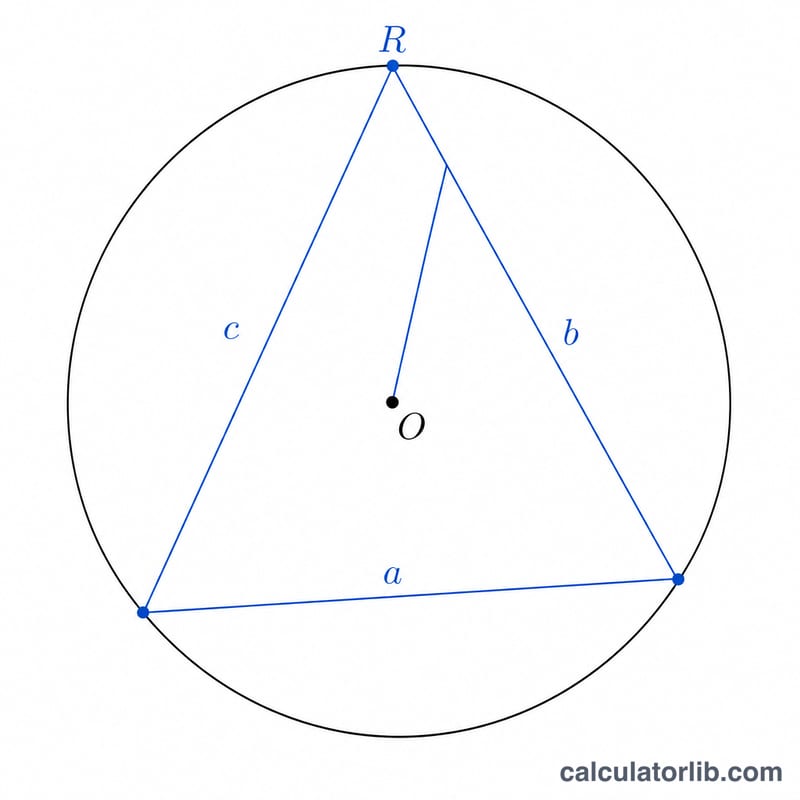
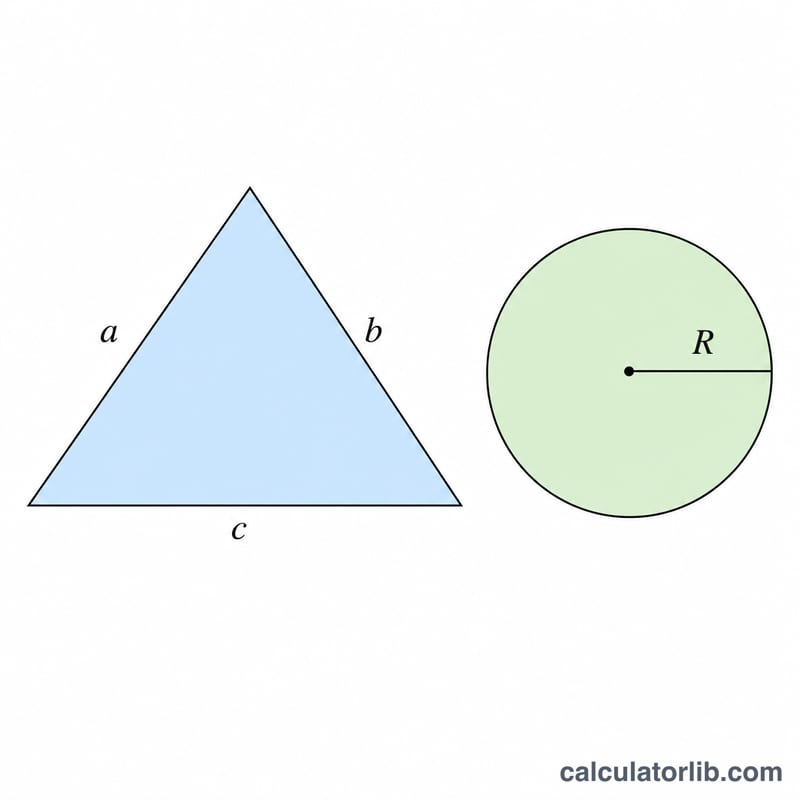
A circumscribed circle (or circumcircle) is the unique circle that passes through all three vertices of a triangle. Its centre is the circumcentre, the point equidistant from each vertex, and its radius is called the circumradius, written \(R\). Every triangle has exactly one circumscribed circle, making it a fundamental concept in geometry, trigonometry and engineering layout work.
How to use this calculator
Enter the three side lengths of your triangle — \(a\), \(b\) and \(c\) — in any consistent unit (cm, m, inches, etc.). The calculator first computes the triangle's area with Heron's formula, then returns the circumradius along with the circle's diameter, circumference and enclosed area. Make sure the three sides actually form a valid triangle: each side must be shorter than the sum of the other two.
The formula explained
The circumradius is given by $$R = \frac{a \cdot b \cdot c}{4 \cdot \text{Area}}.$$ To find the area without knowing the height, we use Heron's formula. First compute the semi-perimeter $$s = \frac{a + b + c}{2},$$ then $$\text{Area} = \sqrt{s(s-a)(s-b)(s-c)}.$$ Substituting this area into the first equation gives the radius. The diameter is \(2R\), the circle circumference is \(2\pi R\), and the circle's area is \(\pi R^2\).
Worked example
Take a 3-4-5 right triangle. The semi-perimeter is $$s = \frac{3+4+5}{2} = 6.$$ Heron's formula gives $$\text{Area} = \sqrt{6 \cdot 3 \cdot 2 \cdot 1} = \sqrt{36} = 6.$$ Then $$R = \frac{3 \cdot 4 \cdot 5}{4 \cdot 6} = \frac{60}{24} = 2.5.$$ This matches the known fact that for a right triangle the circumradius equals half the hypotenuse (\(5/2 = 2.5\)).
FAQ
Does every triangle have a circumscribed circle? Yes. Any three non-collinear points define exactly one circle, so every valid triangle has one circumcircle.
Where is the circumcentre for a right triangle? It lies at the midpoint of the hypotenuse, which is why \(R\) equals half the hypotenuse.
What if my sides don't form a triangle? If the area comes out as zero or undefined, the side lengths violate the triangle inequality and no real circle exists.