
What this calculator does
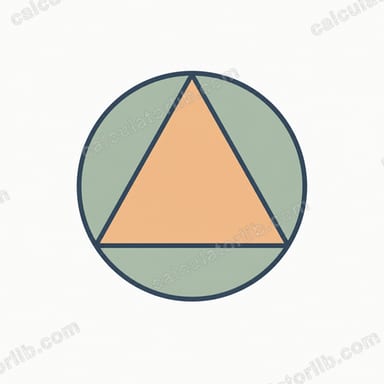
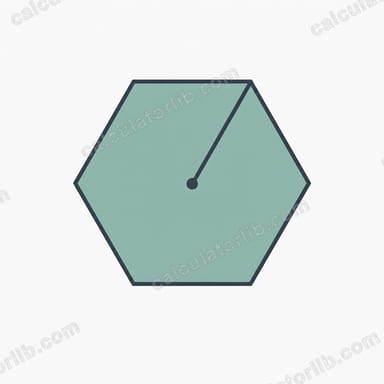
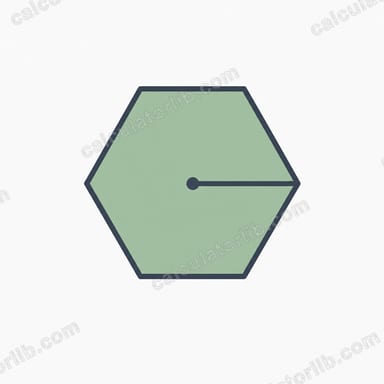
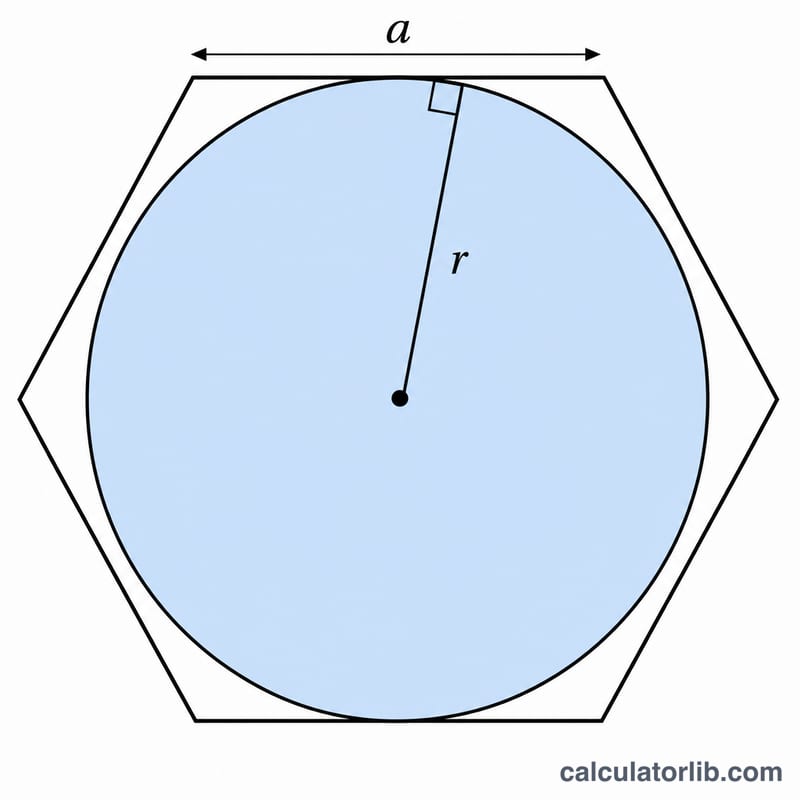
This tool computes the side length and area of regular polygons that are circumscribed about a circle of a given radius \(r\). "Circumscribed about a circle" means the polygon is drawn around the circle so that every side just touches (is tangent to) the circle. As a result, the circle is inscribed in the polygon and \(r\) is the apothem (inradius) of every polygon — the perpendicular distance from the polygon's center to the midpoint of any side. It builds a table over a range of side counts \(n\) and compares each polygon's area to the circle's area.
How to use it
Enter the circle radius \(r\) (any positive number in your chosen length unit), then choose the smallest number of sides (nMin, at least 3) and the largest (nMax). The calculator generates one row for each integer \(n\) from nMin to nMax, listing the side length \(a\) and the polygon area \(S_p\), and reports the circle area \(S_c\) above the table. The table is capped at 200 rows.
The formulas explained
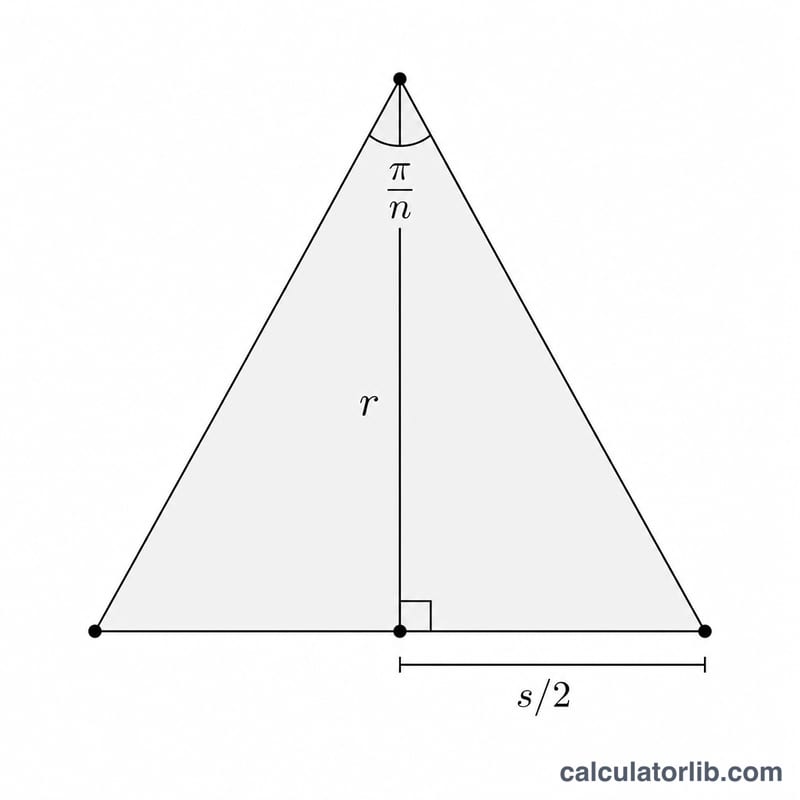
Each polygon side subtends a central angle of \(2\pi/n\). Splitting a side at its tangent point gives a right triangle with opposite side \(a/2\) and adjacent side \(r\), so \(a/2 = r\cdot\tan(\pi/n)\), giving $$a = 2r\tan\!\left(\frac{\pi}{n}\right)$$ The polygon decomposes into \(n\) triangles, each with base \(a\) and height \(r\), so $$S_p = \tfrac{1}{2}\,n\,a\,r = n\,r^2\tan\!\left(\frac{\pi}{n}\right)$$ The inscribed circle has area $$S_c = \pi r^2$$ Because each circumscribed polygon encloses the circle, \(S_p\) is always greater than \(S_c\), and as \(n\) grows \(S_p\) decreases toward \(S_c\).
Worked example
For \(r = 1\) and a hexagon (\(n = 6\)): $$a = 2\cdot\tan\!\left(\frac{\pi}{6}\right) = 2\cdot 0.57735 = 1.15470$$ $$S_p = 6\cdot 1\cdot 0.57735 = 3.46410$$ The circle area is \(S_c = \pi \approx 3.14159\) — confirming the polygon area exceeds the circle area.
FAQ
Is r the side or the apothem? Here \(r\) is the apothem (inradius). The polygon wraps around the circle, so the circle radius equals the perpendicular distance to each side.
Why is the polygon area larger than the circle area? A circumscribed polygon always contains the circle, so its area is greater; the two converge as the number of sides increases.
What units are used? \(r\) is a generic length unit. Side lengths share that unit; areas are in that unit squared. No unit conversion is applied.