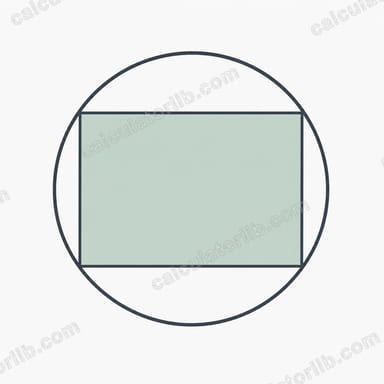
What is the circumscribed circle of a rectangle?
Every rectangle has a unique circle that passes through all four of its corners — the circumscribed circle, or circumcircle. Its center sits exactly where the two diagonals cross, and its diameter is equal to the rectangle's diagonal. This calculator takes the two side lengths and returns the circumcircle radius, diameter and area, the rectangle's own area, and the ratio between the two areas. It is pure geometry and works identically with any length unit you choose.

How to use it
Enter the two side lengths, a and b, in the same length unit (centimetres, inches, metres — whatever you like). Both values must be greater than zero. The results come back in that same unit: lengths for the radius and diameter, square units for the two areas, and a dimensionless number for the area ratio.
The formula explained
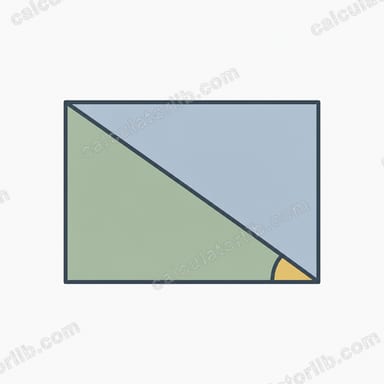
The diagonal of a rectangle is the hypotenuse of a right triangle with legs a and b, so its length is \(\sqrt{a^{2} + b^{2}}\). Because this diagonal is a diameter of the circumcircle, the radius is half of it: $$r = \tfrac{1}{2}\sqrt{a^{2} + b^{2}}.$$ The diameter is \(\phi = 2r\), the circle area is \(S_{c} = \pi r^{2}\), the rectangle area is \(S_{r} = a\cdot b\), and the area ratio is \(S_{c}/S_{r}\).

Worked example
For \(a = 4\) and \(b = 3\): the diagonal is \(\sqrt{16 + 9} = \sqrt{25} = 5\), so \(r = 2.5\) and \(\phi = 5\). The circle area is $$\pi \times 2.5^{2} = 19.6350,$$ the rectangle area is 12, and the ratio is \(19.6350 / 12 \approx 1.6362\).
Circumcircle Results for Different Rectangle Shapes
Every rectangle has a circumscribed circle that passes through all four corners. Its diameter equals the rectangle's diagonal, so \(r = \tfrac{1}{2}\sqrt{a^{2}+b^{2}}\). The circle area is \(\pi r^{2}\), the rectangle area is \(ab\), and the area ratio is \(\dfrac{\pi r^{2}}{ab}\).
| a | b | Diagonal \(d=\sqrt{a^{2}+b^{2}}\) | Radius r | Circle area | Rectangle area | Ratio (circle / rectangle) |
|---|---|---|---|---|---|---|
| 1 | 1 (square) | √2 ≈ 1.4142 | 0.7071 | π/2 ≈ 1.5708 | 1 | π/2 ≈ 1.5708 |
| 4 | 3 | 5 | 2.5 | 6.25π ≈ 19.6350 | 12 | ≈ 1.6362 |
| 2 | 1 | √5 ≈ 2.2361 | 1.1180 | 5π/4 ≈ 3.9270 | 2 | ≈ 1.9635 |
| 5 | 1 | √26 ≈ 5.0990 | 2.5495 | 6.5π ≈ 20.4204 | 5 | ≈ 4.0841 |
| 10 | 1 | √101 ≈ 10.0499 | 5.0249 | 25.25π ≈ 79.3252 | 10 | ≈ 7.9325 |
Example of the substitution for the 4 × 3 row: \(r = \tfrac{1}{2}\sqrt{4^{2}+3^{2}} = \tfrac{1}{2}\sqrt{25} = 2.5\), circle area \(\pi \cdot 2.5^{2} = 6.25\pi \approx 19.6350\), and ratio \(19.6350 / 12 \approx 1.6362\).
Takeaway: the square has the smallest ratio of any rectangle, \(\pi/2 \approx 1.5708\). As the rectangle becomes more elongated, the ratio grows steadily, because the circle must stretch to reach the far corners while the rectangle's area stays small. Algebraically the ratio equals \(\tfrac{\pi}{4}\left(\tfrac{a}{b}+\tfrac{b}{a}\right)\), which increases as \(a/b\) moves away from 1. Units do not matter for the ratio, but lengths and areas are in the units (and squared units) you enter.
FAQ
Does every rectangle have a circumscribed circle? Yes. Because all four corners are equidistant from the diagonal intersection, a single circle always passes through them.
What about a square? A square is a special rectangle with \(a = b\), so \(r = a/\sqrt{2}\) and \(\phi = a\sqrt{2}\). The same formulas apply.
Why is the area ratio always greater than 1? The circle must enclose the rectangle's corners, so its area always exceeds the rectangle's. The minimum ratio, \(\pi/2 \approx 1.5708\), occurs for a square.