
What is the TNT Equivalent Calculator?
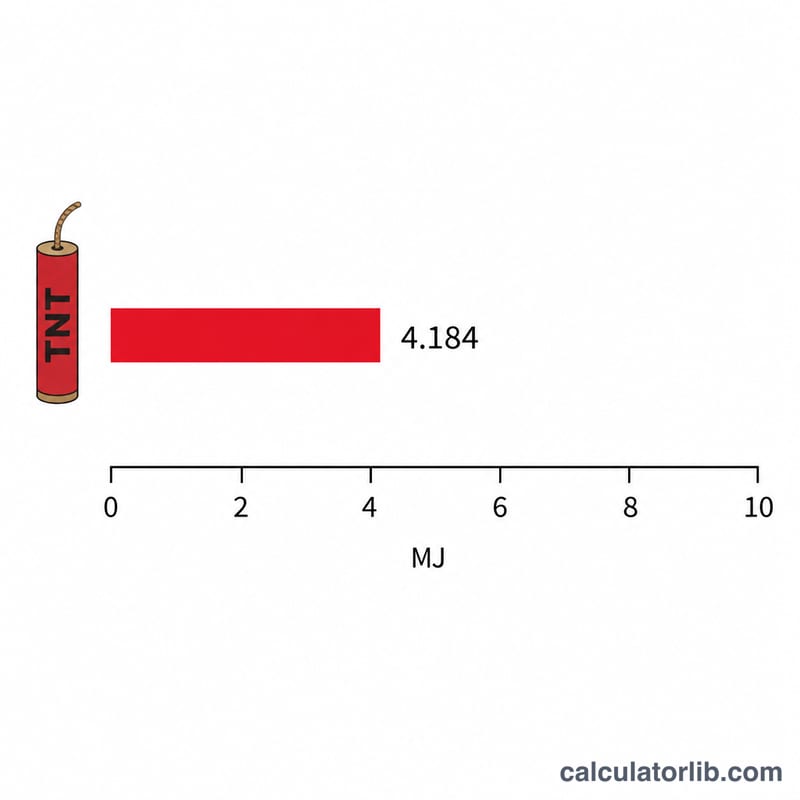
The TNT equivalent calculator converts an amount of released energy into the equivalent mass of trinitrotoluene (TNT) needed to release that same energy. It is a universal energy-conversion tool used in physics, engineering, blast analysis, asteroid impact estimates and energy-scale comparisons. By definition, one kilogram of TNT is taken to release exactly 4.184 megajoules (4,184,000 joules) — the value adopted by convention.
How to use it
Enter the energy released by an event and choose its unit — joules (J), kilojoules (kJ), megajoules (MJ), gigajoules (GJ) or kilowatt-hours (kWh). The calculator converts your value to joules, then divides by \(4.184 \times 10^{6}\) to give the TNT equivalent in kilograms, with grams and tonnes shown for convenience.
The formula explained
The conversion is simply
$$m_{\text{TNT}} = \frac{E}{4.184 \times 10^{6}}$$where \(E\) is the energy in joules and \(m_{\text{TNT}}\) is in kilograms. Because the relationship is linear, doubling the energy doubles the TNT mass. Unit conversions are applied first: \(1\,\text{kJ} = 10^{3}\,\text{J}\), \(1\,\text{MJ} = 10^{6}\,\text{J}\), \(1\,\text{GJ} = 10^{9}\,\text{J}\), and \(1\,\text{kWh} = 3.6 \times 10^{6}\,\text{J}\).
Worked example
Suppose an event releases 1 GJ of energy. Converting to joules gives 1,000,000,000 J. Dividing by 4,184,000 gives
$$\frac{1{,}000{,}000{,}000}{4{,}184{,}000} \approx 239.005\;\text{kg}$$of TNT — roughly a quarter of a tonne. A 100 kWh battery (360 MJ) is equivalent to about 86 kg of TNT.
FAQ
Why 4.184 MJ per kg? This is the agreed convention for TNT's energy content; real explosives vary slightly, but 4.184 MJ/kg is the standard reference value (it equals exactly 1,000 thermochemical kilocalories).
How big is 1 tonne of TNT? One tonne (1,000 kg) of TNT equals 4.184 GJ. The "kiloton" and "megaton" units used for nuclear yields are \(10^{3}\) and \(10^{6}\) tonnes of TNT respectively.
Does this measure destructive power? No. It only compares total energy. Actual blast damage depends on how fast and how the energy is released, not just the amount.