
What This Calculator Does
The Work and Power Calculator computes two fundamental quantities in physics: mechanical work and power. Enter a force in newtons, the distance over which it acts in meters, and the time taken in seconds, and the tool returns the work done in joules (J) and the average power in watts (W). These are universal SI relationships and apply anywhere.
How to Use It
Provide three values: the constant force applied (F), the distance moved in the direction of that force (d), and the elapsed time (t). The calculator multiplies force by distance to find work, then divides work by time to find power. Make sure the force and displacement are in the same direction for the simple \(W = F \cdot d\) form.
The Formula Explained
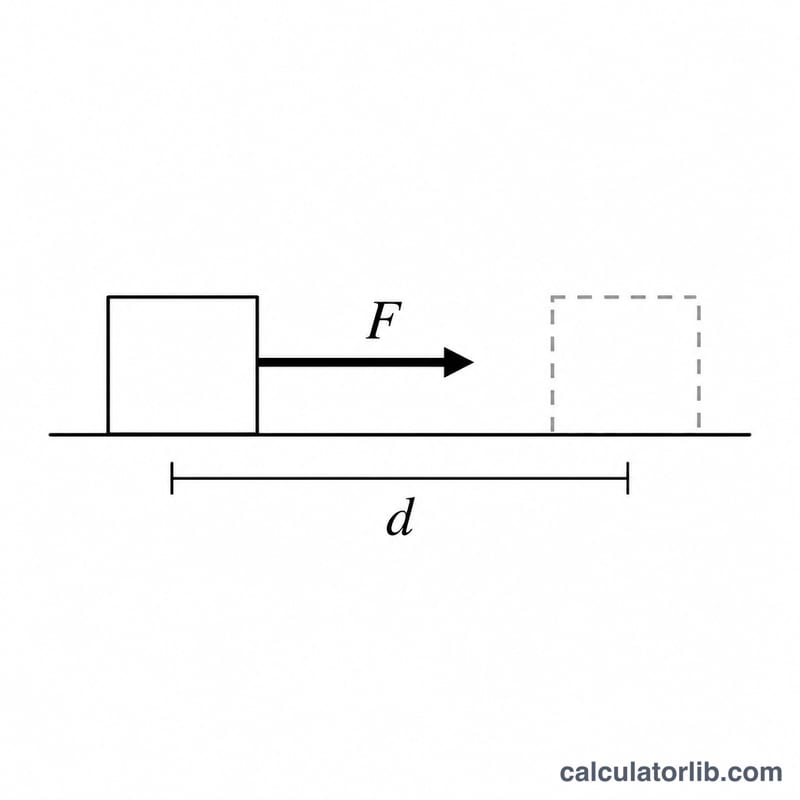
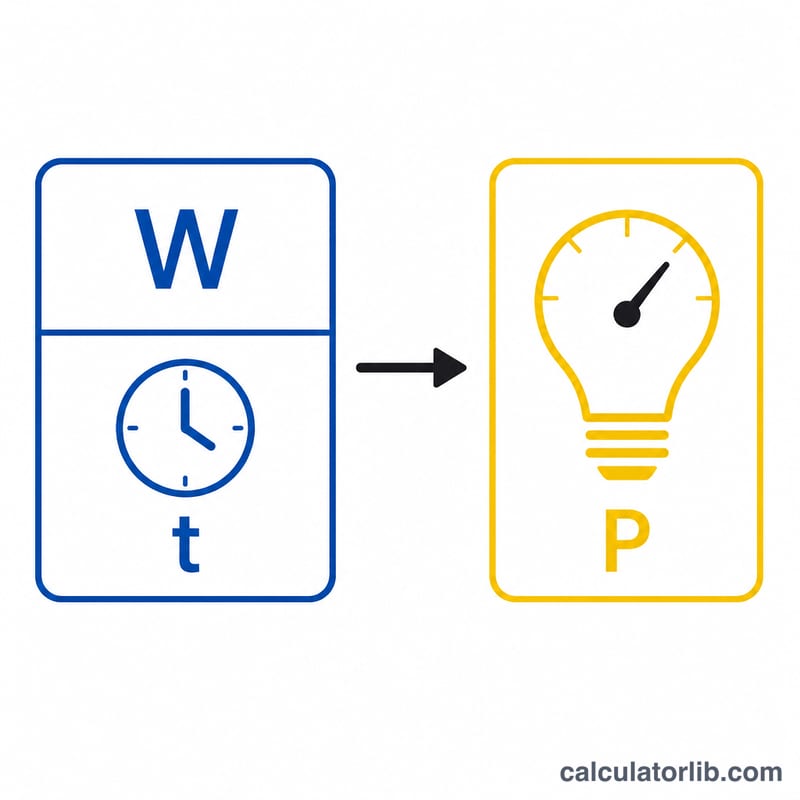
Work is defined as $$W = F \times d$$ where F is force in newtons and d is displacement in meters; the result is in joules. One joule is the work done when one newton acts over one meter. Power measures how fast that work is performed: $$P = \frac{W}{t}$$ where t is time in seconds. One watt equals one joule per second.
Worked Example
Suppose you push a box with a force of 50 N over a distance of 10 m in 5 seconds. $$\text{Work} = 50 \times 10 = 500 \text{ J}$$ $$\text{Power} = 500 \div 5 = 100 \text{ W}$$ So you did 500 joules of work at a rate of 100 watts.
FAQ
Does this account for the angle of the force? No — it assumes the force is parallel to the motion. For an angled force, multiply F by \(\cos(\theta)\) first.
What if time is zero? Power is undefined when time is zero, so the calculator returns 0 to avoid dividing by zero.
Can I use horsepower? The result is in watts; to convert, divide watts by 745.7 to get mechanical horsepower.