
What is the Hydraulic Power Calculator?
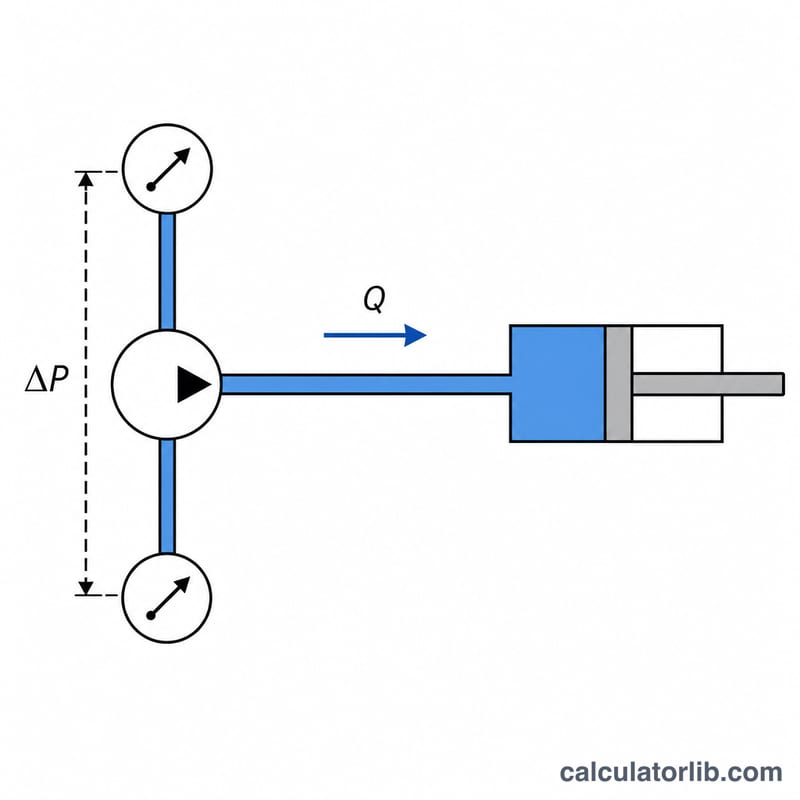
This tool computes the hydraulic (fluid) power carried by a flow of liquid using the relationship \(P = Q \times \Delta P\), where \(Q\) is the volumetric flow rate and \(\Delta P\) is the pressure differential across the component. It is widely used to size pumps, hydraulic cylinders, presses and power packs, and to estimate the motor power needed to drive them.
How to use it
Enter the flow rate in litres per minute, the pressure differential in bar, and your pump (or system) efficiency as a percentage. The calculator returns the pure hydraulic power in kW and W, plus the larger input power your prime mover must deliver once losses are taken into account, expressed in both kW and horsepower.
The formula explained
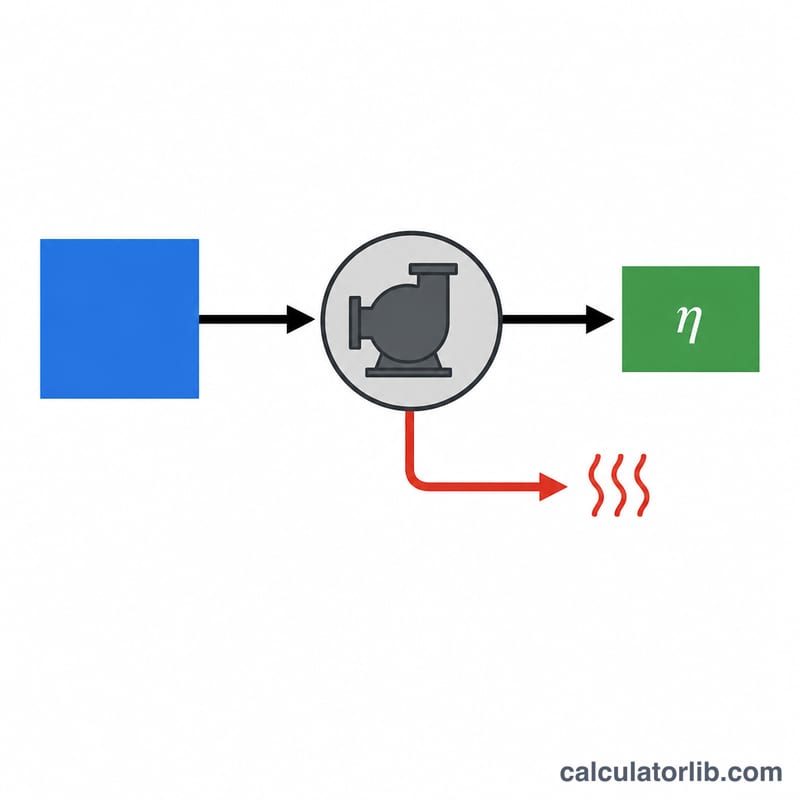
In SI units hydraulic power is \(P = Q \times \Delta P\), with \(Q\) in cubic metres per second and \(\Delta P\) in pascals, giving watts. Practical inputs need conversion: \(1\ \text{L/min} = 1/60000\ \text{m}^3/\text{s}\) and \(1\ \text{bar} = 100{,}000\ \text{Pa}\). A handy shortcut is $$P(\text{kW}) = \frac{Q(\text{L/min}) \times \Delta P(\text{bar})}{600}.$$ The required input power divides this by efficiency: $$P_{in} = \frac{P}{\eta}.$$
Worked example
Take \(Q = 40\ \text{L/min}\) and \(\Delta P = 150\ \text{bar}\) at 100% efficiency. Convert: \(Q = 40/60000 = 0.0006667\ \text{m}^3/\text{s}\), \(\Delta P = 15{,}000{,}000\ \text{Pa}\). Then $$P = 0.0006667 \times 15{,}000{,}000 = 10{,}000\ \text{W} = 10\ \text{kW}.$$ Equivalently, $$\frac{40 \times 150}{600} = 10\ \text{kW}.$$
FAQ
Why is input power higher than hydraulic power? Real pumps lose energy to friction and internal leakage, so the driving motor must supply more than the useful fluid power.
What efficiency should I use? Typical hydraulic pumps run at 80–90% overall efficiency; use the manufacturer figure if you have it, or 100% to see the ideal fluid power only.
Does this work for any liquid? Yes — the formula depends only on flow and pressure, not on fluid density, since pressure already accounts for the working fluid.