
What is pump hydraulic power?
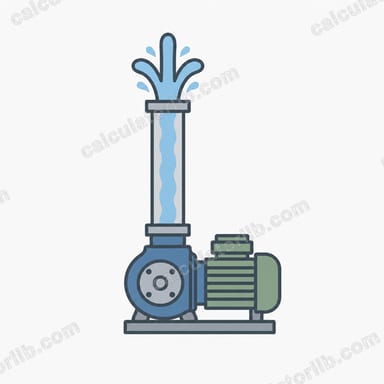
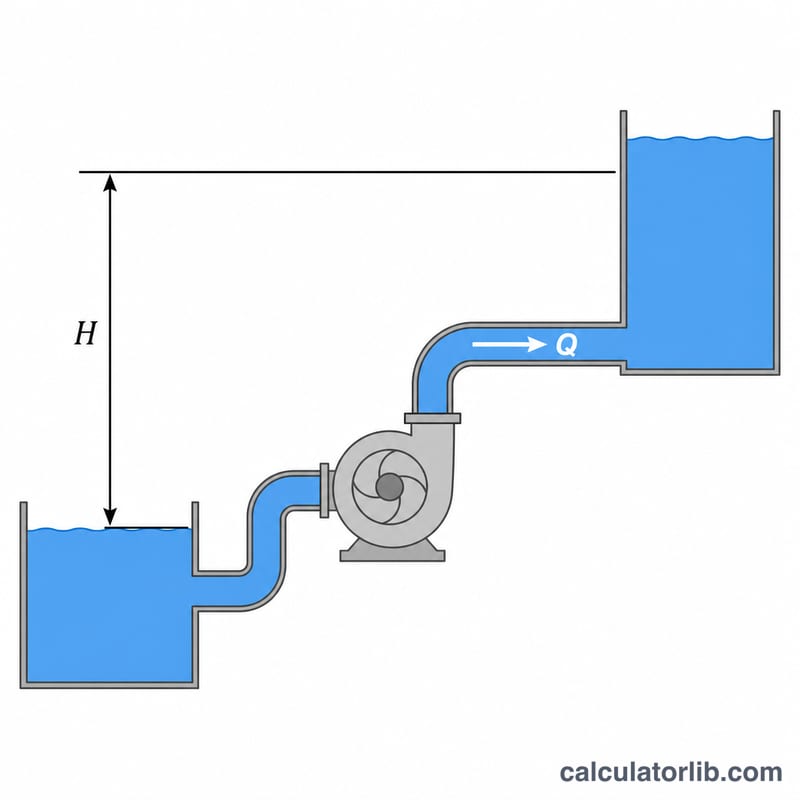
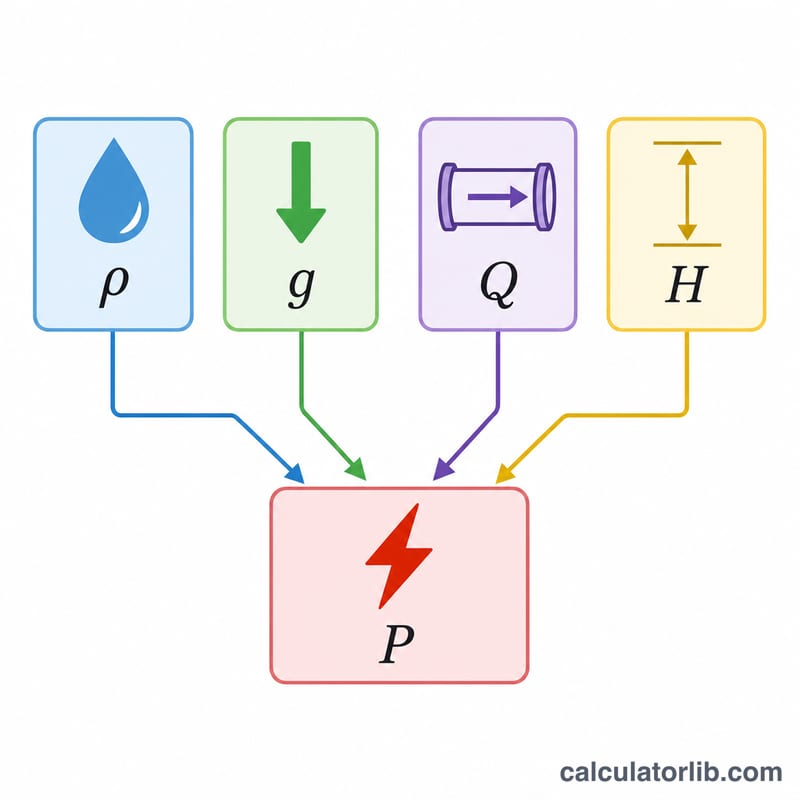
Hydraulic power is the useful power that a pump transfers to the fluid it moves. It depends on how much fluid is lifted (the flow rate), how high or how hard it is pushed (the head), the fluid density, and gravity. This calculator uses the classic relation \(P = \rho g Q H\) and reports the result in kilowatts, watts and horsepower, plus the required shaft power once you account for pump efficiency.
How to use it
Enter the fluid density (water is about 1000 kg/m³), gravitational acceleration (9.81 m/s² on Earth), the volumetric flow rate in cubic metres per second, and the total head in metres. Optionally enter the pump efficiency as a percentage to estimate the shaft (brake) power the motor must deliver. Leave efficiency at 100% to see hydraulic power only.
The formula explained
The product \(\rho g H\) is the pressure (in pascals) the pump must overcome, and multiplying by the flow \(Q\) gives power in watts. Dividing by 1000 converts to kilowatts: $$P = \frac{\rho \cdot g \cdot Q \cdot H}{1000}$$ Because real pumps lose energy to friction and turbulence, the motor must supply more than the hydraulic power; dividing by efficiency gives shaft power.
Worked example
Pump water (\(\rho = 1000\) kg/m³) at \(Q = 0.05\) m³/s against \(H = 20\) m with \(g = 9.81\) m/s². Hydraulic power = $$1000 \times 9.81 \times 0.05 \times 20 = 9810 \text{ W} = 9.81 \text{ kW}$$ At 70% efficiency, shaft power = $$\frac{9.81}{0.70} \approx 14.01 \text{ kW}$$
FAQ
What density should I use? Clean water is about 1000 kg/m³; warm water, brine or oil differ, so use the value for your fluid.
Why is shaft power higher than hydraulic power? No pump is perfectly efficient — friction, leakage and turbulence mean the motor must supply extra power.
How do I convert flow units? 1 m³/s = 3600 m³/h = 1000 L/s. Convert to m³/s before entering Q.