
What is terminal velocity?
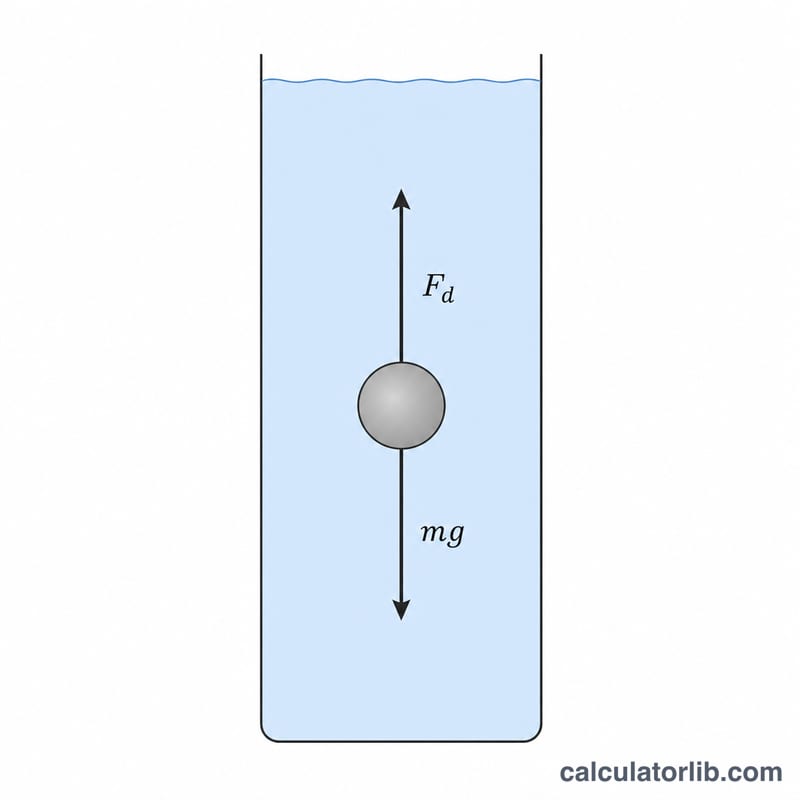
Terminal velocity is the constant speed an object reaches when the aerodynamic (or hydrodynamic) drag force exactly balances the gravitational force pulling it down. In the Newton regime—where flow around the object is turbulent and drag scales with the square of velocity—this balance gives a simple closed-form solution for the settling speed. This calculator is universal and works for any consistent SI inputs.
How to use this calculator
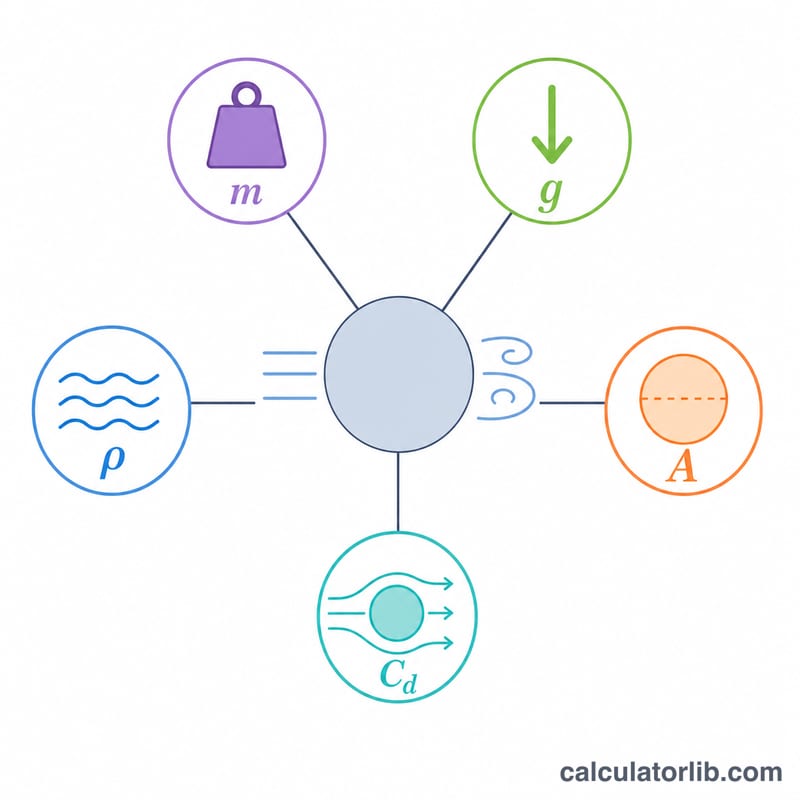
Enter the object mass (kg), local gravitational acceleration (9.81 m/s² on Earth), the density of the surrounding fluid (about 1.225 kg/m³ for air at sea level, 1000 kg/m³ for water), the projected frontal area (m²), and the drag coefficient Cd (≈0.47 for a sphere, ≈1.0 for a flat plate). The calculator returns the terminal velocity in both m/s and km/h.
The formula explained
At terminal velocity the drag force \(\tfrac{1}{2}\rho v^2 A C_d\) equals the weight \(mg\). Solving for \(v\) gives $$v = \sqrt{\dfrac{2 \, \text{Mass} \cdot \text{Gravity}}{\text{Density } \rho \cdot \text{Area } A \cdot \text{Drag } C_d}}$$ Heavier or larger-mass objects fall faster; denser fluid, larger frontal area, or a higher drag coefficient all slow the object down.
Worked example
A baseball with mass 0.145 kg, frontal area 0.0042 m² and Cd = 0.47 falling through air (ρ = 1.225 kg/m³, g = 9.81 m/s²): the denominator \(\rho A C_d = 1.225 \times 0.0042 \times 0.47 \approx 0.002418\). Then $$v = \sqrt{\dfrac{2 \times 0.145 \times 9.81}{0.002418}} \approx \sqrt{1176.6} \approx 34.3 \text{ m/s}$$ (about 123 km/h).
FAQ
Does this apply to small particles in liquids? The Newton-regime equation applies when the Reynolds number is high (roughly 1000–200,000). For very small slow particles, use Stokes law instead.
What drag coefficient should I use? A smooth sphere is ~0.47, a streamlined body ~0.04, a flat plate facing the flow ~1.0–1.28. Use a value appropriate to your shape.
Why two velocity units? m/s is the SI result; km/h is shown for intuitive comparison (multiply m/s by 3.6).