
What This Calculator Does
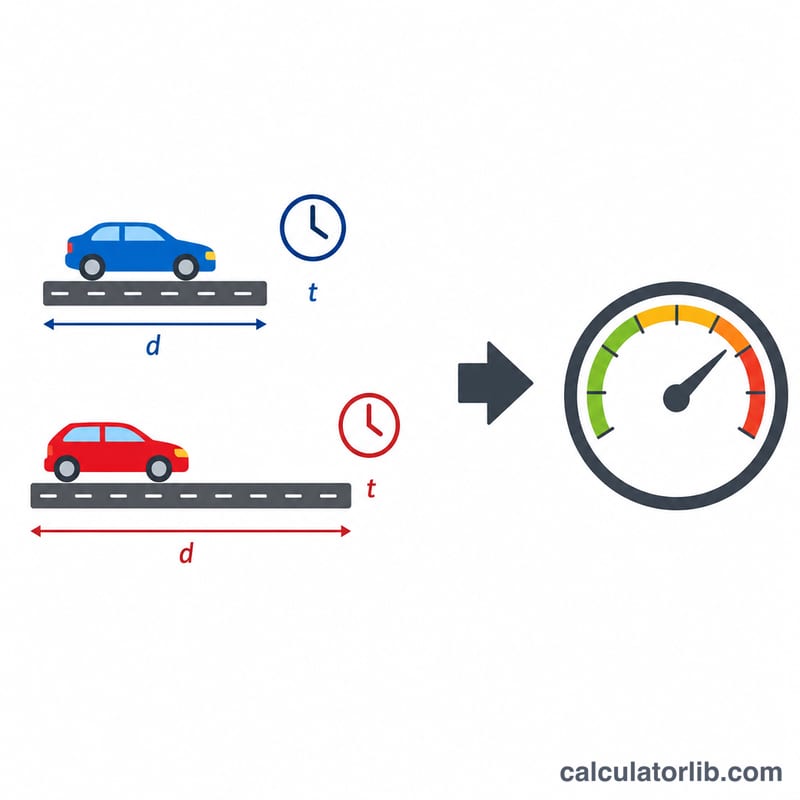
This calculator finds your true average speed over two separate trips (or two legs of a journey). The key insight is that average speed is not the average of the two speeds — it is the total distance traveled divided by the total time spent traveling. Combining segments by simply averaging their speeds gives the wrong answer unless the times happen to be equal.
How to Use It
Enter the distance and time for each of the two trips. Use any consistent distance unit (miles, kilometers, meters) and enter time in hours. The result is expressed in that distance unit per hour. The calculator also shows your combined total distance and total time so you can sanity-check the inputs.
The Formula Explained
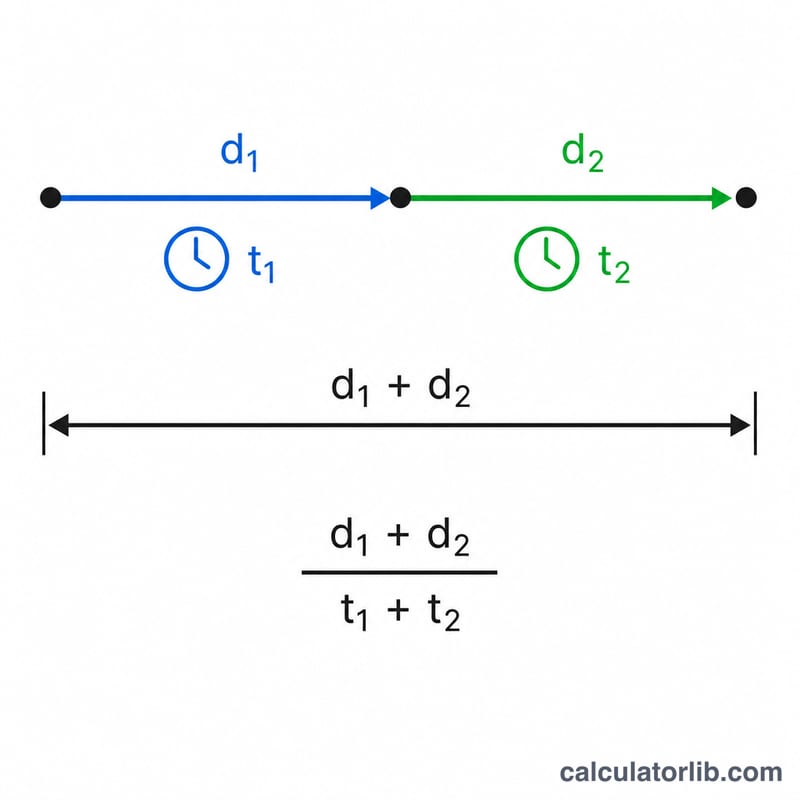
The equation is:
$$\text{Average Speed} = \frac{d_1 + d_2}{t_1 + t_2}$$Here \(d_1\) and \(d_2\) are the two distances and \(t_1\) and \(t_2\) are the two times. You add the distances to get the total ground covered, add the times to get the total duration, and divide. This weights each leg by how long it actually took, which is why it differs from a naive average of the two speeds.
Worked Example
Suppose you drive 60 miles in 1 hour, then 120 miles in 2 hours. Total distance = \(60 + 120 = 180\) miles. Total time = \(1 + 2 = 3\) hours. Average speed = $$\frac{180}{3} = 60 \text{ mph}$$ Note this is not the average of 60 mph and 60 mph by coincidence here — try 90 mph for 1 hour then 30 mph for 1 hour: total 120 miles in 2 hours = 60 mph, which does match the simple average only because the times are equal.
Scenario Comparison
A common mistake is to average the two leg speeds directly. The true average speed is always total distance ÷ total time, which weights each leg by the time spent on it — not by the distance. The table below shows three realistic two-trip cases. Each leg speed is computed as distance ÷ time, the "simple average" is \((s_1 + s_2)/2\), and the "true average" is \((d_1+d_2)/(t_1+t_2)\).
| Scenario | Trip 1 (d1 / t1) | Trip 2 (d2 / t2) | Leg speeds | Simple average of speeds | True average (total/total) |
|---|---|---|---|---|---|
| Equal times | 30 mi / 1 h | 60 mi / 1 h | 30 & 60 mph | 45.0 mph | 45.0 mph |
| Longer slow leg | 120 mi / 3 h | 60 mi / 1 h | 40 & 60 mph | 50.0 mph | 45.0 mph |
| Longer fast leg | 30 mi / 1 h | 180 mi / 3 h | 30 & 60 mph | 45.0 mph | 52.5 mph |
Notice that the simple average of the two speeds equals the true average only when the two times are equal (the first row). Whenever one leg takes longer, the true average shifts toward that leg's speed — which is why total-distance/total-time is the correct method.
Speed Unit Conversion Table
Once you have an average speed, you may want it in different units. The exact relationships are: 1 mph = 1.609344 km/h = 0.44704 m/s, 1 km/h = 0.277778 m/s, and 1 knot = 1 nautical mile per hour = 1.852 km/h exactly.
| From 1 unit | = mph | = km/h | = m/s | = knots |
|---|---|---|---|---|
| 1 mph | 1 | 1.60934 | 0.44704 | 0.86898 |
| 1 km/h | 0.62137 | 1 | 0.27778 | 0.53996 |
| 1 m/s | 2.23694 | 3.6 | 1 | 1.94384 |
| 1 knot | 1.15078 | 1.852 | 0.51444 | 1 |
Worked equivalents:
- A 45 mph average = \(45 \times 1.60934 = 72.42\) km/h = \(45 \times 0.44704 = 20.12\) m/s.
- A 100 km/h cruise = \(100 \times 0.62137 = 62.14\) mph = \(100 \times 0.27778 = 27.78\) m/s.
- A 10 m/s pace = \(10 \times 3.6 = 36\) km/h = \(10 \times 2.23694 = 22.37\) mph.
- A 20 knot speed = \(20 \times 1.15078 = 23.02\) mph = \(20 \times 1.852 = 37.04\) km/h.
FAQ
Why isn't average speed just the average of the two speeds? Because time matters. A slow leg that lasts longer pulls the overall speed down more than a quick fast leg. Only when both legs take the same time does the simple average match.
Can I use kilometers? Yes — any distance unit works as long as you use the same one for both trips. The answer comes out in that unit per hour.
What if a trip time is zero? A time of zero is not physically meaningful for travel; if total time is zero the calculator returns zero to avoid dividing by zero.