
What Is Pump Horsepower?
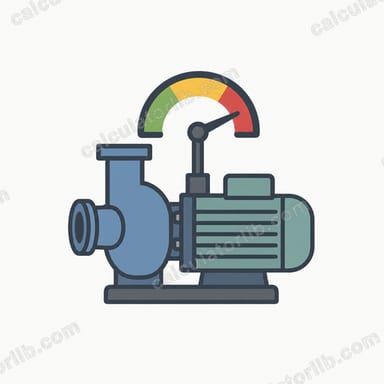
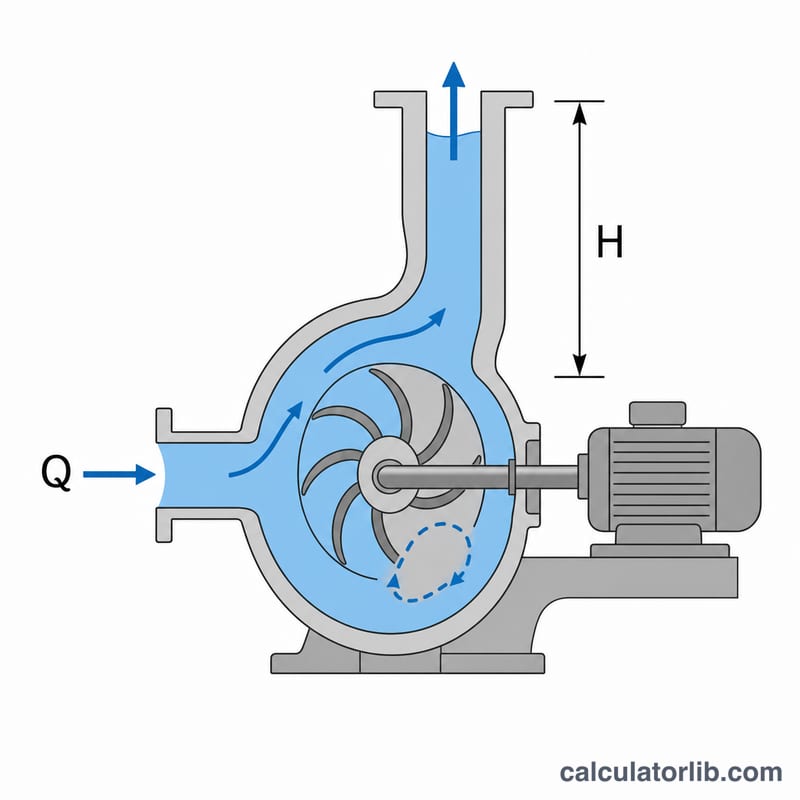
Pump horsepower describes the power a centrifugal pump must deliver to move a fluid at a given flow rate and head. Two related figures matter: hydraulic (water) horsepower, the useful energy transferred to the fluid, and brake horsepower (BHP), the larger amount of power the motor must actually supply once pump inefficiencies are accounted for. This calculator computes both in horsepower and kilowatts.
How to Use It
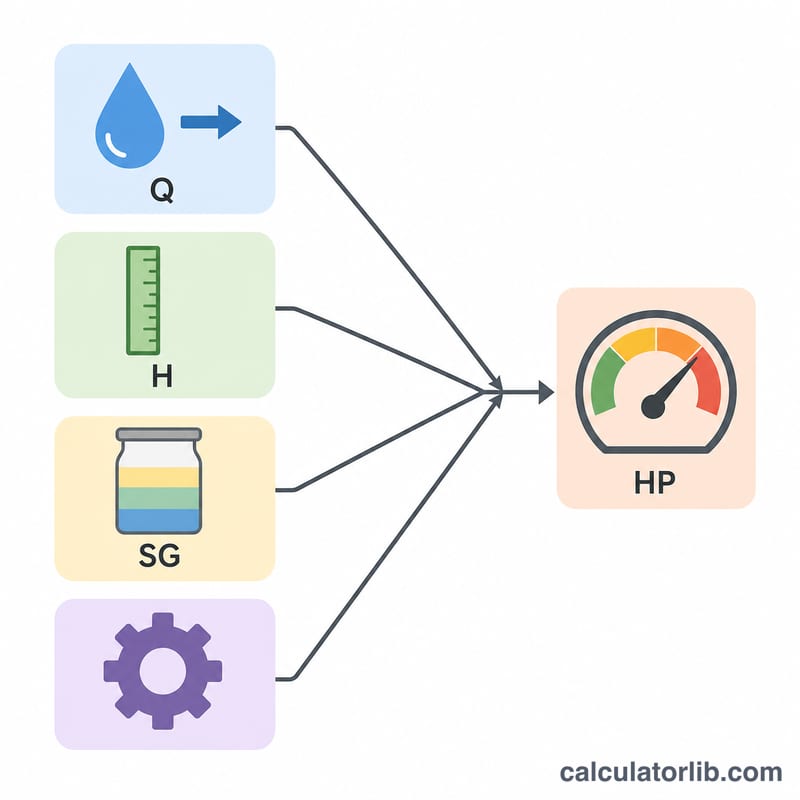
Enter the flow rate in gallons per minute (GPM), the total dynamic head in feet, the fluid's specific gravity (1.0 for water), and the pump's efficiency as a percentage. The tool returns the brake horsepower needed at the shaft, the hydraulic horsepower delivered to the fluid, and the equivalent power in kilowatts to help with motor sizing.
The Formula Explained
The core equation is $$\text{BHP} = \frac{\text{Flow (GPM)} \times \text{Head (ft)} \times \text{Specific Gravity}}{3960 \times \dfrac{\text{Efficiency (\%)}}{100}}$$ The constant 3960 converts gallons per minute and feet of head into horsepower (it comes from 33,000 ft\(\cdot\)lb/min per hp divided by 8.33 lb/gal of water). Multiplying by specific gravity adjusts for fluids heavier or lighter than water. Dividing by efficiency \(\eta\) (as a decimal) accounts for losses inside the pump.
Worked Example
For a pump moving 100 GPM of water (SG = 1.0) against 100 ft of head at 70% efficiency: hydraulic HP = $$\frac{100 \times 100 \times 1.0}{3960} = 2.525 \text{ hp}.$$ Brake horsepower = $$\frac{2.525}{0.70} = 3.608 \text{ hp},$$ or about 2.69 kW. You would typically select a motor rated above this with a safety margin.
FAQ
What specific gravity should I use? Use 1.0 for water at standard conditions; use the fluid's value for other liquids (e.g. ~0.85 for many oils, >1.0 for brines).
Why is brake horsepower higher than water horsepower? No pump is 100% efficient, so the motor must supply more power than what actually reaches the fluid. \(\text{BHP} = \text{WHP} \div \text{efficiency}\).
How do I size the motor? Choose a motor rated at or above the BHP, adding a service-factor margin (commonly 10–25%) for safe continuous operation.