
What is a Spring Rate Calculator?
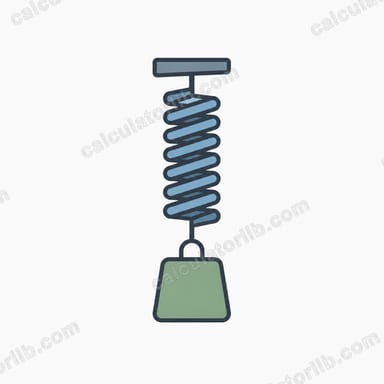
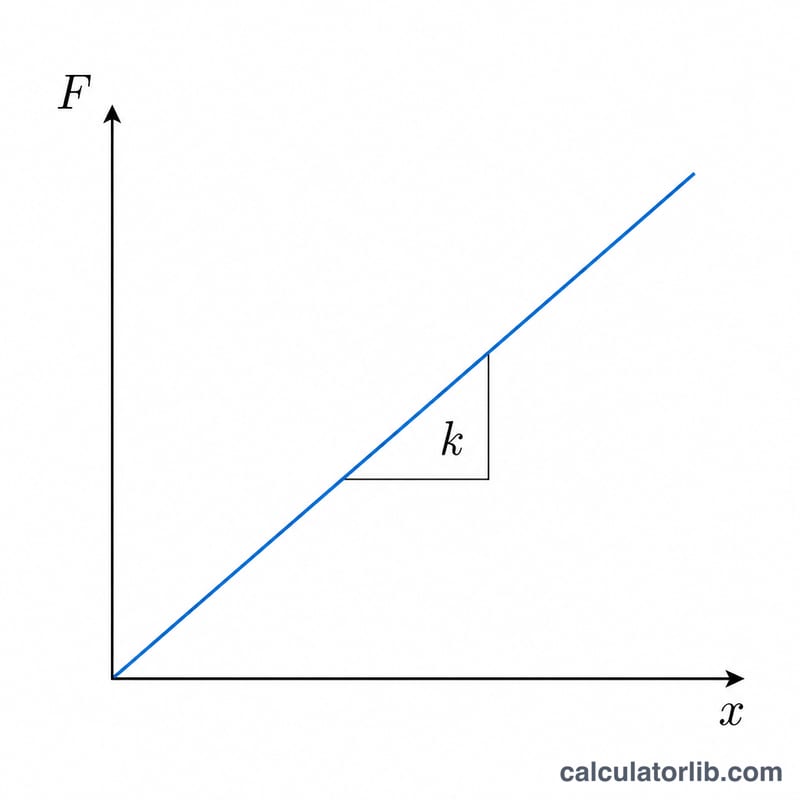
The spring rate (or spring constant) of a helical compression coil spring describes how much force is needed to compress the spring by a unit of length. A higher spring rate means a stiffer spring. This calculator uses the classic mechanics-of-materials formula for a round-wire helical compression spring.
How to use it
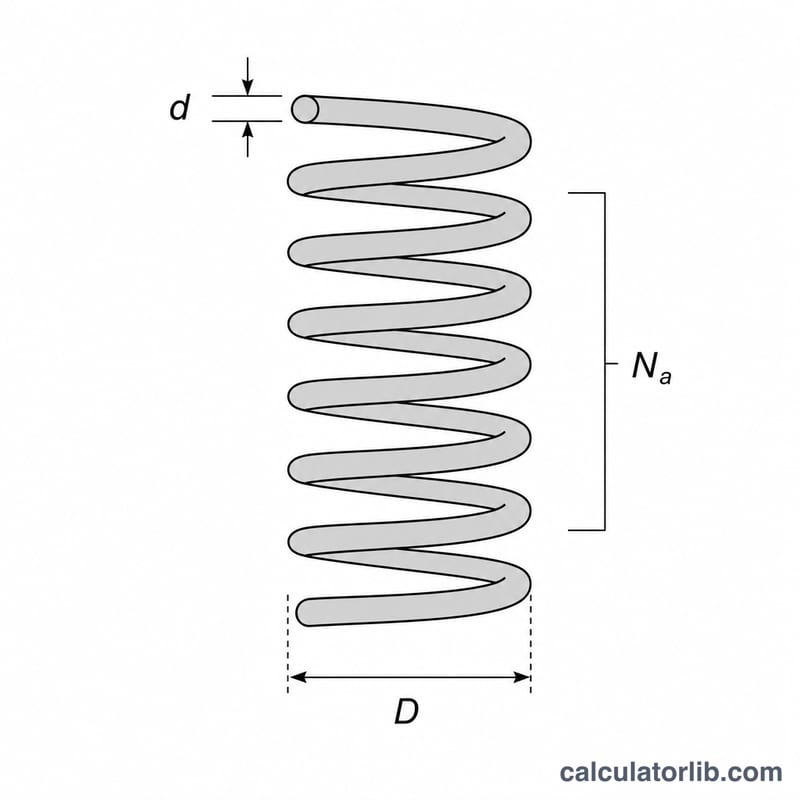
Enter the shear modulus G of the wire material (in GPa — about 79.3 GPa for spring steel), the wire diameter d, the mean coil diameter D (measured center-to-center of the wire across the coil), and the number of active coils Na. The calculator returns the spring rate in N/mm and N/m.
The formula explained
The spring rate is $$k = \frac{\left(1000 \cdot \text{G (GPa)}\right)\,\text{d (mm)}^{4}}{8\,\text{D (mm)}^{3}\,\text{Na}}$$ Note the strong dependence on wire diameter (fourth power) and an inverse cube relationship with the coil diameter — small changes in either dramatically change stiffness. G is converted from GPa to N/mm² (\(1\ \text{GPa} = 1000\ \text{N/mm}^2\)) so that with d and D in mm, k comes out in N/mm.
Worked example
For spring steel G = 79.3 GPa (79,300 N/mm²), d = 2 mm, D = 20 mm, Na = 10 coils: numerator = \(79{,}300 \times 2^4 = 79{,}300 \times 16 = 1{,}268{,}800\); denominator = \(8 \times 20^3 \times 10 = 8 \times 8000 \times 10 = 640{,}000\). $$k = \frac{1{,}268{,}800}{640{,}000} = 1.9825\ \text{N/mm}$$ or 1982.5 N/m.
FAQ
What is the shear modulus of common spring steel? Music/spring steel is typically around 79.3 GPa; stainless steel is closer to 69 GPa.
What counts as an active coil? Active coils are the coils free to deflect; end coils that are ground or closed are not active and are excluded from Na.
Is mean coil diameter the same as outer diameter? No. Mean diameter D = outer diameter − wire diameter d.