
What Is the Barrel Twist Rate Calculator?
This tool estimates the rifling twist rate needed to stabilize a bullet in flight, expressed as inches per single turn (for example "1 in 12" or 1:12"). It uses the time-tested Greenhill formula, developed by mathematician Sir Alfred George Greenhill in 1879. A correct twist rate keeps the projectile spinning fast enough to remain point-forward and accurate downrange.
How to Use It
Enter the bullet diameter in inches (the bore or caliber, e.g. 0.308 for a .308) and the bullet length in inches. Choose the Greenhill constant: use 150 for typical muzzle velocities under about 2800 fps, or 180 for higher-velocity loads. The calculator returns the recommended twist in inches per turn and the equivalent calibers per turn.
The Formula Explained
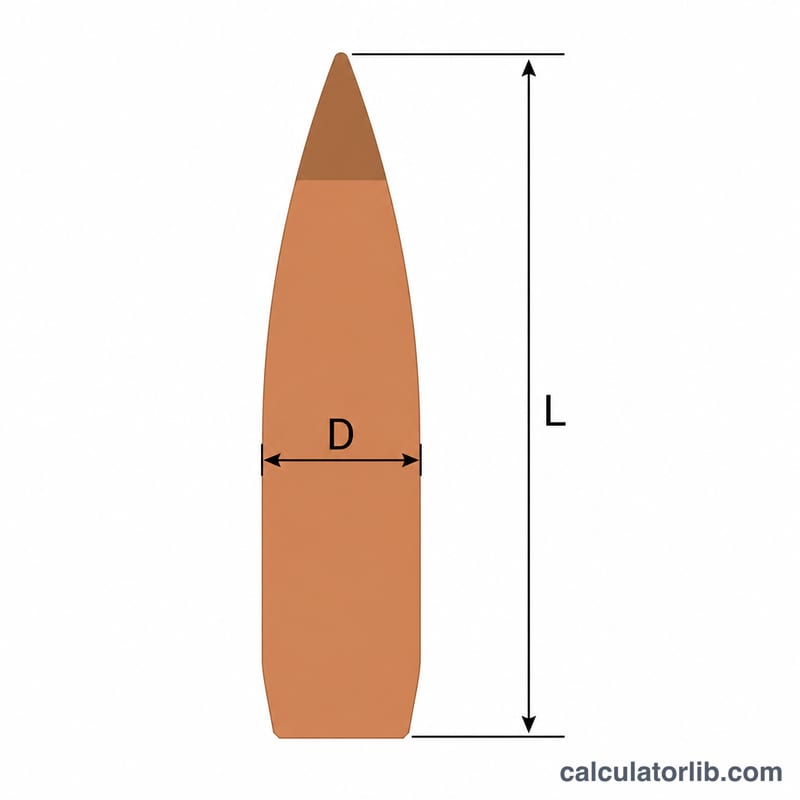
The Greenhill equation is $$\text{Twist} = \frac{\text{C} \times \text{D}^{2}}{\text{L}}$$ where C is the constant, D is bullet diameter, and L is bullet length. Because longer bullets are harder to stabilize, the twist value (inches per turn) gets smaller — a faster twist — as length increases. Heavier, longer bullets therefore need a faster (lower-number) twist.
Worked Example
For a .308 bullet 1.2 inches long with \(C = 150\): $$\text{Twist} = \frac{150 \times 0.308^{2}}{1.2} = \frac{150 \times 0.094864}{1.2} = \frac{14.2296}{1.2} \approx 11.86$$ So a twist near 1:12" is appropriate.
FAQ
What does "1 in 12" mean? The bullet completes one full rotation every 12 inches of barrel travel. A smaller number means a faster twist.
Which constant should I use? Use 150 for standard velocities and 180 when muzzle velocity exceeds roughly 2800 fps for better accuracy at higher speeds.
Is Greenhill exact? No — it is a useful approximation derived for lead-core bullets. Modern designs may use the Miller stability formula for more precision, but Greenhill remains a quick, reliable starting point.