
What is the Barrel Volume Calculator?
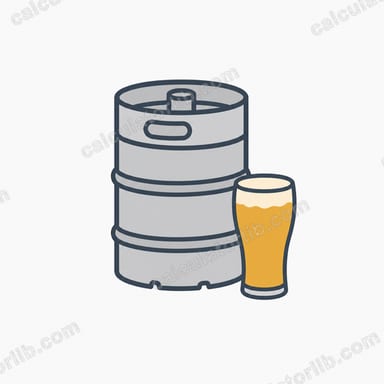
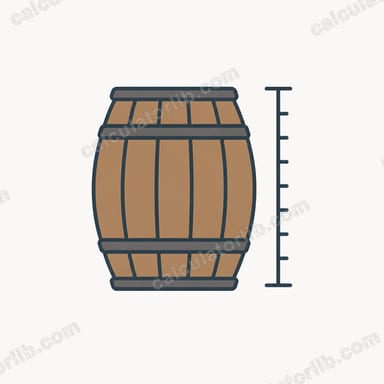
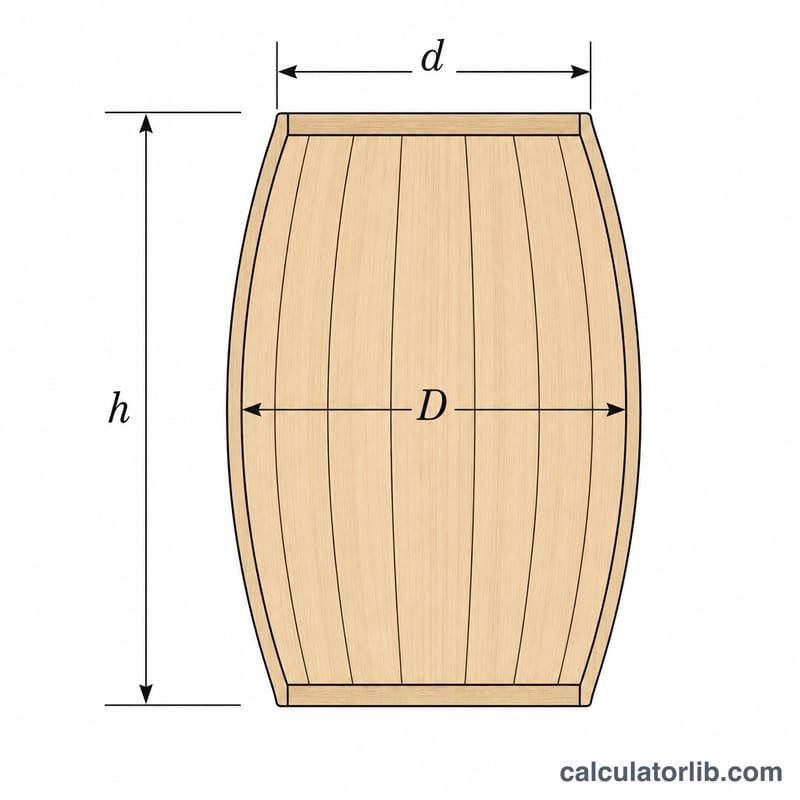
A barrel (or cask, drum, or keg) is wider in the middle than at its ends, so you cannot treat it as a simple cylinder. This calculator uses the Kepler barrel approximation to estimate the internal volume from three easy measurements: the height (or length) of the barrel, the diameter at the middle (the bilge), and the diameter at the flat ends (the head). It returns the result in cubic units, liters, US gallons, and imperial (UK) gallons.
How to use it
Measure the inside dimensions if you want the holding capacity, or the outside dimensions for the overall size. Enter the height (h), the middle diameter (D), and the end diameter (d), then pick the unit you measured in. The calculator instantly converts the cubic result into liters and both gallon standards.
The formula explained
The Kepler approximation treats the barrel as a solid of revolution and gives:
$$V = \frac{\pi \cdot \text{Height }(h)}{12}\left(2\,\text{Middle }(D)^{2} + \text{End }(d)^{2}\right)$$
Here \(D\) is the larger middle diameter and \(d\) is the smaller end diameter. When \(D\) equals \(d\) the formula reduces to the standard cylinder volume \(\pi r^{2}h\), so it behaves correctly for a straight drum too. The factor that doubles \(D^{2}\) reflects that the bulging middle contributes more to the total volume.
Worked example
Suppose a barrel is 90 cm tall, 70 cm across the middle, and 60 cm across each end. Then $$V = \frac{\pi \times 90}{12} \times (2 \times 70^{2} + 60^{2}) = 23.5619 \times (9800 + 3600) = 23.5619 \times 13400 \approx 315{,}730 \text{ cm}^{3},$$ which is about 315.7 liters or roughly 83.4 US gallons.
Volume Unit Conversions
The Kepler approximation gives a barrel's volume in cubic units of whatever length unit you enter (cm³, in³, or m³). Use these factors to convert that raw volume into liters or gallons. The most common conversion is cubic centimeters to liters: \(1\text{ L} = 1000\text{ cm}^3\).
| From | Equals |
|---|---|
| 1 liter (L) | 1000 cm³ = 0.001 m³ = 61.0237 in³ = 0.0353147 ft³ |
| 1 liter (L) | 0.264172 US gal = 0.219969 UK gal |
| 1 cubic meter (m³) | 1000 L = 264.172 US gal = 219.969 UK gal = 35.3147 ft³ |
| 1 US gallon | 3.78541 L = 231 in³ = 0.832674 UK gal |
| 1 UK (imperial) gallon | 4.54609 L = 277.42 in³ = 1.20095 US gal |
| 1 cubic foot (ft³) | 28.3168 L = 7.48052 US gal = 1728 in³ |
| 1 cubic inch (in³) | 16.3871 cm³ = 0.0163871 L |
Worked conversion: a cask whose Kepler volume comes out to 225,000 cm³ holds \(225000 \div 1000 = 225\) L, which is \(225 \times 0.264172 = 59.44\) US gallons.
FAQ
How accurate is the Kepler formula? It is an approximation that assumes the staves curve smoothly. For most real casks it is accurate to within a few percent.
Should I use inside or outside diameters? Use inside measurements for liquid capacity and outside measurements for the space the barrel occupies.
What if my barrel is a straight cylinder? Enter the same value for both the middle and end diameters; the formula reduces to the exact cylinder volume.