
What Is a Fraction to Mixed Number Calculator?
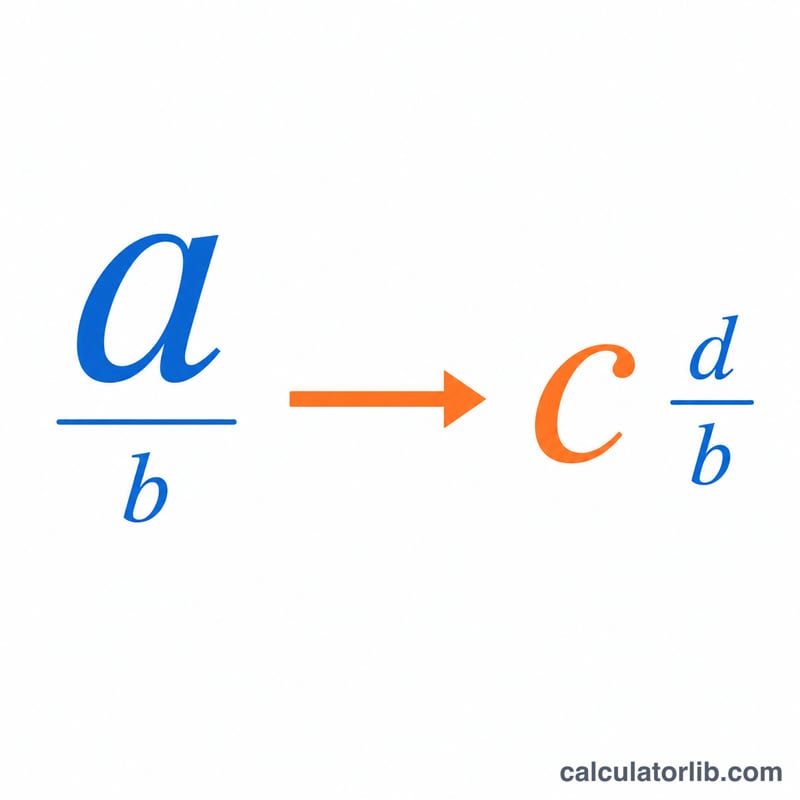
This tool converts an improper fraction — one where the numerator is greater than or equal to the denominator — into a mixed number, which combines a whole number with a proper fraction. For example, \(17/5\) becomes \(3\tfrac{2}{5}\). The calculator also automatically reduces the leftover fraction to its lowest terms.
How to Use It
Enter the numerator (the top number) and the denominator (the bottom number) of your fraction, then read the result. The output shows the whole part and a simplified proper fraction. Negative fractions are supported; the sign is applied to the whole-number part.
The Formula Explained
The conversion uses integer division and the modulo (remainder) operation:
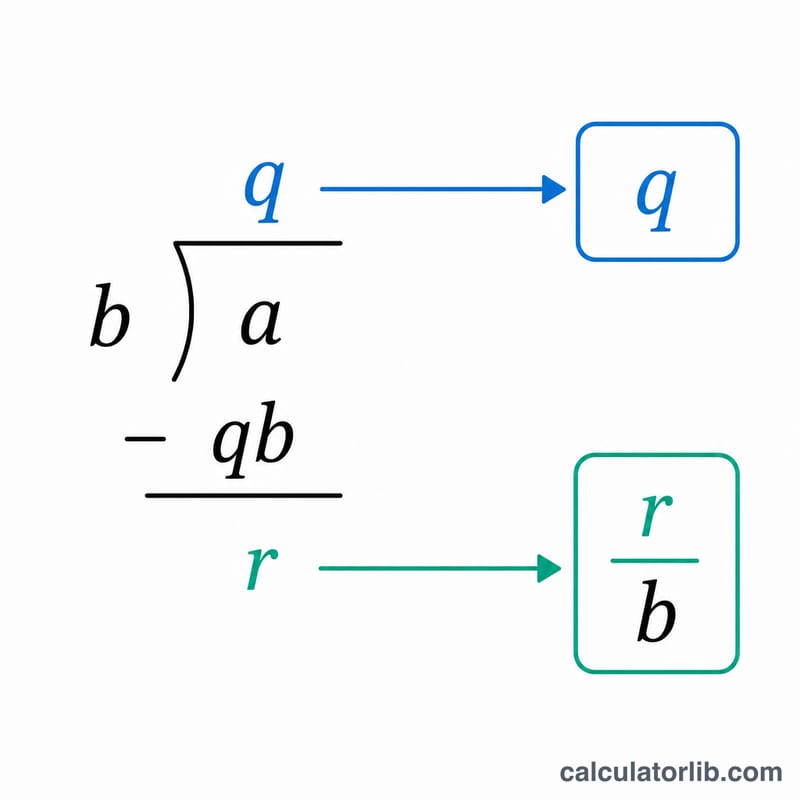
$$\frac{\text{Numerator}}{\text{Denominator}} = W\,\frac{R}{D} \\[1.5em] \text{where}\quad \left\{ \begin{aligned} W &= \left\lfloor \frac{\text{Numerator}}{\text{Denominator}} \right\rfloor \\ R &= \text{Numerator} \bmod \text{Denominator} \end{aligned} \right.$$Here, a ÷ b is the integer quotient (how many whole times b fits into a), and a mod b is what is left over. That remainder sits over the original denominator, and the resulting fraction is then simplified by dividing both parts by their greatest common divisor (GCD).
Worked Example
Convert \(17/5\):
$$17 \div 5 = 3 \text{ remainder } 2 \quad (\text{since } 3 \times 5 = 15 \text{ and } 17 - 15 = 2)$$So the mixed number is \(3\tfrac{2}{5}\). The fraction \(2/5\) is already in lowest terms, so no further reduction is needed.
FAQ
What if the numerator is smaller than the denominator? The whole part is 0 and the result is just the (reduced) proper fraction, e.g. \(3/4\) stays \(3/4\).
What happens with a denominator of zero? Division by zero is undefined, so the calculator returns zero and does not attempt the conversion.
Does it simplify the fraction? Yes. For example, \(14/4\) becomes \(3\tfrac{1}{2}\) because the remainder fraction \(2/4\) reduces to \(1/2\).