
What Is the Pentagon Perimeter Calculator?
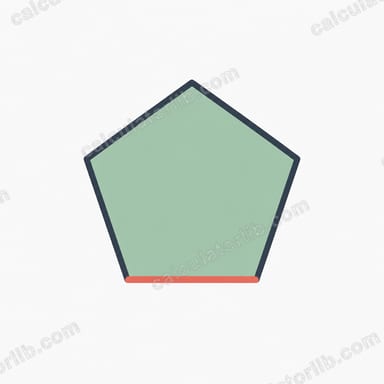
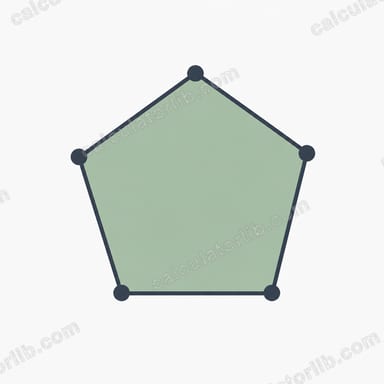
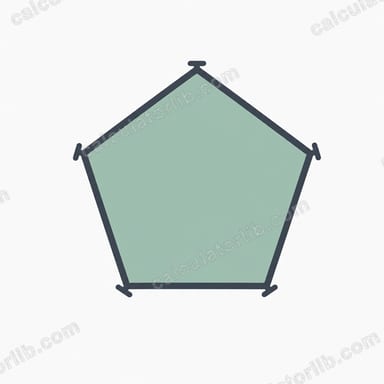
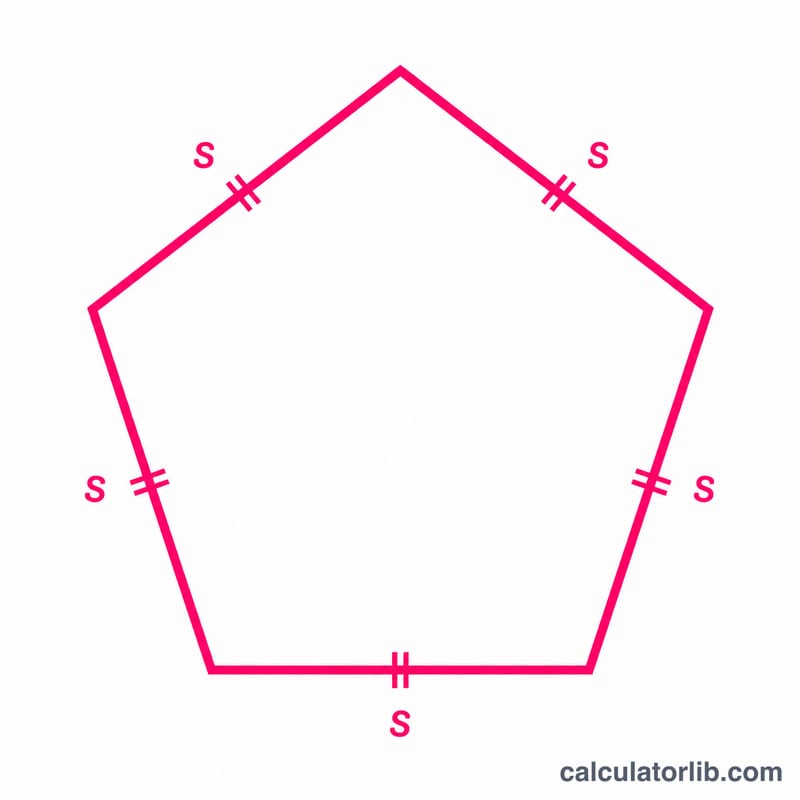
This calculator finds the perimeter of a regular pentagon—a five-sided polygon with all sides equal in length. Because every side has the same measurement, the perimeter is simply five times the length of one side. This tool works with any unit of length (centimeters, inches, meters, feet) as long as you stay consistent; the answer comes out in the same unit you entered.
How to Use It
Enter the length of one side (s) of your regular pentagon and press calculate. The result shows the total distance around all five edges. For example, a stop sign is an octagon, but many garden plots, tiles, and the home plate in baseball are pentagon-shaped, making this a handy everyday geometry tool.
The Formula Explained
The perimeter of any polygon is the sum of all its side lengths. For a regular pentagon with five equal sides of length s:
$$P = s + s + s + s + s = 5s$$
So multiplying the single side length by 5 gives the full perimeter. This shortcut only applies to regular pentagons where all sides are equal—irregular pentagons require adding each side individually.
Worked Example
Suppose a regular pentagon has a side length of 8 cm. Then $$P = 5 \times 8 = 40 \text{ cm}.$$ If the side were 12.5 inches, the perimeter would be $$5 \times 12.5 = 62.5 \text{ inches}.$$
FAQ
Does this work for irregular pentagons? No. The \(P = 5s\) formula assumes all five sides are equal. For irregular pentagons, add the five side lengths separately.
What units does the result use? The perimeter is returned in the same unit you used for the side length.
How is perimeter different from area? Perimeter measures the distance around the shape, while area measures the surface inside it. This calculator computes perimeter only.