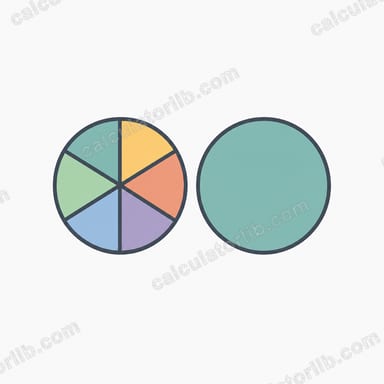

What Is a Whole Number to Fraction Conversion?
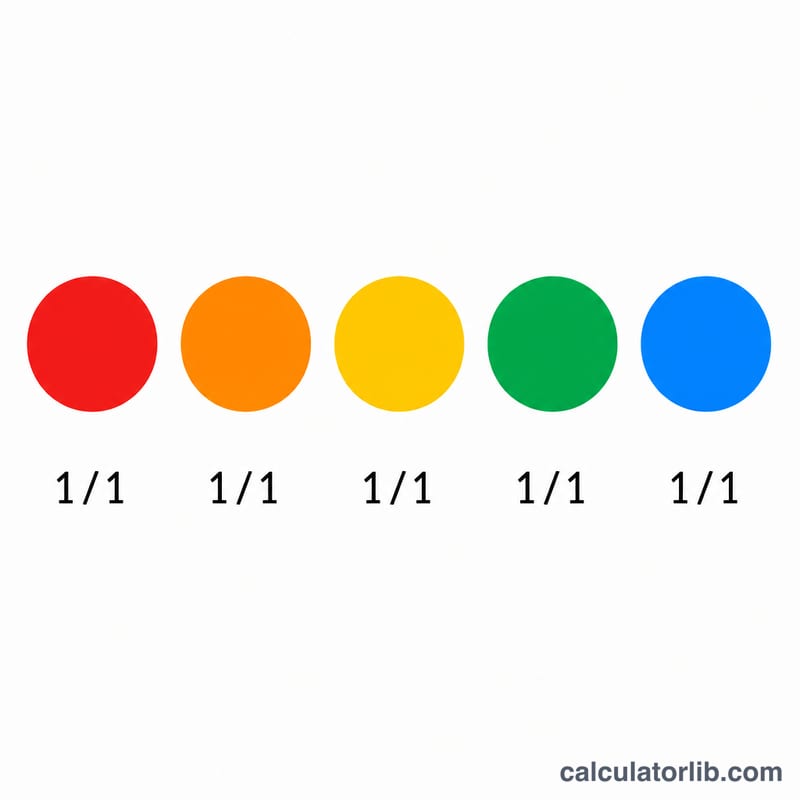
Every whole number is also a fraction. The number 5, for example, can be written as \(5/1\) because dividing 5 by 1 gives 5. This calculator converts any whole number into an equivalent fraction, either in its simplest form over 1 or over a denominator you choose.
How to Use the Calculator
Enter the whole number you want to convert. Optionally enter a denominator if you want the fraction expressed over a specific bottom number (for example, to add it to another fraction with that denominator). Leave the denominator at 1 to get the basic n/1 form. The result shows the numerator and denominator.
The Formula Explained
The basic identity is \(n = n/1\). To write a whole number over any denominator \(d\), multiply both the number and that denominator: \(n = (n \cdot d) / d\). The denominator \(d\) cancels out, so the value never changes — only the way it is written. This is handy when you need a common denominator for adding or subtracting fractions.
$$\text{Fraction} = \frac{\text{Whole Number} \times \text{Denominator}}{\text{Denominator}}$$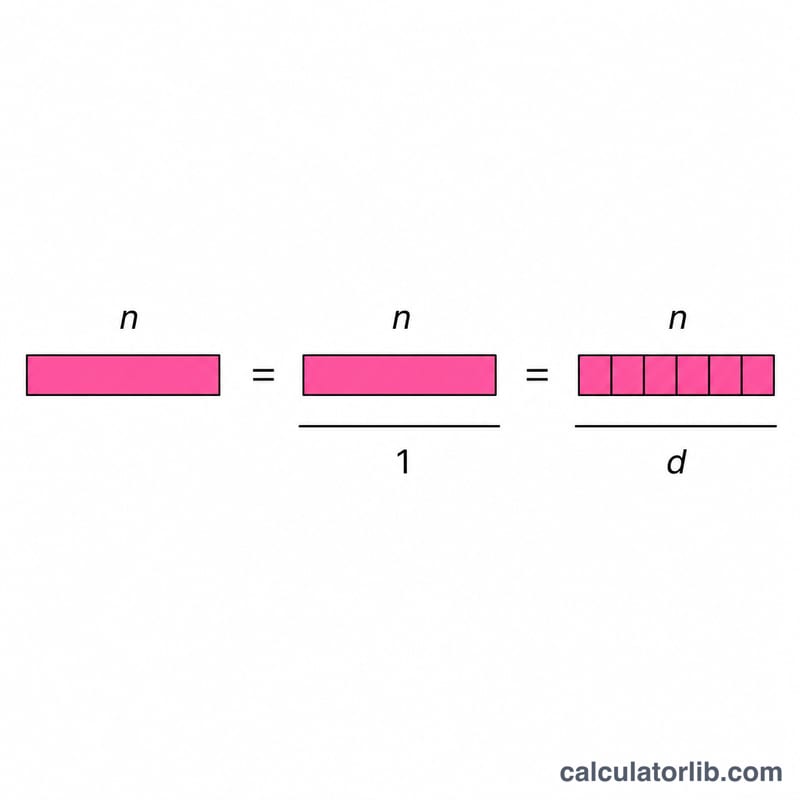
Worked Example
Convert 7 to a fraction with denominator 4. Multiply:
$$7 \times 4 = 28$$so \(7 = 28/4\). You can verify: \(28 \div 4 = 7\). With the default denominator of 1, 7 simply becomes \(7/1\).
FAQ
Why is a whole number a fraction? Because a fraction means "parts of a whole," and any number divided by 1 equals itself, so \(n/1\) is always valid.
Can I get a mixed number? A whole number is already complete, so the fraction is improper (numerator divisible by denominator), not mixed.
Does the value change with a bigger denominator? No. \(7/1\), \(14/2\), and \(28/4\) are all equal to 7 — only the representation differs.