What Is a Fraction of a Number?
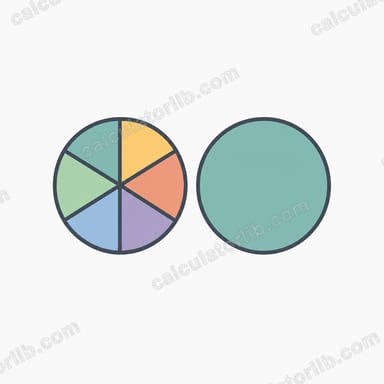
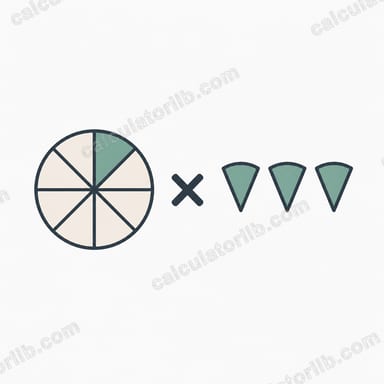
Taking a fraction of a number means finding a specific part of a whole quantity. For example, "three quarters of 200" is the fraction 3/4 applied to the number 200. This calculator computes \((a/b) \times N\) for any numerator a, denominator b, and number N, giving you an exact result in seconds.

How to Use This Calculator
Enter the numerator (the top number of the fraction), the denominator (the bottom number), and the number you want a fraction of. Press calculate and you'll get the result, plus the decimal value of the fraction itself for reference.
The Formula Explained
The math is straightforward: first divide the numerator by the denominator to convert the fraction to a decimal, then multiply by the number.
$$\text{Result} = \frac{\text{Numerator (a)}}{\text{Denominator (b)}} \times \text{Number (N)}$$
This works for proper fractions (like 1/2), improper fractions (like 7/4), and even decimal inputs.

Worked Example
Suppose you want to find 3/4 of 200. Divide 3 by 4 to get 0.75, then multiply by 200: $$0.75 \times 200 = \mathbf{150}$$ So three quarters of 200 is 150.
Common Fractions of a Number Reference Table
The table shows each fraction as a decimal and a percentage, and gives its value when applied to 100 and to 360 (the number of degrees in a full circle). Decimals and percentages that do not terminate are rounded to two decimal places for the percentage and four for the decimal.
| Fraction | Decimal | Percentage | Fraction of 100 | Fraction of 360 |
|---|---|---|---|---|
| 1/2 | 0.5 | 50% | 50 | 180 |
| 1/3 | 0.3333 | 33.33% | 33.33 | 120 |
| 1/4 | 0.25 | 25% | 25 | 90 |
| 2/3 | 0.6667 | 66.67% | 66.67 | 240 |
| 3/4 | 0.75 | 75% | 75 | 270 |
| 1/5 | 0.2 | 20% | 20 | 72 |
| 1/8 | 0.125 | 12.5% | 12.5 | 45 |
| 3/8 | 0.375 | 37.5% | 37.5 | 135 |
| 5/8 | 0.625 | 62.5% | 62.5 | 225 |
| 1/10 | 0.1 | 10% | 10 | 36 |
To get the decimal, divide the numerator by the denominator. Multiply that decimal by 100 to get the percentage, and by any number N to get the fraction of N.
More Worked Examples
The general formula is \(\frac{a}{b} \times N\). It can be computed either as \(\frac{a \times N}{b}\) (multiply first, then divide) or as \(\left(\frac{N}{b}\right) \times a\) (divide first, then multiply). Both give the same result.
Example 1: 2/3 of 90
- Multiply the numerator by the number: \(2 \times 90 = 180\).
- Divide by the denominator: \(180 \div 3 = 60\).
So 2/3 of 90 = 60.
Example 2: Improper fraction, 7/4 of 40
When the numerator is larger than the denominator, the result is larger than the original number.
- Multiply: \(7 \times 40 = 280\).
- Divide: \(280 \div 4 = 70\).
So 7/4 of 40 = 70. Check: 7/4 = 1.75 and \(1.75 \times 40 = 70\).
Example 3: Real-world case, 3/8 of a 250 km trip
Suppose you have driven 3/8 of a 250 km journey.
- Multiply first: \(3 \times 250 = 750\).
- Divide: \(750 \div 8 = 93.75\).
You have driven 93.75 km.
Alternative (divide first): \(250 \div 8 = 31.25\), then \(31.25 \times 3 = 93.75\). The answer is the same. Multiplying first is often easier to do mentally when the division then comes out evenly, as in Example 1.
FAQ
What happens if the denominator is zero? Division by zero is undefined, so the calculator treats the fraction value as 0 to avoid an error. Always use a non-zero denominator.
Can I use improper fractions? Yes. For example, \(5/2\) of \(60 = 2.5 \times 60 = 150\). The result can be larger than the original number.
Does it work with decimals? Yes — you can enter decimal numerators, denominators, or numbers and the formula still applies.