
What Is Delta-V?
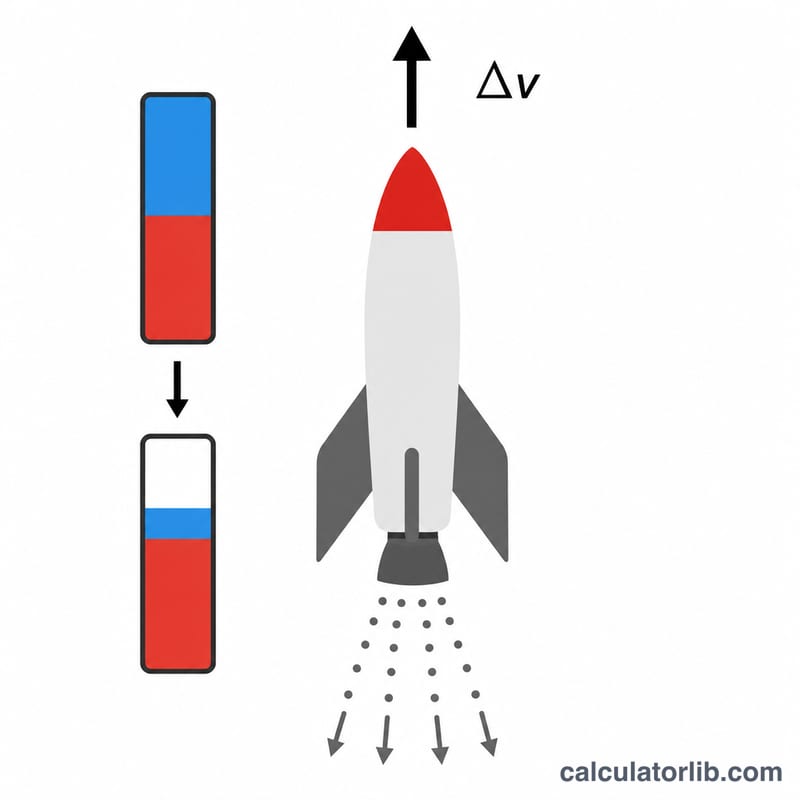
Delta-v (Δv) is the change in velocity a spacecraft or rocket stage can achieve by burning its propellant. It is the single most important measure of a rocket's capability — every maneuver, from launch to orbital insertion to landing, has a delta-v "cost." This calculator uses the classic Tsiolkovsky rocket equation, a universal physics result that applies to any vehicle expelling reaction mass.
How to Use This Calculator
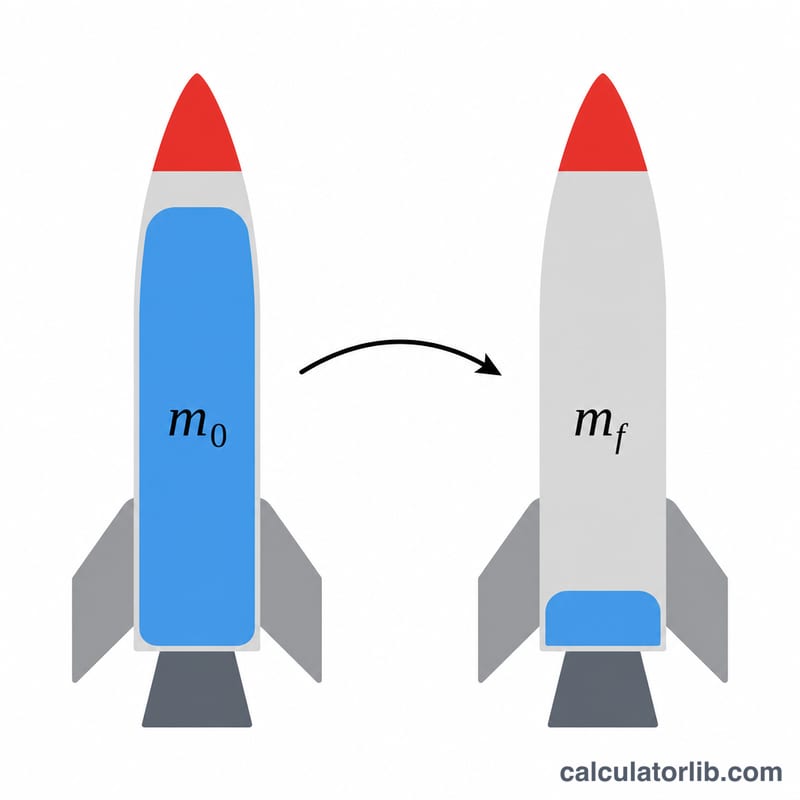
Enter four values: the engine's specific impulse (Isp) in seconds, the initial mass (m₀) of the fully fueled vehicle in kilograms, the final mass (m_f) after the burn (dry mass plus payload), and the standard gravity (g₀), which defaults to 9.80665 m/s². The tool returns the total delta-v in meters per second, along with the mass ratio and the propellant mass consumed.
The Formula Explained
The equation is $$\Delta v = \text{I}_{sp} \cdot \text{g}_0 \cdot \ln\!\left(\frac{\text{m}_0}{\text{m}_f}\right)$$ Specific impulse multiplied by \(\text{g}_0\) gives the effective exhaust velocity. The natural logarithm of the mass ratio captures the diminishing returns of carrying ever more fuel — doubling the mass ratio does not double delta-v. This is why staging and high-Isp engines are so valuable in spaceflight.
Worked Example
Suppose a stage has \(\text{I}_{sp} = 311\ \text{s}\), initial mass \(\text{m}_0 = 100{,}000\ \text{kg}\), final mass \(\text{m}_f = 30{,}000\ \text{kg}\), and \(\text{g}_0 = 9.80665\ \text{m/s}^2\). The mass ratio is \(100{,}000 / 30{,}000 \approx 3.3333\), and \(\ln(3.3333) \approx 1.20397\). So $$\Delta v = 311 \times 9.80665 \times 1.20397 \approx 3{,}671.6\ \text{m/s}$$
FAQ
Why use g₀ if there's no gravity in space? \(\text{g}_0\) is just a fixed constant (9.80665 m/s²) used to convert specific impulse in seconds into an effective exhaust velocity; it does not represent local gravity.
What happens if final mass equals initial mass? The mass ratio is 1, \(\ln(1) = 0\), and delta-v is zero — no propellant was burned.
Can I use effective exhaust velocity instead of Isp? Yes. If you know exhaust velocity directly, set Isp to that value and \(\text{g}_0\) to 1.