

What Is the Tsiolkovsky Rocket Equation?
The Tsiolkovsky rocket equation, derived by Konstantin Tsiolkovsky in 1903, describes the maximum change in velocity (delta-v, or \(\Delta v\)) a rocket can achieve given its propellant and engine performance. Delta-v is the single most important number in mission planning: reaching low Earth orbit, transferring to the Moon, or landing on Mars each require a known \(\Delta v\) budget. This calculator is a universal physics tool — it works for any rocket regardless of country or manufacturer.
How to Use This Calculator
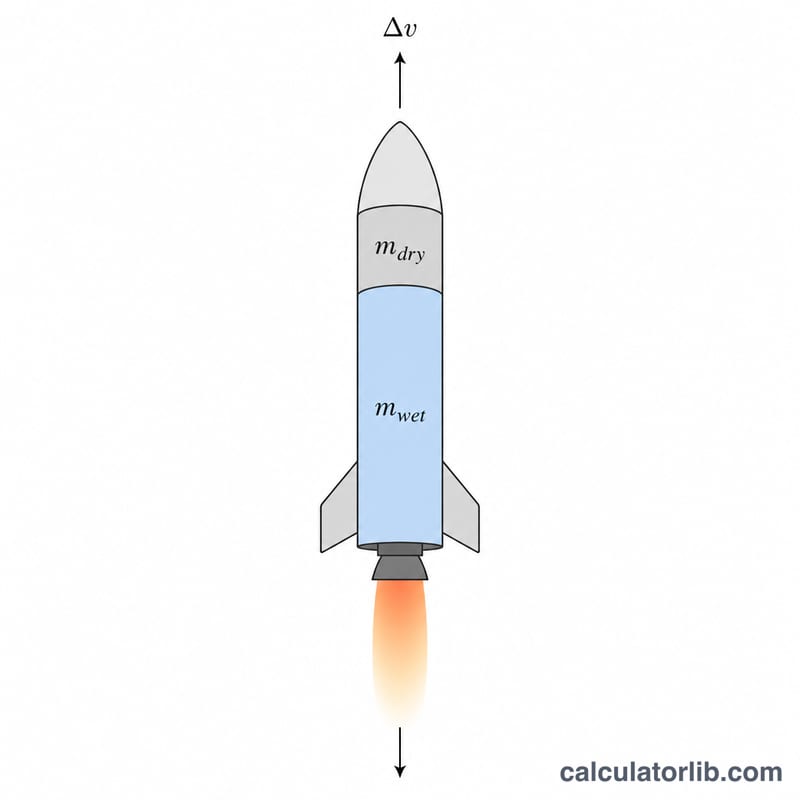
Enter four values: the engine's specific impulse (Isp) in seconds, the standard gravity g₀ (use 9.80665 m/s² by convention), the wet mass (the rocket fully fueled, in kg), and the dry mass (the rocket after all propellant is burned, in kg). The calculator returns total delta-v in both m/s and km/s, the mass ratio, and the propellant mass consumed.
The Formula Explained
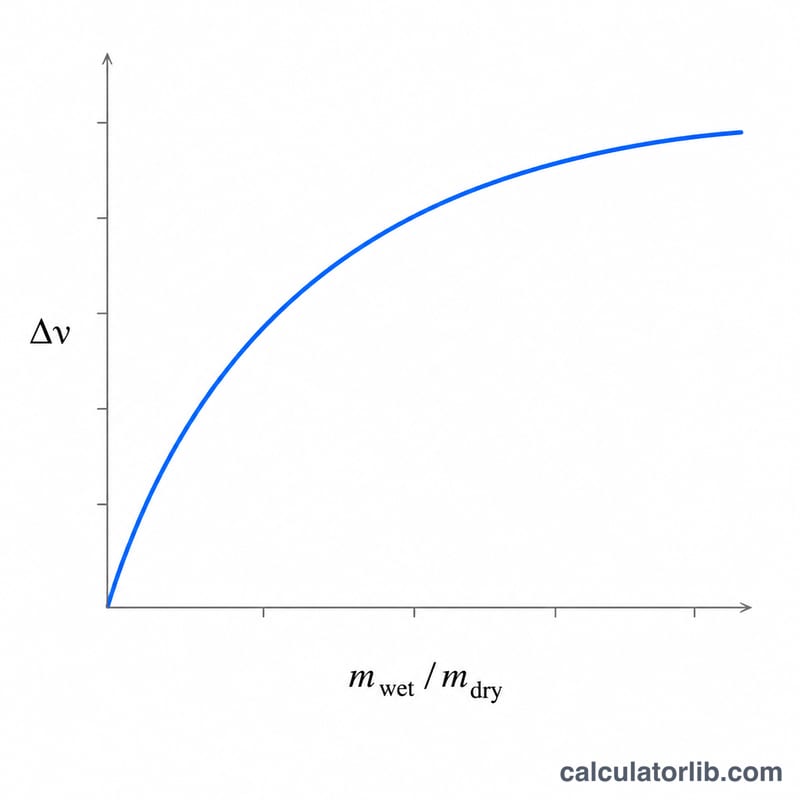
$$\Delta v = \text{Isp} \cdot g_0 \cdot \ln\!\left(\frac{\text{Wet Mass}}{\text{Dry Mass}}\right)$$ The term \(\text{Isp} \cdot g_0\) is the effective exhaust velocity (\(v_e\)), measured in m/s. The natural logarithm of the mass ratio captures the diminishing returns of carrying more fuel — doubling propellant does not double \(\Delta v\). A higher Isp engine or a lighter dry mass both increase the achievable \(\Delta v\).
Worked Example
Suppose Isp = 300 s, g₀ = 9.80665 m/s², wet mass = 10,000 kg, and dry mass = 3,000 kg. The mass ratio is \(10{,}000 / 3{,}000 = 3.3333\), and \(\ln(3.3333) \approx 1.20397\). Then $$\Delta v = 300 \times 9.80665 \times 1.20397 \approx 3542.2 \ \text{m/s} \approx 3.54 \ \text{km/s}$$
FAQ
What is a typical delta-v budget? Reaching low Earth orbit needs roughly 9.4 km/s including losses; an Earth-to-Mars transfer adds several more km/s.
Why use g₀ = 9.80665? Specific impulse in seconds is defined relative to standard gravity, so g₀ is a fixed constant, not the local gravity at your launch site.
What if I know exhaust velocity instead of Isp? Divide your exhaust velocity by g₀ to get the equivalent Isp, then enter that value.