
What Is a Hash Rate Converter?
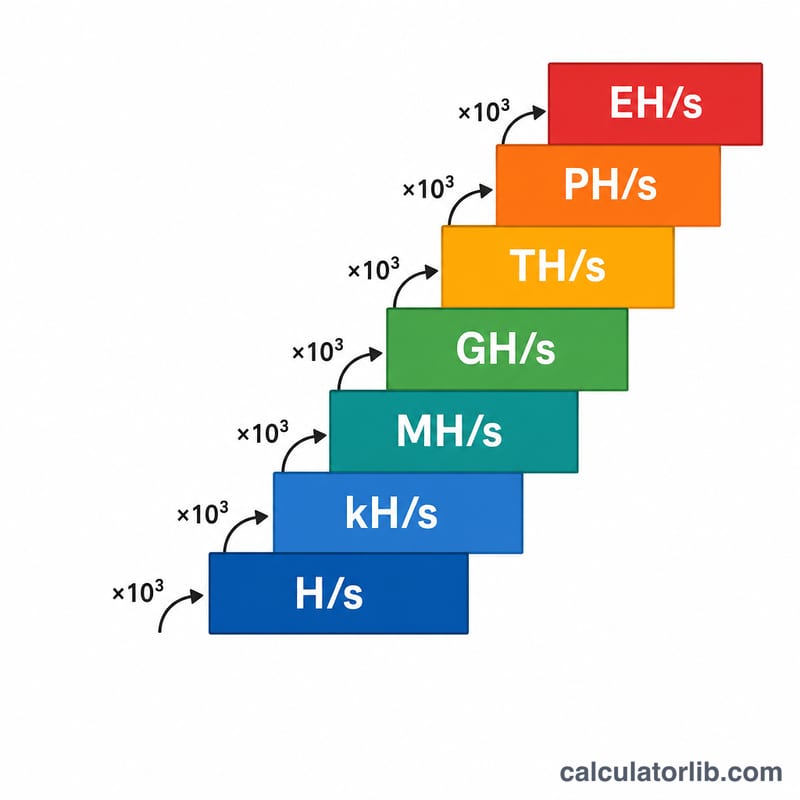
A hash rate measures how many cryptographic hash computations a miner or mining network performs per second. Because modern hardware is so fast, hash rates are expressed in scaled units: hashes per second (H/s), kilohashes (kH/s), megahashes (MH/s), gigahashes (GH/s), terahashes (TH/s), petahashes (PH/s) and exahashes (EH/s). Each step up is 1000× larger. This calculator converts any value from one of these units to another instantly.
How to Use It
Enter your hash rate value, pick the unit it is currently in (From Unit), then choose the unit you want to convert to (To Unit). The calculator returns the equivalent value plus the multiplication factor used. It works for hardware specs (e.g. an ASIC rated at 110 TH/s) as well as whole-network rates reported in EH/s.
The Formula Explained
Each unit has a base-10 exponent: H/s = 0, kH/s = 3, MH/s = 6, GH/s = 9, TH/s = 12, PH/s = 15, EH/s = 18. The conversion is $$\text{target} = \text{value} \times 10^{\left(\text{source\_exp} - \text{target\_exp}\right)}$$ Converting to a smaller unit gives a positive exponent (the number grows); converting to a larger unit gives a negative exponent (the number shrinks).
Worked Example
Convert 1 TH/s to GH/s. The source exponent is 12 and the target exponent is 9, so the factor is \(10^{(12-9)} = 10^3 = 1000\). Therefore $$1 \times 1000 = 1000 \text{ GH/s}$$ To go the other way, 5000 GH/s to TH/s uses \(10^{(9-12)} = 0.001\), giving 5 TH/s.
FAQ
Is the scale decimal or binary? Hash rate prefixes are decimal SI prefixes — each step is exactly 1000×, not 1024×.
What is a typical Bitcoin network hash rate? It is often hundreds of EH/s; converting EH/s to TH/s multiplies by 1,000,000.
Can I convert fractional values? Yes — enter decimals such as 0.5 TH/s, which equals 500 GH/s.