
What is orbital velocity?
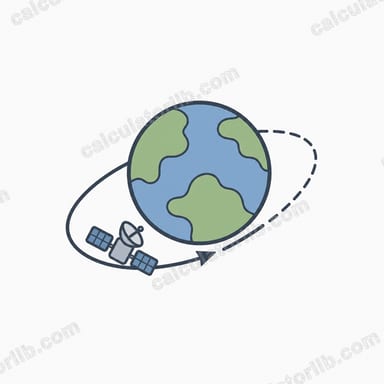
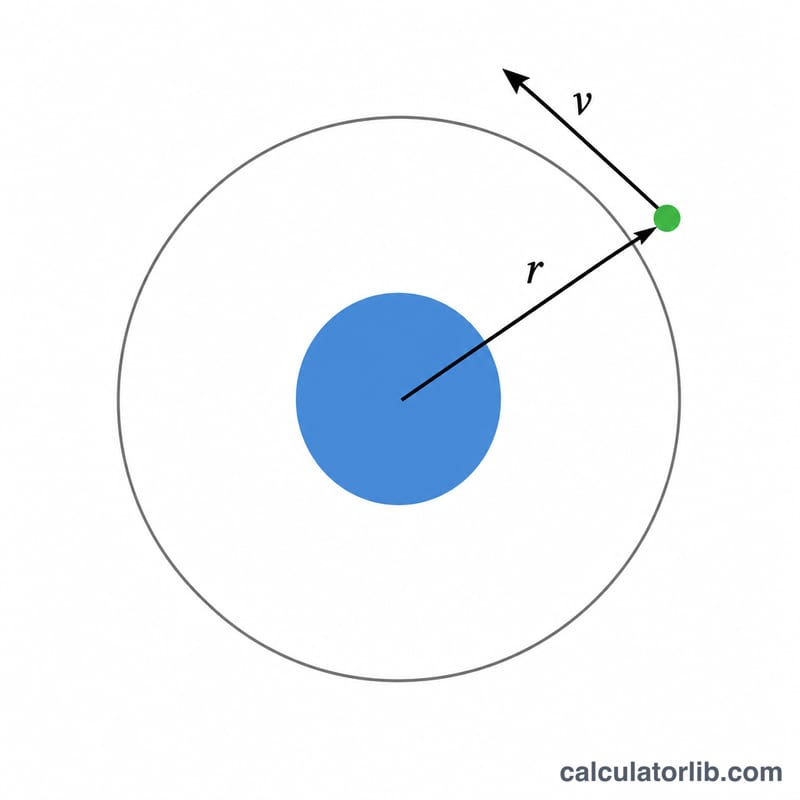
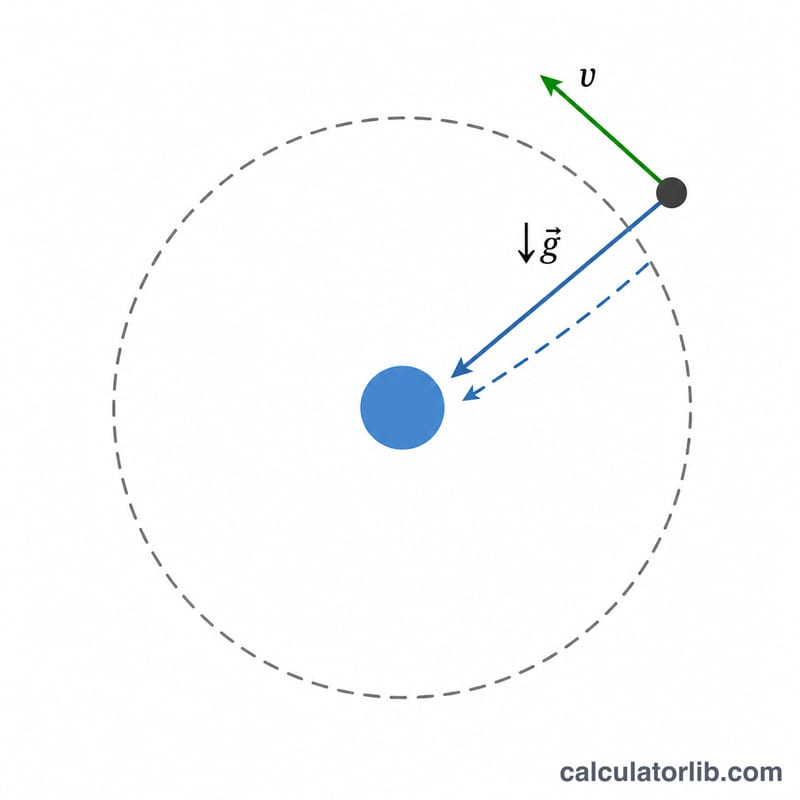
Orbital velocity is the speed an object must travel to maintain a stable circular orbit around a massive body. At this speed, the gravitational pull toward the center is exactly balanced by the satellite's tendency to fly off in a straight line, so it neither falls in nor escapes. This calculator works for any central body — Earth, the Moon, Mars, the Sun, or a custom mass you enter yourself.
How to use it
Pick a central body (or choose "Custom mass" and enter the mass \(M\) in kilograms). Then enter the orbital radius \(r\) in meters, measured from the center of the body — not its surface. For a satellite 400 km above Earth's surface, \(r \approx 6{,}371{,}000 + 400{,}000 = 6{,}771{,}000\) m. The calculator returns the orbital speed in m/s and km/s, plus the orbital period.
The formula explained
The circular orbit equation is $$v = \sqrt{\dfrac{G \cdot M}{r}}$$ where \(G = 6.674\times10^{-11}\ \text{N}\cdot\text{m}^2/\text{kg}^2\) is the universal gravitational constant, \(M\) is the mass of the central body, and \(r\) is the orbital radius. Higher mass means a faster orbit at the same radius; a larger radius means a slower orbit. The orbital period follows from \(T = \dfrac{2\pi r}{v}\).
Worked example
For a low Earth orbit with \(M = 5.972\times10^{24}\) kg and \(r = 6{,}771{,}000\) m: $$v = \sqrt{\dfrac{6.674\text{e-}11 \times 5.972\text{e}24}{6{,}771{,}000}} \approx \sqrt{5.886\times10^{7}} \approx 7{,}672 \ \text{m/s}$$ about 7.67 km/s. The period is \(T = \dfrac{2\pi \times 6{,}771{,}000}{7{,}672} \approx 5{,}545\) seconds, roughly 1.54 hours.
FAQ
Is this for circular orbits only? Yes — for elliptical orbits the speed varies along the path. This gives the constant speed of an ideal circular orbit.
Why use radius from the center? Gravity depends on distance to the center of mass, so altitude above the surface must be added to the body's radius.
What is escape velocity vs orbital velocity? Escape velocity is \(\sqrt{2}\) times the circular orbital velocity at the same radius.