

What This Calculator Does
The EV CO₂ Savings Calculator estimates how much carbon dioxide you avoid emitting each year by driving an electric vehicle (EV) instead of a gasoline car. Unlike simplistic "zero emissions" claims, it accounts for the fact that charging an EV produces indirect emissions that depend on how clean your local electricity grid is. This makes the tool universal — just plug in your own grid carbon intensity for an honest, location-specific comparison.
How to Use It
Enter four values: the distance you drive per year (km), your gasoline car's tailpipe emissions in grams of CO₂ per km, your EV's energy consumption in kWh per km, and your electricity grid's carbon intensity in grams of CO₂ per kWh. The calculator returns the kilograms of CO₂ saved per year, the total emissions of each vehicle, and the percentage reduction.
Typical reference values: a gasoline car emits roughly 150–250 g CO₂/km, an EV uses about 0.15–0.20 kWh/km, and grid intensity ranges from near 0 (hydro/nuclear/renewables) to 800+ g CO₂/kWh (coal-heavy grids).
The Formula Explained
The core equation is:
$$\text{CO}_2\text{ saved (kg)} = \frac{\text{distance} \times \left( \text{gas g/km} - \text{EV kWh/km} \times \text{grid g/kWh} \right)}{1000}$$
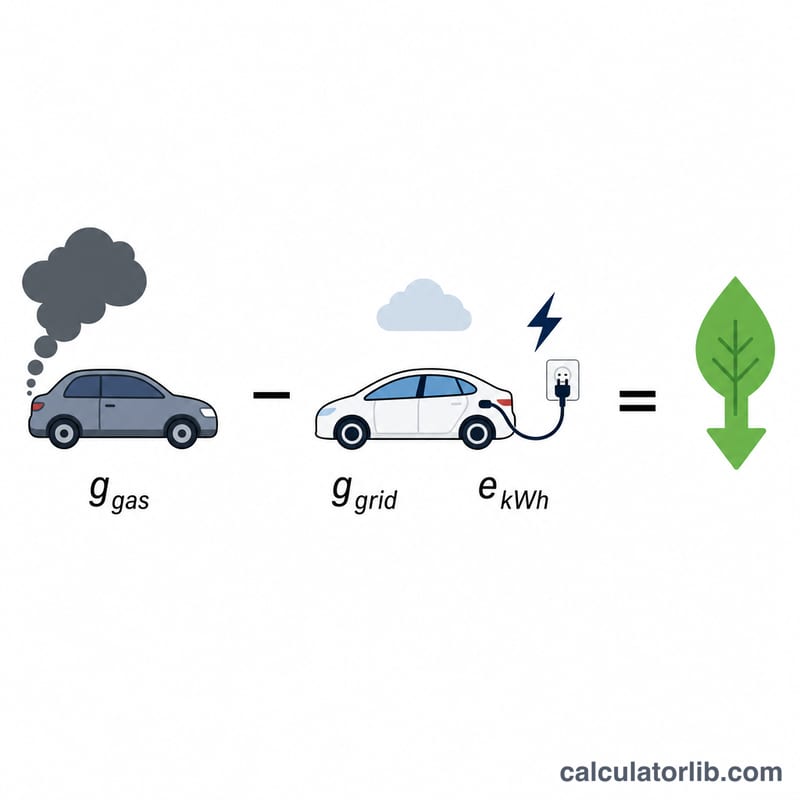
The gasoline car's per-km emissions are direct. The EV's effective per-km emissions equal its energy use multiplied by grid intensity. Subtracting the EV figure from the gas figure gives the per-km saving, multiplied by distance and divided by 1000 to convert grams to kilograms.
Worked Example
Suppose you drive 15,000 km/year, your gas car emits 180 g CO₂/km, your EV uses 0.18 kWh/km, and your grid emits 400 g CO₂/kWh. EV per-km = \(0.18 \times 400 = 72\) g/km. Saving per km = \(180 - 72 = 108\) g/km. Annual saving = $$15{,}000 \times 108 \div 1000 = 1{,}620 \text{ kg CO}_2,$$ a 60% reduction.

FAQ
Why isn't an EV always zero-emission? Charging draws power from the grid, which may burn fossil fuels. Cleaner grids mean larger savings.
Can the result be negative? Yes — on a very dirty grid with an inefficient EV and an efficient gas car, the EV could emit more, giving a negative saving.
Does this include manufacturing emissions? No, it covers operational (driving) emissions only. Lifecycle analysis would add battery production but typically still favors EVs over their lifetime.