
What is the Car CO2 Emissions Calculator?
This tool estimates the carbon dioxide (CO₂) released when you drive a car a given distance. It converts the amount of fuel you burn into the equivalent CO₂ emissions using standard combustion emission factors. The result helps you understand the carbon footprint of a single trip, a daily commute, or an annual mileage total.
How to use it
Choose your fuel type (gasoline or diesel), enter the distance driven in kilometres, and enter your car's fuel economy in kilometres per litre (km/L). The calculator returns total CO₂ in kilograms, the litres of fuel consumed, and the emissions per kilometre in grams.
The formula explained
First the fuel consumed is found by dividing distance by fuel economy: \(\text{litres} = \text{distance} \div (\text{km/L})\). Each litre of fuel emits a fixed mass of CO₂ when burned — about 2.31 kg for gasoline and 2.68 kg for diesel, because diesel is denser and more carbon-rich. Multiplying litres by this factor gives total CO₂:
$$\text{CO}_2 = (\text{distance} \div \text{economy}) \times \text{factor}$$
These are tailpipe (tank-to-wheel) values and do not include emissions from producing or transporting the fuel.
Worked example
Suppose you drive 100 km in a gasoline car that does 12 km/L. Fuel used = \(100 \div 12 = 8.33\) L. CO₂ = \(8.33 \times 2.31 \approx 19.25\) kg. That works out to roughly 192 g of CO₂ per kilometre.
FAQ
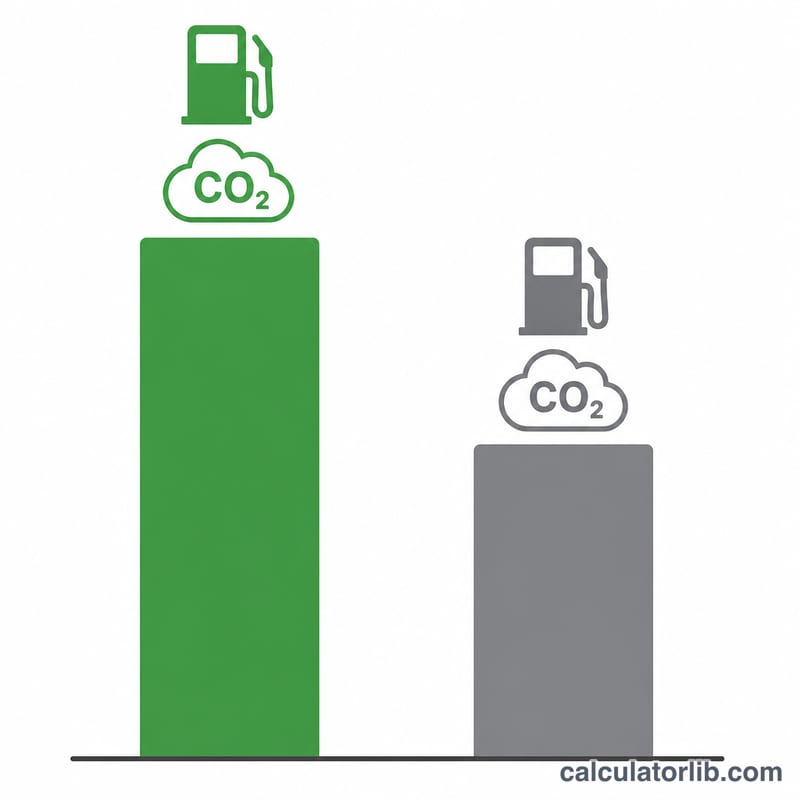
Why is diesel's factor higher than gasoline's? Diesel fuel contains more carbon per litre and is denser, so each litre produces more CO₂ when burned — even though diesel engines are often more efficient.
Does this include manufacturing or electricity? No. It only counts direct tailpipe CO₂ from burning fuel. Well-to-wheel and vehicle production emissions are not included.
My economy is in L/100km — what do I enter? Convert it to km/L by dividing 100 by your L/100km figure (e.g. 8 L/100km = 12.5 km/L).