
What this calculator does
This tool estimates how much carbon dioxide (CO2) an electrical appliance produces, based on its power draw and how many hours a day you run it. The emission-factor presets are for the ten regional Japanese power utilities and use the Japan Ministry of the Environment fiscal-year "actual emission coefficients" in kg-CO2 per kWh. These coefficients change every fiscal year, so the listed values are editable defaults. If you are outside Japan, simply overwrite the Emission Factor field with your own grid's value.
How to use it
Enter the appliance's Power Consumption in watts (check the label or spec sheet), its average Usage Time in hours per day, then pick your power utility — this auto-fills a typical emission factor. You can always type a custom factor (for example your country's published grid intensity). The calculator returns monthly and yearly CO2 estimates.
The formula explained
First convert power from watts to kilowatts by dividing by 1000. Multiply by daily hours to get daily energy in kWh. Multiply daily energy by the emission factor and by the number of days in the period: 30.5 days for a month and 365.25 days (the Julian average year) for a year.
$$\text{CO}_2^{\text{month}} = \frac{\text{Power (W)}}{1000} \times \text{Hours/day} \times 30.5 \times \text{Factor}$$$$\text{CO}_2^{\text{year}} = \frac{\text{Power (W)}}{1000} \times \text{Hours/day} \times 365.25 \times \text{Factor}$$Worked example: a 300 W appliance running 24 h/day on the Tokyo Electric factor 0.441. Daily energy \(= 0.300 \text{ kW} \times 24 = 7.2 \text{ kWh}\). Monthly CO2:
$$7.2 \times 30.5 \times 0.441 = 96.84 \text{ kg-CO2/month}$$Yearly CO2:
$$7.2 \times 365.25 \times 0.441 = 1159.74 \text{ kg-CO2/year}$$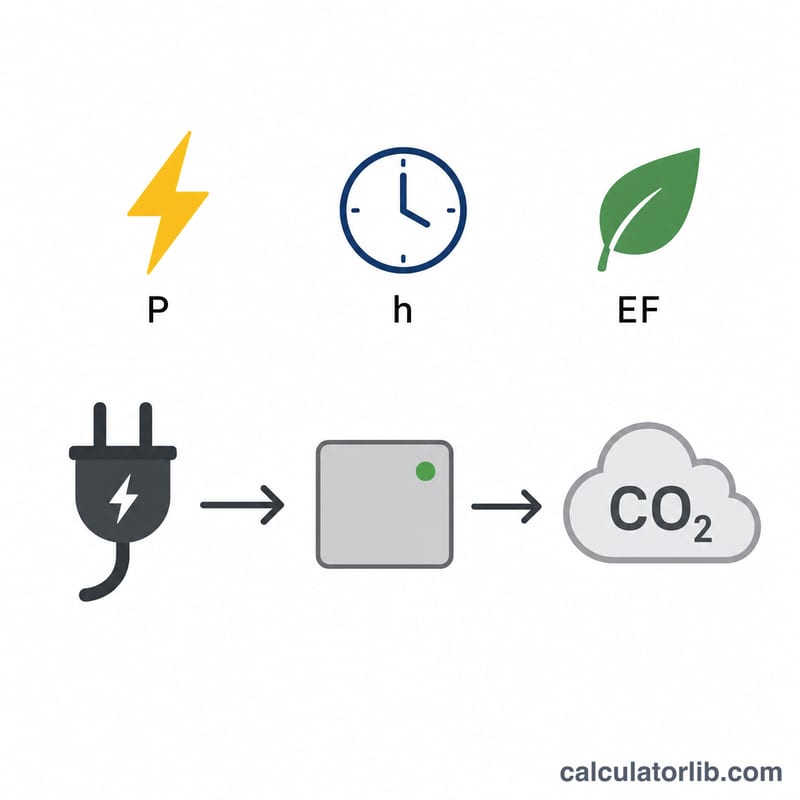
Japanese Utility CO2 Emission Factors
Each of Japan's regional electric power companies reports an actual emission coefficient (実排出係数) measuring how many kilograms of CO₂ are released per kilowatt-hour of electricity delivered. These values reflect each utility's generation mix — utilities relying more on coal and gas have higher coefficients, while those with more nuclear, hydro or renewables have lower ones. Enter the value below into the emissionFactor field (or pick the matching utility preset).
| Utility (region) | Preset value | Coefficient (kg-CO₂/kWh) |
|---|---|---|
| Hokkaido Electric Power | hokkaido | 0.601 |
| Tohoku Electric Power | tohoku | 0.522 |
| TEPCO (Tokyo) | tokyo | 0.441 |
| Chubu Electric Power | chubu | 0.434 |
| Hokuriku Electric Power | hokuriku | 0.514 |
| Kansai Electric Power | kansai | 0.314 |
| Chugoku Electric Power | chugoku | 0.570 |
| Shikoku Electric Power | shikoku | 0.494 |
| Kyushu Electric Power | kyushu | 0.319 |
| Okinawa Electric Power | okinawa | 0.748 |
Source & year: These figures are representative actual emission coefficients published by Japan's Ministry of the Environment / METI in the annual list of emission coefficients by electricity retailer (電気事業者別排出係数). They are recalculated and re-published every fiscal year, so coefficients shift as each utility's fuel mix and nuclear availability change. Always confirm the latest published value for the fiscal year you need, and use the alternative preset to enter your own factor for non-Japanese grids or for a specific green-power plan.
Key Terms Explained
- Power Consumption (W)
- The instantaneous rate at which an appliance draws electrical energy, measured in watts. A device's nameplate or label usually lists its rated power. Power is the power input to the formula; if you only know voltage and current, multiply them (\(P = V \times I\)) to get watts.
- Energy (kWh)
- The total electricity used over time, equal to power (in kilowatts) multiplied by hours of use. One kilowatt-hour is 1000 watts running for one hour. Energy is what your meter records and what utilities bill — the CO₂ calculation first converts watts and hours into kWh, then multiplies by the emission factor.
- Emission Factor / Grid Intensity (kg-CO₂/kWh)
- The mass of carbon dioxide released per kilowatt-hour of electricity generated and delivered on a particular grid. Also called carbon intensity, it varies by region, season and fuel mix. A grid dominated by coal might exceed 0.7 kg-CO₂/kWh, while one rich in nuclear and renewables can fall below 0.3.
- Actual Emission Coefficient (実排出係数)
- Japan's officially published per-utility emission factor based on the electricity actually generated in a fiscal year, including all fuels burned. It is distinct from the adjusted coefficient (調整後排出係数), which credits purchased renewable-energy certificates and offsets. This tool's presets use the actual coefficient for a straightforward physical estimate.
- CO₂ Equivalent (CO₂e)
- A common unit that expresses the warming impact of all greenhouse gases as the amount of CO₂ that would cause the same effect, using each gas's global-warming potential. Grid emission factors are sometimes quoted in CO₂e to capture methane and other gases; for electricity the difference from plain CO₂ is usually small.
FAQ
Why 30.5 and 365.25 days? 30.5 is an even average month and 365.25 is the Julian average year that accounts for leap years, giving smooth long-run estimates.
Where do the utility factors come from? They are illustrative recent "actual emission coefficients" published by the Japan Ministry of the Environment. They are updated yearly, so treat them as starting defaults and edit as needed.
Can I use this outside Japan? Yes. Replace the emission factor with your national or regional grid intensity in kg-CO2/kWh and the math works identically.