
What is the Electrical Energy Calculator?
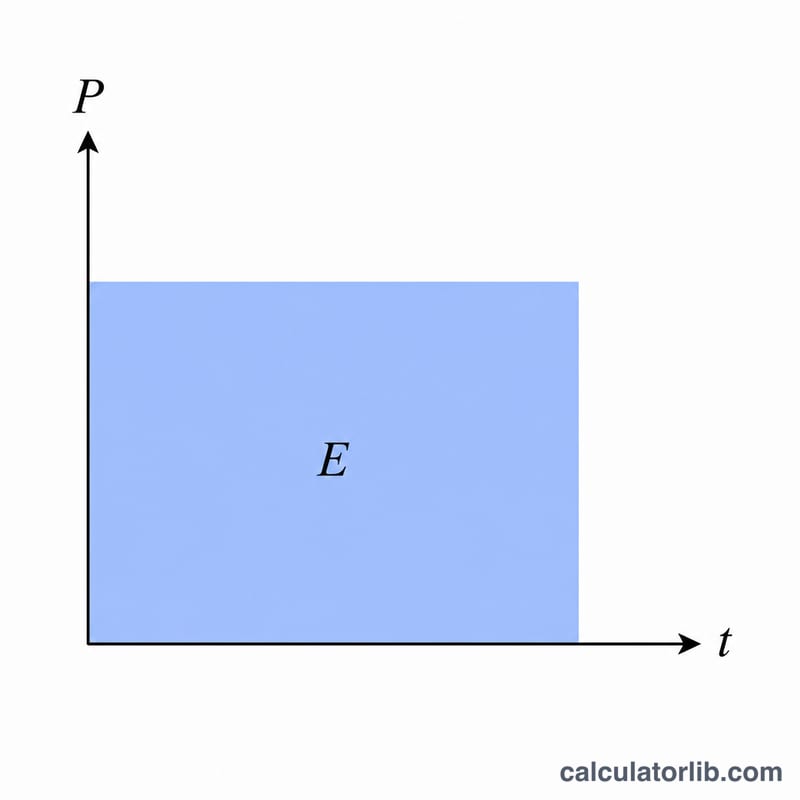
This calculator finds the electrical energy E consumed or delivered by a device using the fundamental relationship \(E = P \cdot t\), where P is power and t is time. It reports the answer in joules (the SI unit of energy), watt-hours, and kilowatt-hours (kWh) — the unit your utility uses to bill electricity. It is a universal physics and engineering tool that applies anywhere.
How to use it
Enter the power rating of your device and choose its unit (watts or kilowatts). Then enter how long it runs and pick the time unit (seconds, minutes, or hours). The calculator converts power to watts and time to seconds internally, multiplies them to get joules, then converts to Wh and kWh.
The formula explained
Power is the rate of energy transfer: one watt equals one joule per second. So over a span of t seconds, a device drawing P watts uses the following joules:
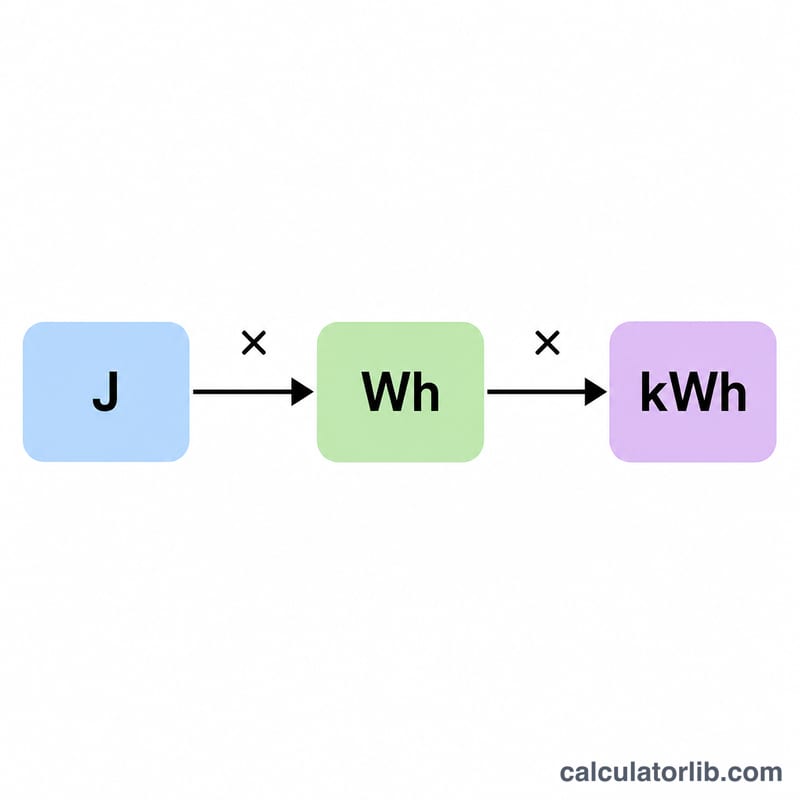
$$E = P \times t$$Because a joule is small, energy is often expressed in kilowatt-hours: \(1 \text{ kWh} = 1000 \text{ W} \times 3600 \text{ s} = 3{,}600{,}000 \text{ J}\). Dividing joules by 3,600,000 gives kWh.
Worked example
A 2 kW electric heater runs for 3 hours. Convert: \(P = 2000 \text{ W}\), \(t = 3 \times 3600 = 10{,}800 \text{ s}\). Energy:
$$E = 2000 \times 10{,}800 = 21{,}600{,}000 \text{ J}$$In kWh that is \(21{,}600{,}000 \div 3{,}600{,}000 = 6 \text{ kWh}\) — which also equals \(2 \text{ kW} \times 3 \text{ h}\). At a typical rate, that lets you estimate the running cost directly.
FAQ
What units does it output? Joules (J), watt-hours (Wh), and kilowatt-hours (kWh).
How do I get cost? Multiply the kWh result by your electricity price per kWh.
Does this work for any device? Yes, as long as power stays roughly constant. For variable loads, use the average power or sum energy over intervals.