
What Is the Spring-Mass Period Calculator?
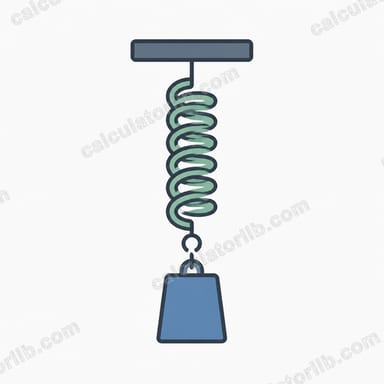
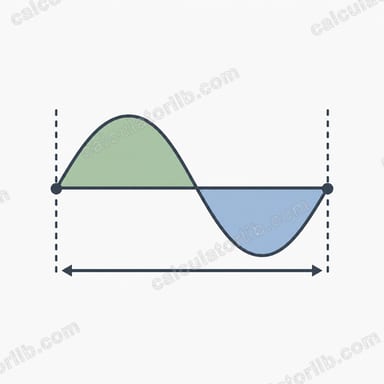
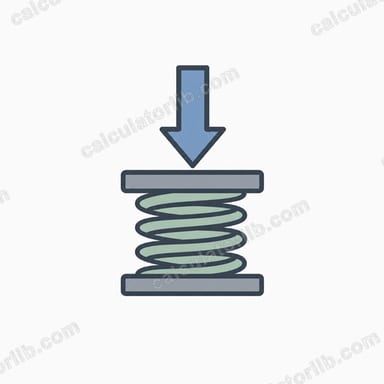
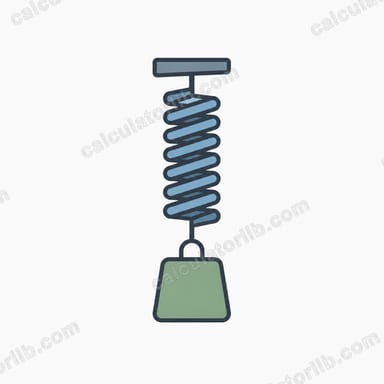
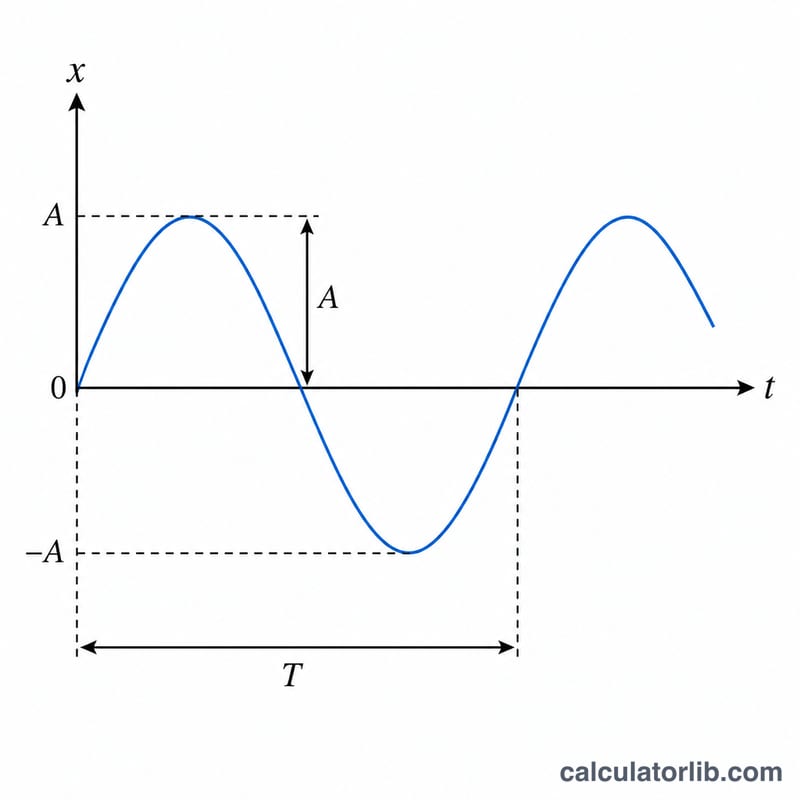
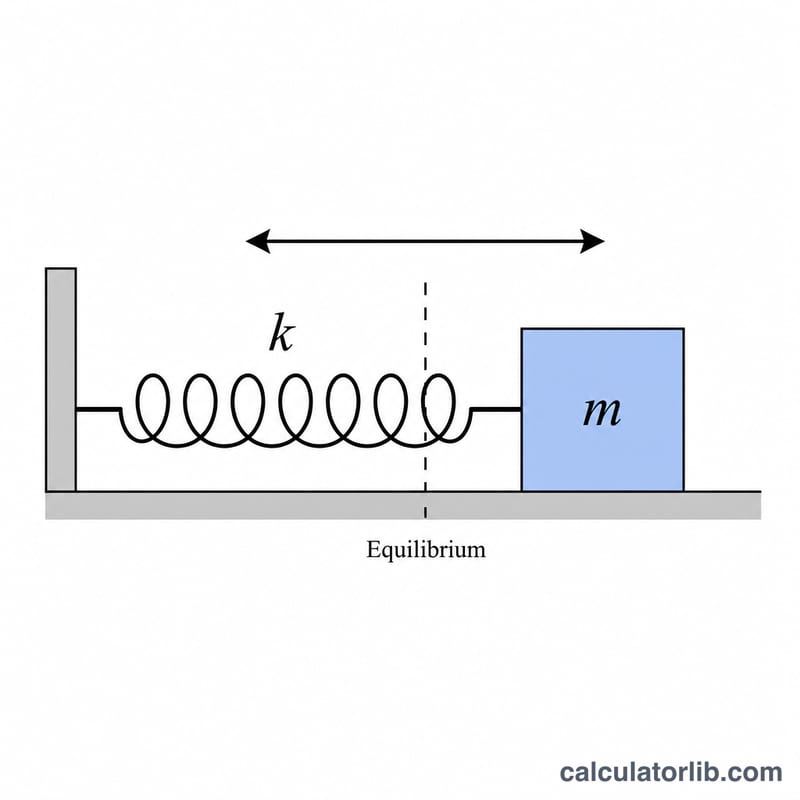
This tool computes how long it takes a mass attached to an ideal spring to complete one full oscillation — its period T. A mass on a spring is the classic example of simple harmonic motion (SHM), where the restoring force is proportional to displacement (Hooke's law, \(F = -kx\)). Enter the mass and the spring constant to get the period, the frequency, and the angular frequency.
How to Use It
Enter the mass m in kilograms and the spring constant k in newtons per metre (N/m). Click calculate to see the period in seconds, the frequency in hertz, and the angular frequency in radians per second. The result assumes an ideal, massless spring with no damping or friction, and the period does not depend on the amplitude of the oscillation.
The Formula Explained
The governing equation is:
$$T = 2\pi \sqrt{\dfrac{m}{k}}$$
A larger mass makes the system sluggish, increasing the period. A stiffer spring (larger \(k\)) pulls harder for a given displacement, shortening the period. Frequency is simply the inverse, \(f = 1/T\), and angular frequency is \(\omega = \sqrt{k/m} = 2\pi f\).
Worked Example
Suppose a 0.5 kg mass hangs from a spring with \(k = 20\) N/m. Then $$T = 2\pi \sqrt{\dfrac{0.5}{20}} = 2\pi \sqrt{0.025} = 2\pi \cdot 0.15811 \approx 0.9935 \text{ s}.$$ The frequency is \(f = 1/0.9935 \approx 1.0066\) Hz, and \(\omega = \sqrt{20/0.5} = \sqrt{40} \approx 6.3246\) rad/s.
FAQ
Does amplitude affect the period? No. For an ideal spring obeying Hooke's law, the period is independent of how far you stretch it — this is a hallmark of SHM.
Does gravity change the period of a vertical spring? No. Gravity only shifts the equilibrium position; the oscillation period stays \(T = 2\pi\sqrt{m/k}\).
What units should I use? Use SI units: mass in kilograms and spring constant in N/m, which gives the period in seconds.