
What Is the Continuity Equation?
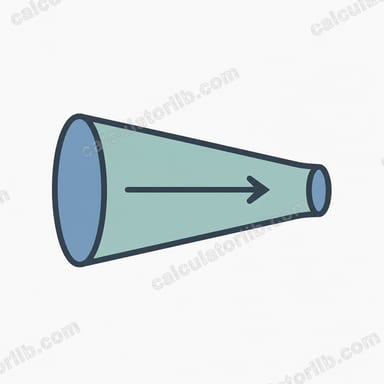
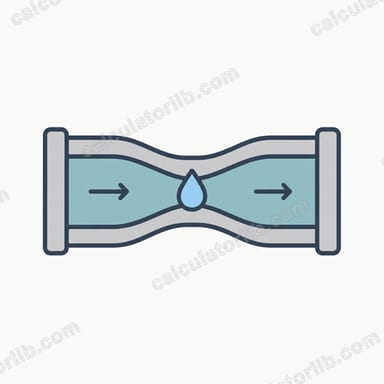
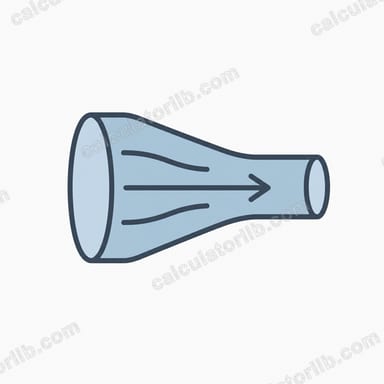
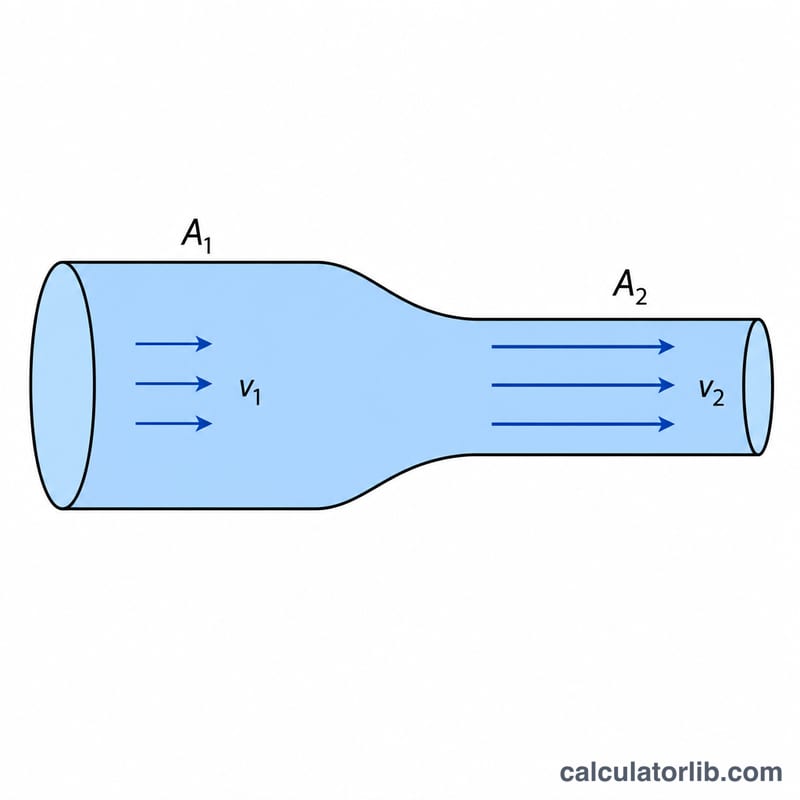
The continuity equation describes the conservation of mass for an incompressible fluid flowing steadily through a pipe or duct. It states that the volumetric flow rate entering a section must equal the flow rate leaving it: \(A_1 v_1 = A_2 v_2\). When a pipe narrows, the fluid must speed up to carry the same volume; when it widens, the fluid slows down. This calculator solves for the downstream velocity \(v_2\) and the volumetric flow rate \(Q\).
How to Use This Calculator
Enter the cross-sectional area at the first point (\(A_1\)) in square metres, the fluid velocity there (\(v_1\)) in metres per second, and the cross-sectional area at the second point (\(A_2\)). The tool computes the flow rate \(Q = A_1 \cdot v_1\) and the velocity at the second section $$v_2 = \frac{Q}{A_2}$$ All inputs use consistent SI units, so the result is in metres per second.
The Formula Explained
Starting from \(A_1 v_1 = A_2 v_2\), we first compute the volumetric flow rate \(Q = A_1 \cdot v_1\) (units \(\text{m}^3/\text{s}\)). Because mass is conserved and the fluid is incompressible, this same \(Q\) passes through section 2, so \(v_2 = Q / A_2\). A smaller \(A_2\) yields a larger \(v_2\), which explains why water speeds up at the nozzle of a hose.
Worked Example
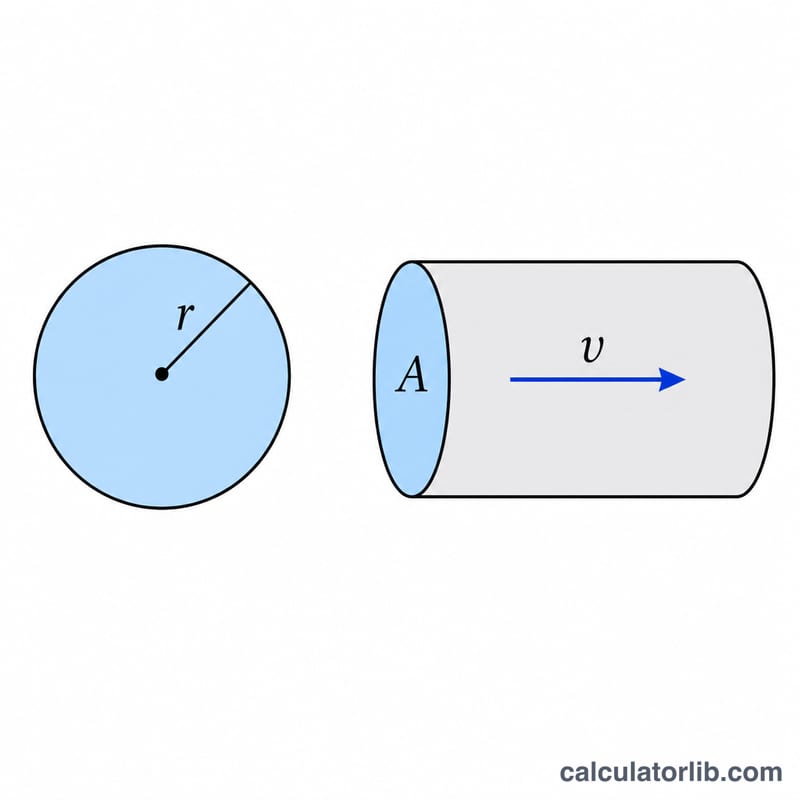
Suppose \(A_1 = 0.05\ \text{m}^2\), \(v_1 = 4\ \text{m/s}\), and \(A_2 = 0.02\ \text{m}^2\). The flow rate is $$Q = 0.05 \times 4 = 0.2\ \text{m}^3/\text{s}$$ The downstream velocity is $$v_2 = \frac{0.2}{0.02} = 10\ \text{m/s}$$ As the pipe area shrinks to 40% of its original size, the velocity rises by 2.5×.
FAQ
Does this work for gases? The simple form \(A_1 v_1 = A_2 v_2\) assumes incompressible flow, which is a good approximation for liquids and low-speed gases. For high-speed compressible flow, density changes must be included.
What units should I use? Use consistent SI units: areas in \(\text{m}^2\) and velocities in \(\text{m/s}\), giving \(Q\) in \(\text{m}^3/\text{s}\). You can use any unit system as long as it is consistent.
Can I find \(A_2\) instead? This version solves for \(v_2\). To find an area, rearrange \(A_2 = A_1 v_1 / v_2\).