
What this calculator does
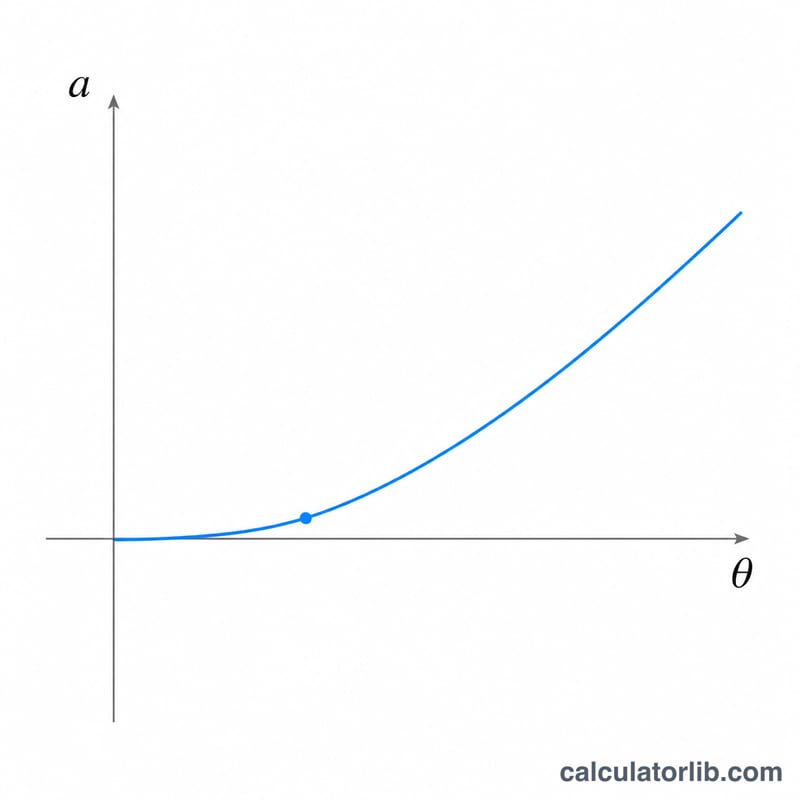
This tool computes the acceleration of a block sliding down a rough inclined plane. Given the incline angle θ, the coefficient of kinetic friction μ between the block and surface, and the gravitational acceleration g, it returns the net acceleration along the slope using \(a = \text{g}(\sin\theta - \mu\cos\theta)\). It is a universal physics tool valid in any consistent unit system (SI metres per second squared by default).
How to use it
Enter the incline angle in degrees (0–90), the kinetic friction coefficient (typically 0.1–0.8 for common surfaces), and the gravitational acceleration (9.81 m/s² on Earth). The calculator reports the acceleration, the driving gravity component \(\text{g}\cdot\sin\theta\), the resisting friction component \(\mu\cdot\text{g}\cdot\cos\theta\), and whether the block will actually start to slide.
The formula explained
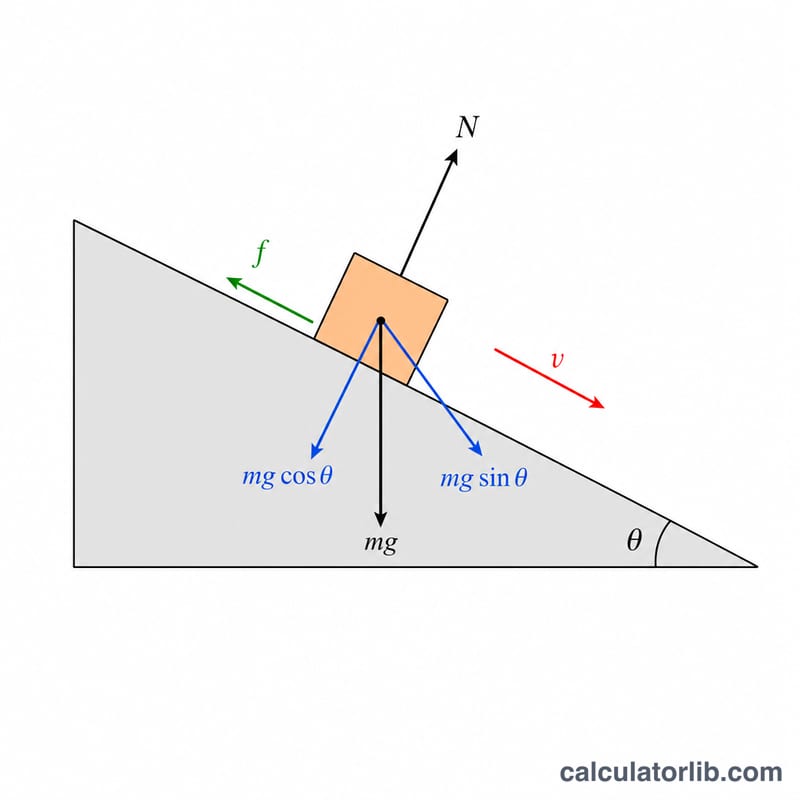
Two forces act along the slope: gravity pulls the block downhill with component \(\text{g}\cdot\sin\theta\), while kinetic friction resists motion with magnitude \(\mu\cdot\text{g}\cdot\cos\theta\) (the normal force is \(m\text{g}\cdot\cos\theta\), so friction per unit mass is \(\mu\cdot\text{g}\cdot\cos\theta\)). The mass cancels, leaving $$a = \text{g}\left(\sin\theta - \mu\cos\theta\right)$$ If this is positive the block accelerates downhill; if zero or negative, friction balances or overcomes gravity and the block stays put or decelerates. Sliding begins when \(\tan\theta > \mu\).
Worked example
For θ = 30°, μ = 0.2, g = 9.81: \(\sin 30° = 0.5\), \(\cos 30° \approx 0.8660\). Gravity component = \(9.81 \times 0.5 = 4.905 \text{ m/s}^2\). Friction component = \(0.2 \times 9.81 \times 0.8660 \approx 1.699 \text{ m/s}^2\). Acceleration $$a = 4.905 - 1.699 \approx 3.206 \text{ m/s}^2$$ Since this is positive, the block slides.
FAQ
What if the result is negative? A negative value means friction exceeds the gravity component — a moving block would decelerate, and a stationary block would not start sliding.
Does mass matter? No. Mass cancels out, so acceleration depends only on angle, friction, and gravity.
What's the difference between static and kinetic friction here? This uses kinetic (sliding) friction. Whether motion starts at all depends on static friction, but once moving, kinetic friction governs the acceleration.