What is the Weighted vs Unweighted GPA Calculator?
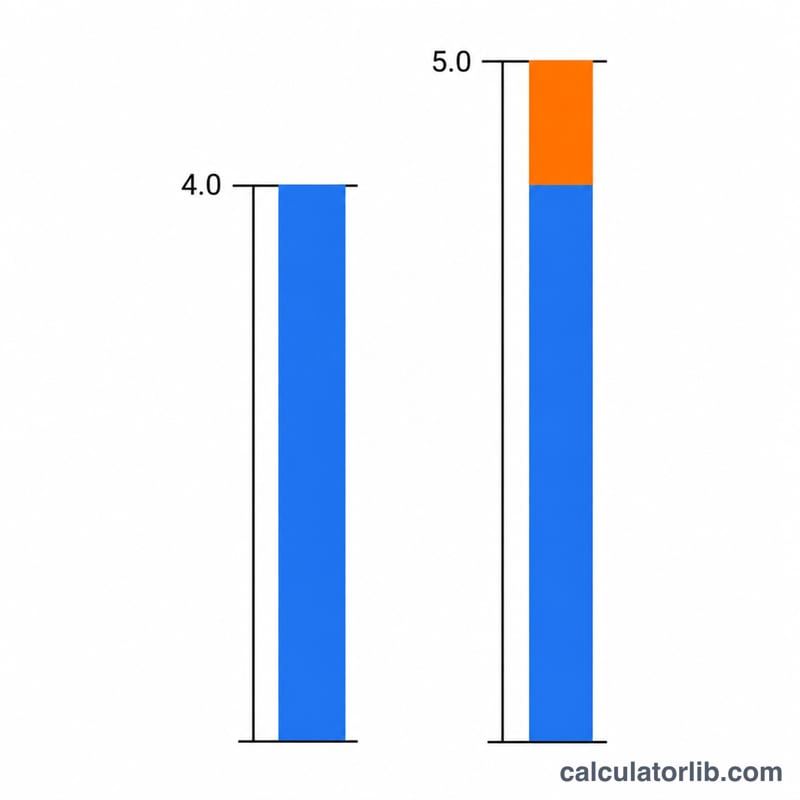
This tool compares two ways of summarizing your academic performance. An unweighted GPA averages your course grade points on a standard scale (typically 0–4.0) without regard to course difficulty. A weighted GPA adds bonus points for harder classes — such as Honors, AP, or IB — so that challenging coursework is rewarded. Seeing both side by side helps you understand how rigor affects your transcript.
How to use it
Enter your grade points for each course as a comma-separated list (for example 4,3.7,3.3). Then enter the bonus points for each corresponding course in the same order (for example 1,0.5,0 — a full point for an AP class, half a point for Honors, zero for a regular class). The calculator returns your unweighted GPA, your weighted GPA, and the difference between them.
The formula explained
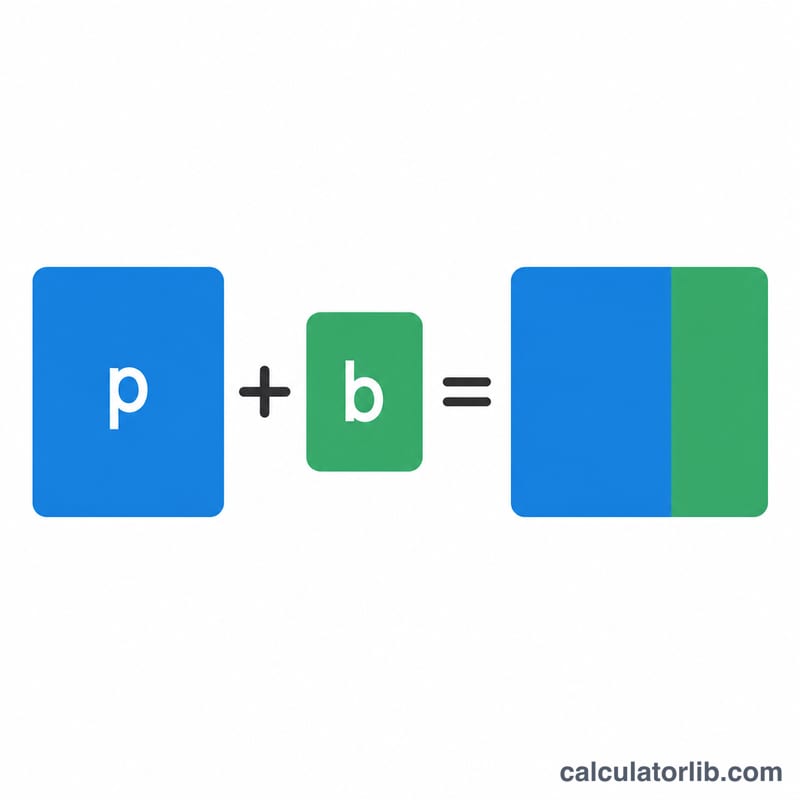
For n courses with base grade points pi and bonus points bi:
$$\text{Unweighted} = \frac{\sum p_i}{n} \qquad \text{Weighted} = \frac{\sum (p_i + b_i)}{n}$$ The difference is simply the average bonus per course.
Worked example
Suppose you took three courses with grade points 4.0, 3.7, and 3.3, earning bonuses of 1.0, 0.5, and 0.0. The base sum is 11.0, so the unweighted GPA is $$\frac{11.0}{3} = 3.67$$ Adding bonuses gives 12.5, so the weighted GPA is $$\frac{12.5}{3} = 4.17$$ The difference is \(0.50\) — the average bonus across your courses.
Standard Letter Grade to Grade Point Scale
Most US high schools and colleges convert letter grades to points on a 4.0 scale. This is the usual unweighted scale. The percentage ranges below are typical, but schools vary: some use a 93–100 cutoff for an A, others 90–100, and some do not give an A+ any extra value. Always check your school's grading policy. Use these points as the values for the "grades" field.
| Letter Grade | Grade Points (4.0 scale) | Typical Percentage Range |
|---|---|---|
| A+ | 4.0 (some schools use 4.3) | 97–100% |
| A | 4.0 | 93–96% |
| A- | 3.7 | 90–92% |
| B+ | 3.3 | 87–89% |
| B | 3.0 | 83–86% |
| B- | 2.7 | 80–82% |
| C+ | 2.3 | 77–79% |
| C | 2.0 | 73–76% |
| C- | 1.7 | 70–72% |
| D+ | 1.3 | 67–69% |
| D | 1.0 | 63–66% |
| D- | 0.7 | 60–62% |
| F | 0.0 | Below 60% |
Typical Weighting Bonus by Course Level
Many US schools add bonus points to the grade points of more demanding courses to compute a weighted GPA. The values below are commonly used, but they are not a universal standard. Bonus values are set by each school or district, so check your school's policy. Some schools use no weighting at all, and some use different bonuses for different grades. Use these numbers as the values for the "bonuses" field, one per course and in the same order as your grades.
| Course Type | Commonly Used Bonus Points |
|---|---|
| Regular / Standard / College Prep | 0 |
| Honors | 0.5 |
| Advanced / Accelerated | 0.5 (some schools use 1.0) |
| AP (Advanced Placement) | 1.0 |
| IB HL (Higher Level) | 1.0 |
| IB SL (Standard Level) | 0.5 (some schools use 1.0 or 0) |
| Dual Enrollment | 1.0 (some schools use 0.5 or 0) |
Because the weighted GPA is the unweighted GPA plus the total bonus divided by the number of courses, one AP course with a 1.0 bonus in a 5-course schedule raises the GPA by \(1.0 / 5 = 0.2\).
FAQ
Why can a weighted GPA exceed 4.0? Because bonus points for Honors and AP classes push the average above the standard 4.0 ceiling.
Which GPA do colleges use? It varies — many recalculate using their own scale, but most consider both your GPA and the rigor of your courses.
What if a course has no bonus? Enter 0 for that position so the lists stay aligned.