
What this calculator does
The Cumulative GPA Calculator updates your overall grade point average after a new term or set of courses. Instead of recalculating every grade you have ever earned, it takes the GPA you already hold, combines it with the GPA from your latest classes, and weights both by their credit hours. It uses the standard credit-weighted method common in the United States, where GPA typically runs on a 4.0 scale, though the same math works for any scale your school uses.
The four inputs explained
- Current GPA – your existing cumulative GPA before adding new courses (e.g. 3.40).
- Total Credits Completed – the number of credit hours that GPA is based on (e.g. 60).
- New Course GPA – the GPA earned in your newest set of courses (e.g. 3.80).
- New Course Credits – the credit hours those new courses are worth (e.g. 15).
The formula
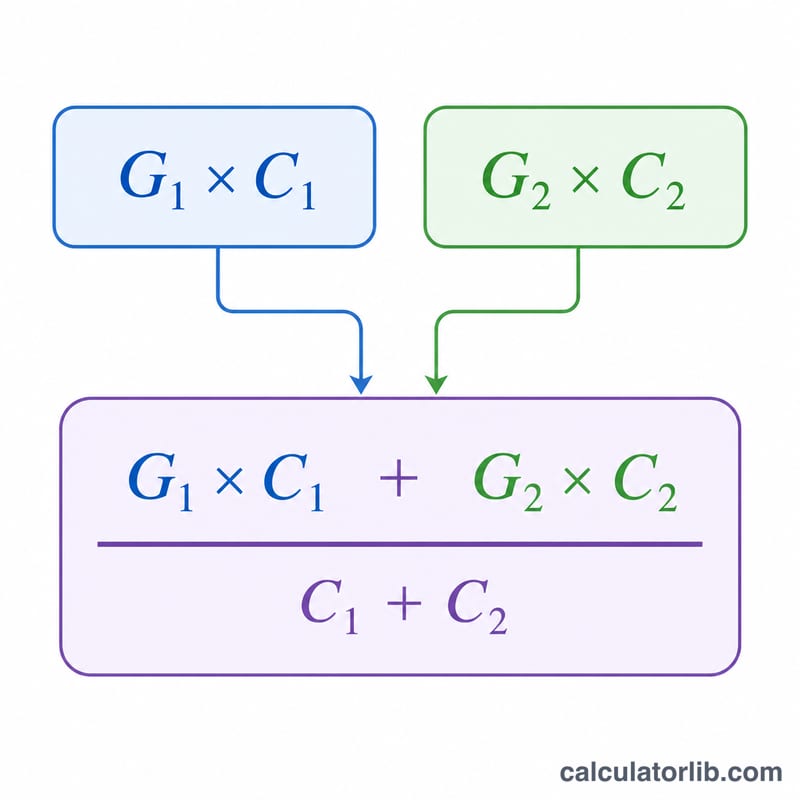
Behind the scenes the calculator converts GPAs into quality points (GPA × credits), adds them together, and divides by the total credits:
$$\text{Cumulative GPA} = \frac{\text{Current GPA} \times \text{Total Credits} + \text{New GPA} \times \text{New Credits}}{\text{Total Credits} + \text{New Credits}}$$
This works because GPA is simply quality points per credit. Multiplying restores the original points, and dividing by the combined credits gives the new weighted average — so a heavy course load moves your GPA more than a light one.
Worked example
Suppose your current GPA is 3.40 over 60 credits, and you finish a term with a 3.80 GPA across 15 new credits.
- Existing quality points: \(3.40 \times 60 = 204\)
- New quality points: \(3.80 \times 15 = 57\)
- Total quality points: \(204 + 57 = 261\)
- Total credits: \(60 + 15 = 75\)
- Cumulative GPA: \(261 \div 75 = \textbf{3.48}\)
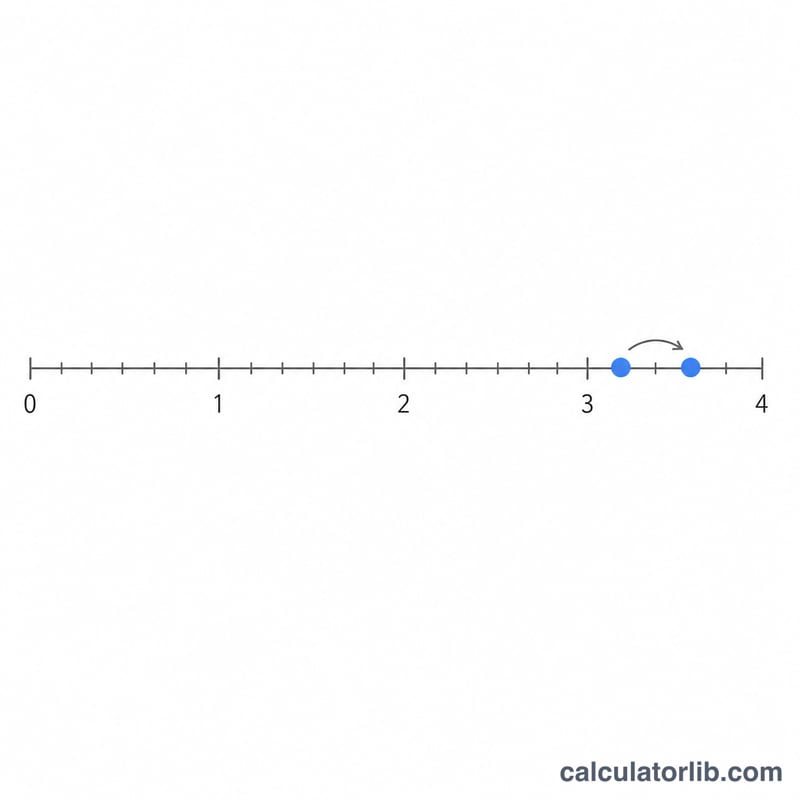
Your overall GPA rises from 3.40 to 3.48 — a modest jump, because the new 15 credits are small next to the 60 already on record.
Frequently asked questions
Why didn't my GPA rise more after a great term? Each credit you have already completed carries equal weight. The more credits behind you, the harder it is for a single term to shift the average — which is why early grades have outsized impact.
What if I don't know my total credits? Check your transcript or student portal; most schools list earned credit hours alongside your cumulative GPA. Accurate credit totals are essential, since they weight the whole calculation.
Can I use this on a non-4.0 scale? Yes. The formula is scale-independent. As long as your Current GPA and New GPA use the same scale, the result will be valid for that scale.