
What This Calculator Does
When you retake a course under a grade replacement policy, the original grade's quality points are removed from your record and replaced by the new grade's points — while the total credit hours stay the same. This calculator estimates your updated cumulative GPA on a standard 4.0 scale so you can see exactly how much a retake will move your numbers.
How to Use It
Enter your current cumulative GPA, your total credits earned, the credit hours of the class you are retaking, the old grade you originally received (as grade points, e.g. 1.0 for a D), and the new grade you expect (e.g. 4.0 for an A). The tool returns your projected GPA and the point change.
The Formula Explained
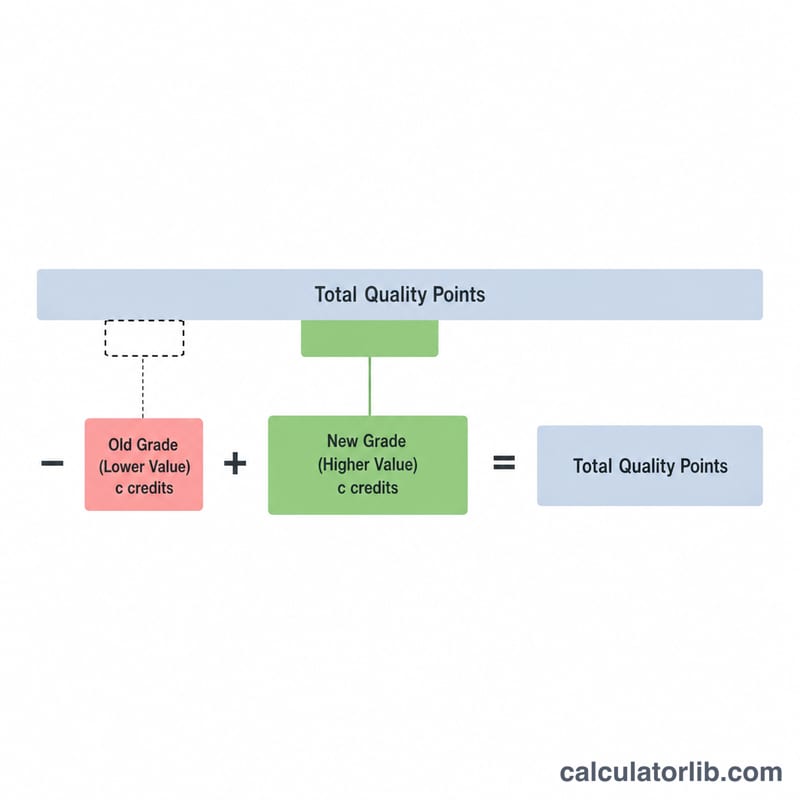
Your current quality points are GPA \(\times\) Total Credits. We subtract the old grade's contribution (Old \(\times\) class credits) and add the new grade's contribution (New \(\times\) class credits), then divide by the same total credits:
$$\text{New GPA} = \frac{(\text{GPA} \times C_t) - (G_{old} \times C_c) + (G_{new} \times C_c)}{C_t}$$
Because grade replacement keeps the total credit count unchanged, only the quality points shift.
Worked Example
Suppose your GPA is 2.80 across 60 credits, and you retake a 3-credit class where you originally earned a D (1.0) and now expect an A (4.0).
Total points = \(2.80 \times 60 = 168\). Adjusted = \(168 - (1.0 \times 3) + (4.0 \times 3) = 168 - 3 + 12 = 177\). New GPA = \(177 \div 60 = \) 2.95, a gain of +0.15.
FAQ
Does this work for grade averaging policies? No — this assumes grade replacement. Under averaging, both attempts count and total credits increase; use a different method.
What grade points should I use? A=4.0, B=3.0, C=2.0, D=1.0, F=0.0. Adjust for plus/minus scales (e.g. B+ = 3.3) if your school uses them.
Is the result official? No. It is an estimate. Always confirm your school's specific retake and GPA rules with your registrar.