
What is the Acceleration Calculator?
This tool computes acceleration — the rate at which an object's velocity changes over time. Given an initial velocity, a final velocity, and the time over which the change occurs, it returns the average acceleration in metres per second squared (m/s²). It works for any consistent unit system, but the default labels assume SI units (m/s and seconds).
How to use it
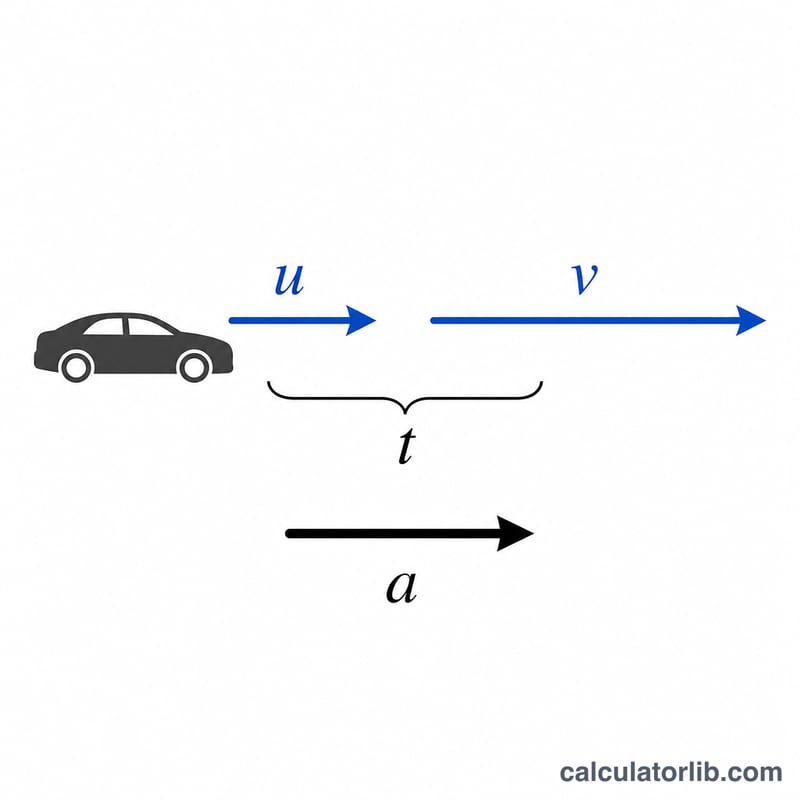
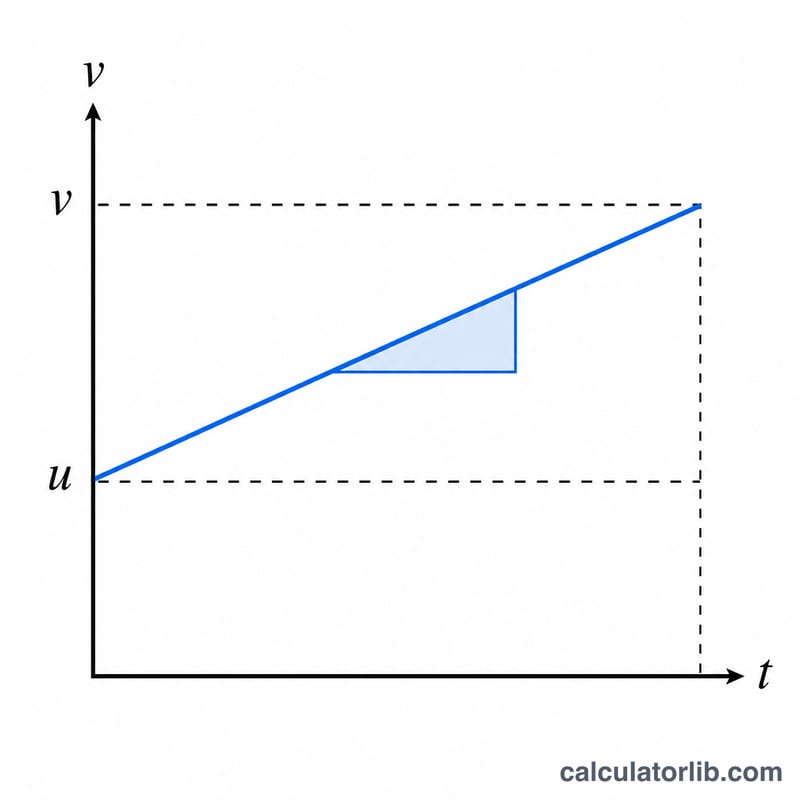
Enter the initial velocity (\(u\)), the final velocity (\(v\)), and the time taken (\(t\)). Click calculate to see the acceleration along with the change in velocity (\(\Delta v\)) and time interval. A positive result means the object is speeding up; a negative result means it is slowing down (deceleration).
The formula explained
Acceleration is defined as:
$$a = \frac{v - u}{t}$$
where \(a\) is acceleration, \(v\) is final velocity, \(u\) is initial velocity, and \(t\) is the elapsed time. The numerator (\(v - u\)) is the change in velocity, often written \(\Delta v\), and \(t\) is the change in time, \(\Delta t\) — so acceleration is simply \(\Delta v \div \Delta t\).
Worked example
A car accelerates from 10 m/s to 30 m/s in 4 seconds. The change in velocity is \(30 - 10 = 20\) m/s. Dividing by the time, $$a = \frac{20}{4} = 5 \ \text{m/s}^2.$$ The car gains 5 metres per second of speed every second.
Typical Acceleration Values
Acceleration is the rate of change of velocity, expressed in metres per second squared (m/s²). The standard acceleration due to gravity on Earth, denoted \(g\), is defined as exactly 9.80665 m/s² (commonly rounded to 9.81 m/s²). The values below place common accelerations in context.
| Situation | Approximate acceleration (m/s²) | In units of g |
|---|---|---|
| Standard gravity (g) | 9.81 | 1.0 |
| Free-fall near Earth's surface (no drag) | 9.81 | 1.0 |
| Typical car, 0–60 mph in ~7 s | 3.8 | 0.39 |
| Sports car, 0–60 mph in ~3 s | 8.9 | 0.91 |
| 100 m sprinter, initial burst | 3–4 | 0.3–0.4 |
| Commercial jet during takeoff roll | 1.5–3 | 0.15–0.3 |
| Gravity on the Moon | 1.62 | 0.165 |
| Gravity on Mars | 3.71 | 0.38 |
| Gravity on Jupiter (cloud tops) | 24.79 | 2.53 |
| Gravity on the Sun (surface) | 274 | 27.9 |
For reference, a car accelerating from rest to 60 mph (26.82 m/s) in 7.0 s has an acceleration of 3.83 m/s², matching the typical car row above.
Velocity & Acceleration Unit Conversions
Because the formula \(a = (v - u)/t\) expects velocities in m/s and time in seconds, you often need to convert speeds first. Multiply your value by the factor shown to obtain the target unit.
| From | To | Multiply by | Example |
|---|---|---|---|
| km/h | m/s | 0.27778 (i.e. ÷ 3.6) | 100 km/h = 27.78 m/s |
| mph | m/s | 0.44704 | 60 mph = 26.82 m/s |
| m/s | km/h | 3.6 | 10 m/s = 36 km/h |
| ft/s | m/s | 0.3048 | 30 ft/s = 9.14 m/s |
| m/s² | g | 0.10197 (i.e. ÷ 9.81) | 4.9 m/s² = 0.5 g |
| g | m/s² | 9.80665 | 2 g = 19.61 m/s² |
| ft/s² | m/s² | 0.3048 | 10 ft/s² = 3.05 m/s² |
| km/h per second | m/s² | 0.27778 | 36 km/h/s = 10 m/s² |
Tip: to convert km/h to m/s quickly, divide by 3.6; to go the other way, multiply by 3.6.
More Worked Examples
Example 1 — Deceleration (negative result)
A cyclist slows from \(u = 12\) m/s to \(v = 4\) m/s in \(t = 5\) s. Substituting into the formula:
$$a = \frac{v - u}{t} = \frac{4 - 12}{5} = \frac{-8}{5} = -1.6\ \text{m/s}^2$$The result is -1.6 m/s². The negative sign indicates deceleration — the velocity is decreasing.
Example 2 — Starting from rest (u = 0)
A train accelerates from rest, so \(u = 0\) m/s, reaching \(v = 30\) m/s in \(t = 12\) s:
$$a = \frac{v - u}{t} = \frac{30 - 0}{12} = \frac{30}{12} = 2.5\ \text{m/s}^2$$The acceleration is 2.5 m/s².
Example 3 — Requiring a km/h → m/s conversion
A car accelerates from 0 to 108 km/h in 8 seconds. First convert the final velocity to m/s by dividing by 3.6:
$$v = \frac{108}{3.6} = 30\ \text{m/s}$$With \(u = 0\) m/s, \(v = 30\) m/s and \(t = 8\) s:
$$a = \frac{v - u}{t} = \frac{30 - 0}{8} = 3.75\ \text{m/s}^2$$The acceleration is 3.75 m/s². Always convert speeds to m/s before applying the formula.
FAQ
What does a negative acceleration mean? It indicates deceleration — the object is slowing down because the final velocity is lower than the initial velocity.
What units should I use? For an answer in m/s², use velocity in m/s and time in seconds. The formula works with any consistent units (e.g. km/h and hours give km/h²).
Is this average or instantaneous acceleration? This computes average acceleration over the time interval. Instantaneous acceleration requires calculus (the derivative of velocity).