
What is Average Acceleration?
Average acceleration measures how quickly an object changes its velocity over a period of time. Unlike instantaneous acceleration, which is the value at a single moment, average acceleration looks at the overall change between two points. It is a vector quantity, meaning it has both magnitude and direction, and is expressed in metres per second squared (m/s²).
How to Use This Calculator
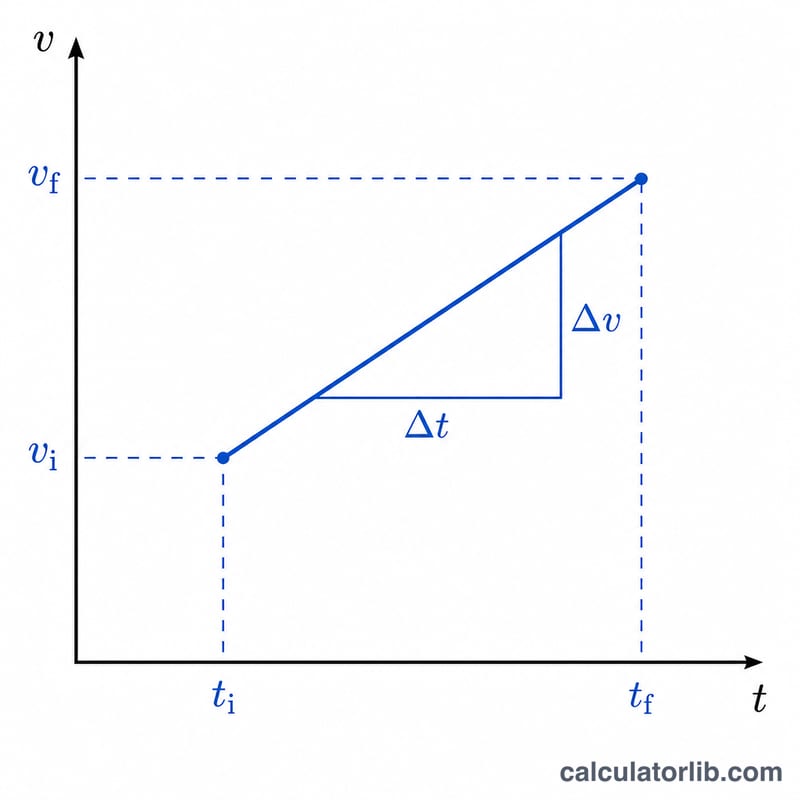
Enter the initial velocity (\(v_i\)), the final velocity (\(v_f\)), and the time interval (\(\Delta t\)) over which the change occurred. The calculator subtracts the initial velocity from the final velocity to get the change in velocity, then divides by the time interval to return the average acceleration. A positive result means the object sped up in the positive direction; a negative result indicates deceleration or acceleration in the opposite direction.
The Formula Explained
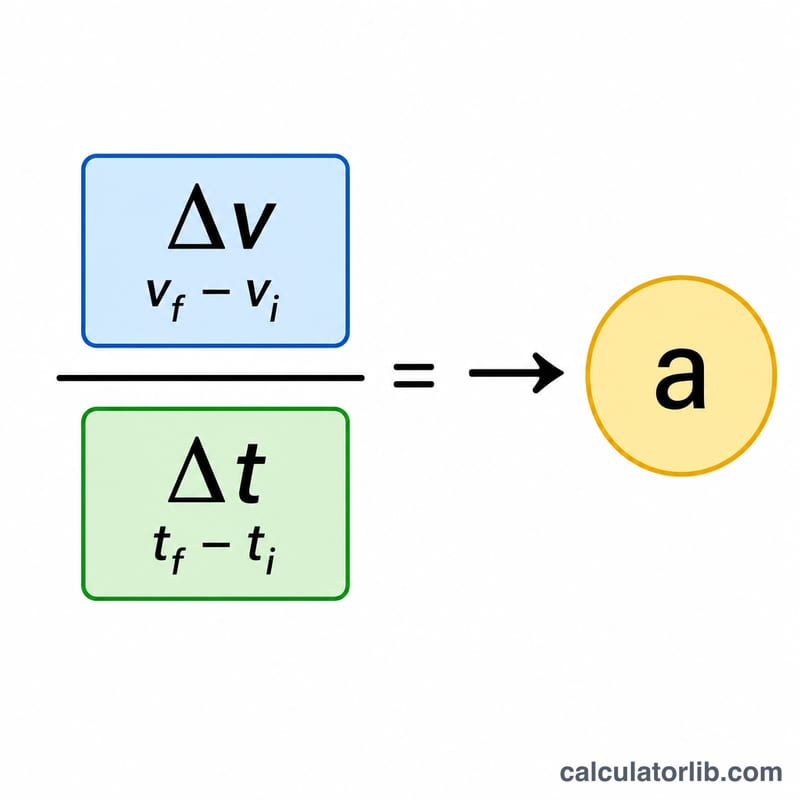
The governing equation is $$a_{avg} = \frac{\Delta v}{\Delta t} = \frac{v_f - v_i}{t_f - t_i}.$$ The numerator \(\Delta v\) is the difference between final and initial velocity. The denominator \(\Delta t\) is the elapsed time. Because acceleration is a rate of change, a larger velocity change in a shorter time produces a larger acceleration.
Worked Example
A car accelerates from 0 m/s to 20 m/s in 5 seconds. The change in velocity is \(20 - 0 = 20\) m/s. Dividing by the time interval gives $$\frac{20}{5} = 4 \text{ m/s}^2.$$ So the average acceleration is 4 metres per second squared.
Typical Acceleration Values
Acceleration is a vector measuring the rate of change of velocity. The table below lists documented magnitudes in metres per second squared (m/s²) alongside their equivalent in units of standard gravity, where \(1\,g = 9.81\,\text{m/s}^2\). The g-force column is computed as \(a \div 9.81\).
| Scenario | Acceleration (m/s²) | In g (÷9.81) | Notes |
|---|---|---|---|
| Free fall near Earth's surface | 9.81 | 1.00 | Standard gravity \(g\) |
| Commercial jet at takeoff | ~3 | ~0.31 | Sustained on runway |
| Sprinter leaving the blocks | 3–4 | ~0.31–0.41 | Peak in first strides |
| Family car, 0–100 km/h | 3–5 | 0.31–0.51 | \(\approx\) 5.6–9.3 s to 100 km/h |
| Emergency braking (dry road) | 6–8 | 0.61–0.82 | Deceleration, tyre-limited |
| Sports car, 0–100 km/h | ~9–10 | ~0.9–1.0 | High-grip launch |
As a quick check, a car reaching 100 km/h (27.78 m/s) from rest in 6 s averages 4.63 m/s², landing squarely in the family-car range.
Velocity & Acceleration Unit Conversions
The calculator works in SI units: velocities in metres per second (m/s) and the resulting acceleration in m/s². If your data is given in km/h or mph, convert it first. The factors below cover the common cases.
| Convert | Multiply by | Example |
|---|---|---|
| km/h → m/s | 1 / 3.6 ≈ 0.27778 | 100 km/h = 27.78 m/s |
| m/s → km/h | 3.6 | 10 m/s = 36 km/h |
| mph → m/s | 0.44704 | 60 mph = 26.82 m/s |
| m/s → mph | 2.23694 | 10 m/s = 22.37 mph |
For acceleration units:
| Convert | Multiply by | Example |
|---|---|---|
| m/s² → g | 1 / 9.81 ≈ 0.10194 | 6 m/s² = 0.61 g |
| g → m/s² | 9.81 | 2 g = 19.62 m/s² |
| m/s² → (km/h)/s | 3.6 | 4 m/s² = 14.4 (km/h)/s |
| (km/h)/s → m/s² | 1 / 3.6 ≈ 0.27778 | 10 (km/h)/s = 2.78 m/s² |
The "(km/h)/s" row is handy intuition: an acceleration of \(1\,\text{m/s}^2\) means your speed climbs by 3.6 km/h every second.
More Worked Examples
Each example uses the average acceleration formula \(a = \dfrac{v_f - v_i}{\Delta t}\), where \(v_f\) is the final velocity, \(v_i\) the initial velocity, and \(\Delta t\) the elapsed time.
Example 1 — Deceleration (negative result)
A car slows from 30 m/s to 10 m/s over 4 seconds. Substituting the values:
$$a = \frac{10\ \text{m/s} - 30\ \text{m/s}}{4\ \text{s}} = \frac{-20\ \text{m/s}}{4\ \text{s}} = -5\ \text{m/s}^2$$The average acceleration is -5 m/s². The negative sign indicates the velocity is decreasing — the object is decelerating in the direction of motion.
Example 2 — Convert km/h to m/s first
A car accelerates from rest (0 km/h) to 100 km/h in 6 seconds. First convert the final velocity to m/s by dividing by 3.6:
$$v_f = \frac{100\ \text{km/h}}{3.6} = 27.78\ \text{m/s}$$Now apply the formula with \(v_i = 0\) and \(\Delta t = 6\ \text{s}\):
$$a = \frac{27.78\ \text{m/s} - 0\ \text{m/s}}{6\ \text{s}} = 4.63\ \text{m/s}^2$$The average acceleration is 4.63 m/s², or about 0.47 g. Always convert both velocities to the same unit (m/s) before dividing.
FAQ
What units does this use? Velocity in metres per second (m/s) and time in seconds (s), giving acceleration in m/s².
Can acceleration be negative? Yes. A negative value means the object is slowing down or accelerating in the opposite direction (often called deceleration).
Is average the same as instantaneous acceleration? Only if acceleration is constant. Otherwise the average smooths out variations over the whole interval.