What Is Water Hammer?
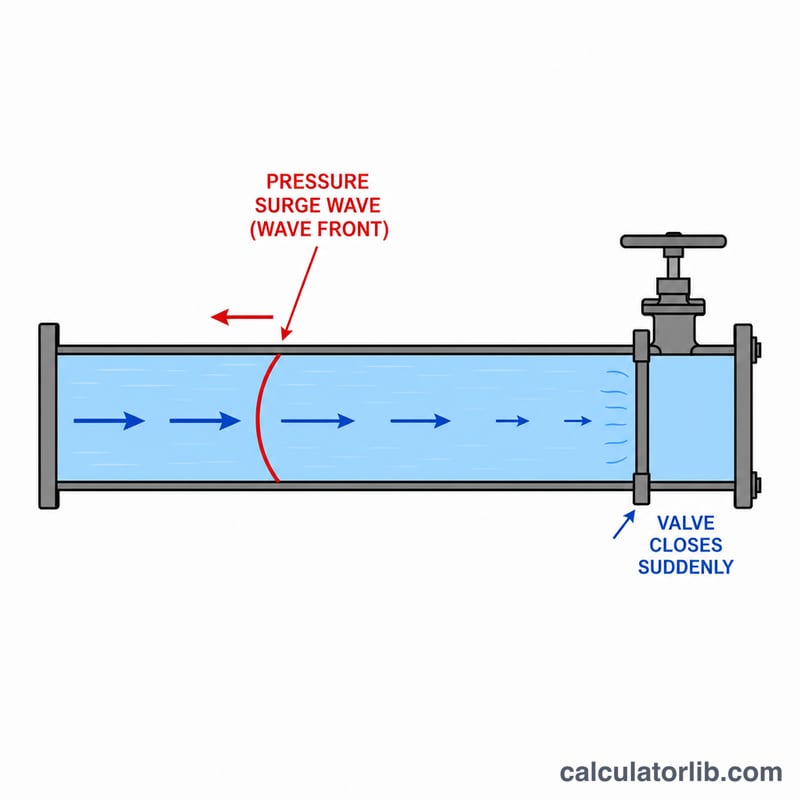
Water hammer is a pressure surge or shock wave that travels through a pipe when a moving fluid is suddenly forced to stop or change direction — for example when a valve closes quickly or a pump trips. The momentum of the fluid is converted into a spike in pressure that can be many times the normal operating pressure, potentially bursting pipes, damaging valves and shaking pipework. This calculator estimates the magnitude of that surge using the classic Joukowsky equation.
How to Use This Calculator
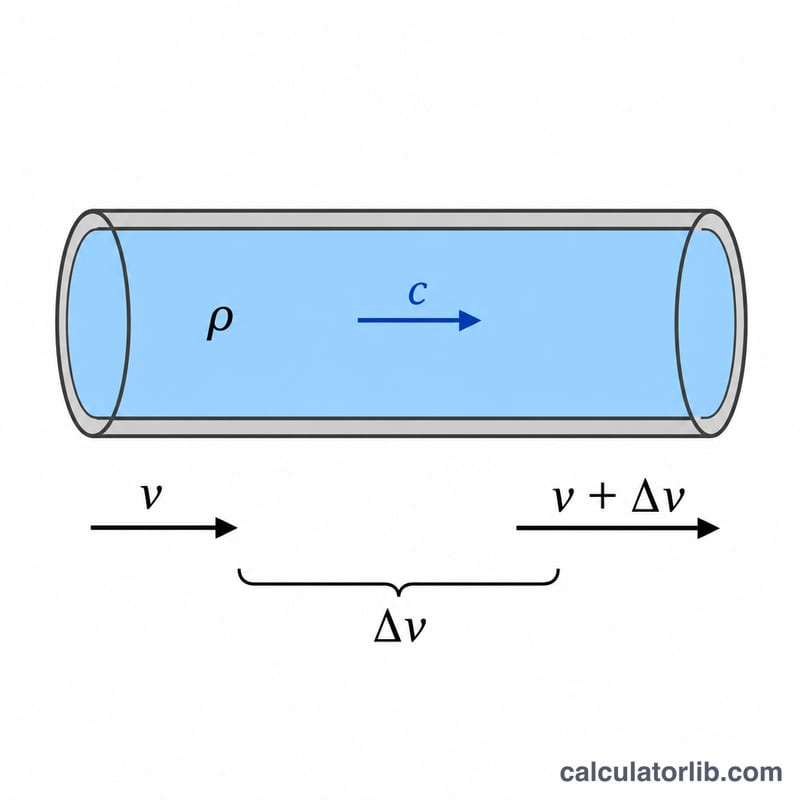
Enter three values: the fluid density (about 1000 kg/m³ for water), the pressure wave speed \(c\) (the speed at which the shock wave travels through the fluid-pipe system, often 1000–1400 m/s for water in steel pipe), and the velocity change \(\Delta v\) (the difference between the initial flow velocity and the final velocity, typically the full pipe velocity for instant valve closure). The tool returns the peak pressure surge in pascals, kilopascals, bar and psi.
The Formula Explained
The Joukowsky equation is $$\Delta P = \text{Density } \rho \cdot \text{Wave Speed } c \cdot \left| \Delta v \right|$$ It assumes an instantaneous valve closure (faster than the pipe’s critical time, \(2L/c\)). The surge is independent of pipe length and depends only on density, wave speed and how much the velocity changes. Slower closures produce smaller surges, so this gives a conservative worst-case estimate.
Worked Example
Water (\(\rho = 1000\) kg/m³) flows at 2 m/s and is stopped instantly. With a wave speed of 1200 m/s: $$\Delta P = 1000 \times 1200 \times 2 = 2{,}400{,}000 \text{ Pa} = 2400 \text{ kPa} = 24 \text{ bar} \approx 348 \text{ psi}$$ That surge is added on top of the static line pressure.
Typical Wave Speeds by Pipe Material
The pressure wave speed \(c\) depends on the fluid's bulk modulus and on how much the pipe wall flexes. Stiffer pipes give higher wave speeds and larger surges. The values below are approximate, for water at about 20 °C. Real values depend on wall thickness, diameter, pipe restraint or anchoring, temperature, and any trapped air. Use the manufacturer's or a design-standard value for final design.
| Pipe material / case | Approximate wave speed c (m/s) |
|---|---|
| Rigid pipe / free water (no wall flexing) | ≈ 1480 |
| Steel | ≈ 1000–1250 |
| Ductile iron | ≈ 1000–1300 |
| Concrete | ≈ 900–1200 |
| Copper | ≈ 1100–1300 |
| PVC | ≈ 300–500 |
| HDPE | ≈ 200–400 |
Thin walls, large diameters and unrestrained pipes lower the wave speed. Thick walls, small diameters and well-anchored pipes raise it toward the rigid-pipe limit. Even a small amount of entrained air can reduce the wave speed sharply.
Surge Comparison for Different Flow Velocities and Pipe Materials
The table uses water density \(\rho = 1000\) kg/m³ and the Joukowsky equation \(\Delta P = \rho \cdot c \cdot |\Delta v|\). Conversions: 1 bar = 100 kPa, and 1 psi ≈ 6.8948 kPa. For example, with \(c = 1000\) m/s and \(\Delta v = 2\) m/s: \(\Delta P = 1000 \times 1000 \times 2 = 2{,}000{,}000\) Pa.
| Wave speed c (m/s) | Typical pipe | Δv (m/s) | Surge (kPa) | Surge (bar) | Surge (psi) |
|---|---|---|---|---|---|
| 400 | Plastic | 1 | 400 | 4 | 58.0 |
| 400 | Plastic | 2 | 800 | 8 | 116.0 |
| 400 | Plastic | 3 | 1200 | 12 | 174.0 |
| 1000 | Steel | 1 | 1000 | 10 | 145.0 |
| 1000 | Steel | 2 | 2000 | 20 | 290.1 |
| 1000 | Steel | 3 | 3000 | 30 | 435.1 |
| 1200 | Stiff metal pipe | 1 | 1200 | 12 | 174.0 |
| 1200 | Stiff metal pipe | 2 | 2400 | 24 | 348.1 |
| 1200 | Stiff metal pipe | 3 | 3600 | 36 | 522.1 |
The surge scales linearly with both the velocity change and the wave speed. Halving the flow velocity halves the surge, and switching from steel to a flexible plastic pipe with a much lower wave speed reduces it substantially.
Interpreting the Surge Result
- Peak pressure = static pressure + surge. The Joukowsky result \(\Delta P\) is only the pressure change. The maximum pressure the pipe sees is \(P_{\text{max}} = P_{\text{static}} + \Delta P\). The pressure falls by the same amount on the low side of the wave, which can cause vacuum or column separation.
- Compare with the pipe rating. Compare \(P_{\text{max}}\) with the pipe's pressure class (for example PN in bar, as used in European and ISO practice) and with the surge allowance in the relevant product standard or manufacturer data. Apply a suitable safety factor. Fittings, valves, joints and flanges may be the weakest components.
- Instantaneous closure is conservative. The equation assumes the velocity changes abruptly, which gives the maximum possible surge. Real valves close over a finite time, and friction and pipe elasticity reduce the peak, so the result is a safe upper bound for fast events.
- Closure time versus 2L/c. A pressure wave travels to the other end of a pipe of length \(L\) and back in \(t_c = 2L/c\). If the valve closes in a time less than or equal to \(2L/c\), the full Joukowsky surge applies. If closure is much slower, the surge is lower and a transient analysis is needed. For example, \(L = 500\) m and \(c = 1000\) m/s give \(2L/c = 2 \times 500 / 1000 = 1\) s.
- Rule of thumb. For water in steel, \(c \approx 1000\) m/s, so \(\Delta P = 1000 \times 1000 \times 0.1 = 100{,}000\) Pa = 1 bar per 0.1 m/s. That is about 10 bar for every 1 m/s of velocity change.
Typical mitigation measures include slower valve closure, surge vessels or accumulators, surge relief valves, and lower design velocities. This is general engineering information, not a substitute for a transient analysis by a qualified engineer for a real system.
FAQ
Does pipe length matter? Not for the peak surge in the Joukowsky equation, but length sets the critical closure time \(2L/c\); longer pipes give more time for valves to close gradually.
What wave speed should I use? Use ~1480 m/s for water in a rigid pipe, but real elastic pipes lower it — steel pipes are often 1000–1300 m/s, plastic pipes 300–500 m/s.
How do I reduce water hammer? Close valves slowly, use surge tanks or air chambers, install pressure-relief valves, and select pipe materials with lower wave speed.