
What This Calculator Does
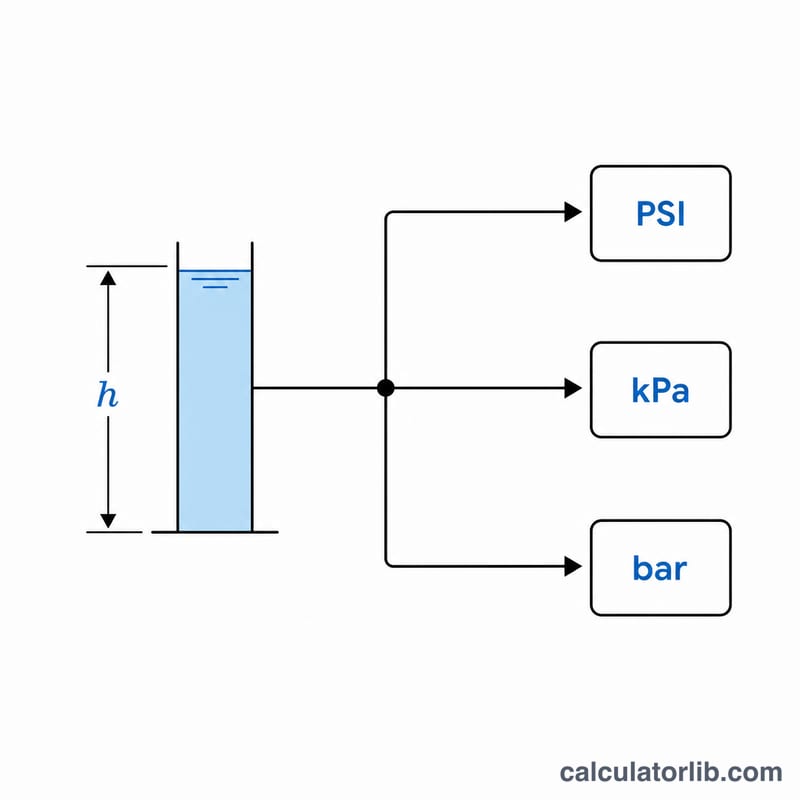
This tool converts the height of a water column into the hydrostatic pressure it produces at its base. Enter a height in feet of water (ftH2O) or inches of water (inH2O) and get the equivalent pressure in PSI, kilopascals (kPa) and bar. It is useful for plumbing, HVAC duct-static measurement, well and tank design, pump head calculations, and fluid mechanics homework.
How to Use It
Type the water column height into the box, pick the matching unit, and read the pressure result. The primary output is PSI; the table below shows the same value in kPa and bar for convenience.
The Formula Explained
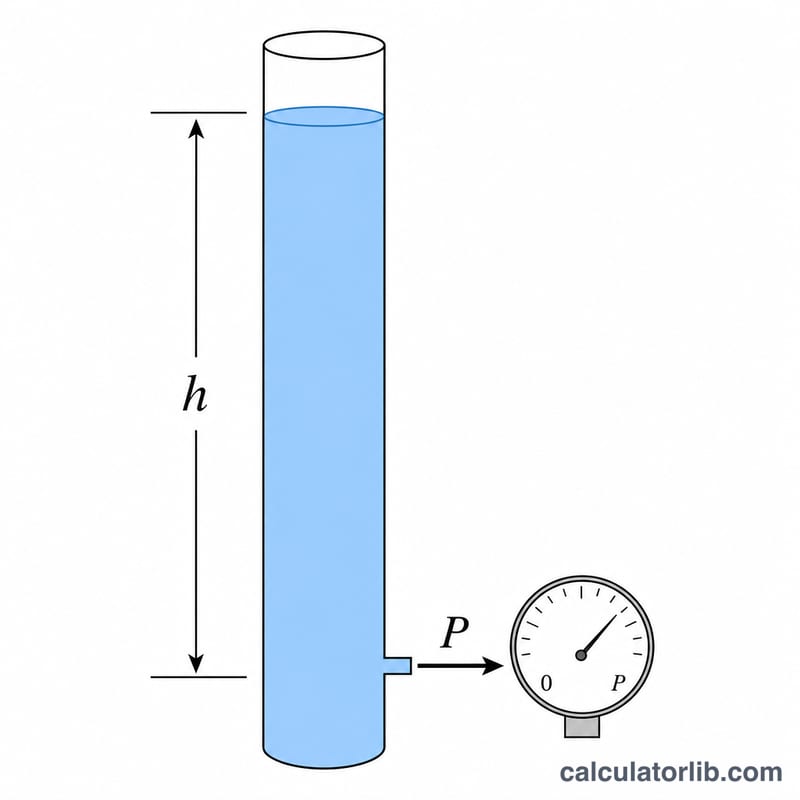
Hydrostatic pressure depends only on fluid height and density, not container shape. For fresh water at typical conditions, each foot of vertical water gives about 0.4335 PSI, and each inch gives about 0.03613 PSI:
$$P \text{ (PSI)} = \text{feet of water} \times 0.4335$$$$P \text{ (PSI)} = \text{inches of water} \times 0.03613$$To convert further: \(1 \text{ PSI} = 6.894757 \text{ kPa} = 0.0689476 \text{ bar}\).
Worked Example
A storage tank holds water to a depth of 10 feet. Pressure at the bottom = $$10 \times 0.4335 = 4.335 \text{ PSI}$$ which equals about 29.89 kPa or 0.299 bar. This is why a tall building needs booster pumps: every 10 feet of rise adds roughly 4.3 PSI of demand.
FAQ
Does water temperature matter? Slightly. The 0.4335 factor assumes fresh water near room temperature. Hot water is a little less dense, so pressure is marginally lower.
What about salt water? Seawater is denser (about 1.025x), so multiply the result by roughly 1.025 for an estimate.
Is this gauge or absolute pressure? It is gauge pressure — the pressure added by the water column above atmospheric. Add about 14.7 PSI for absolute pressure at sea level.