
What is a part of a whole?
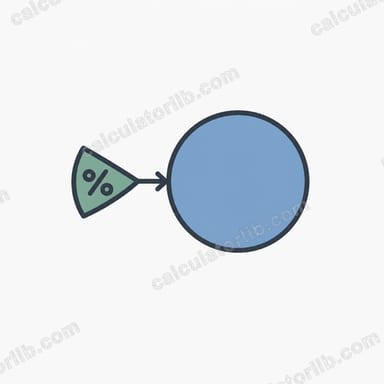
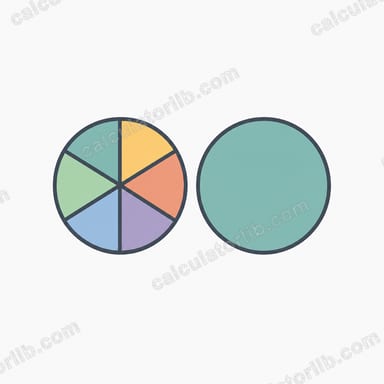
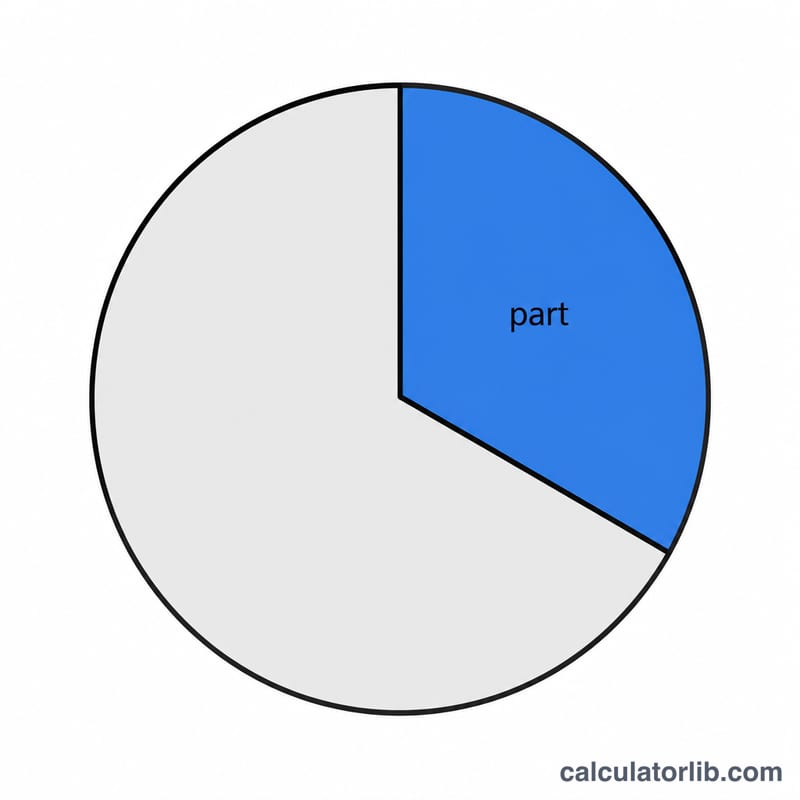
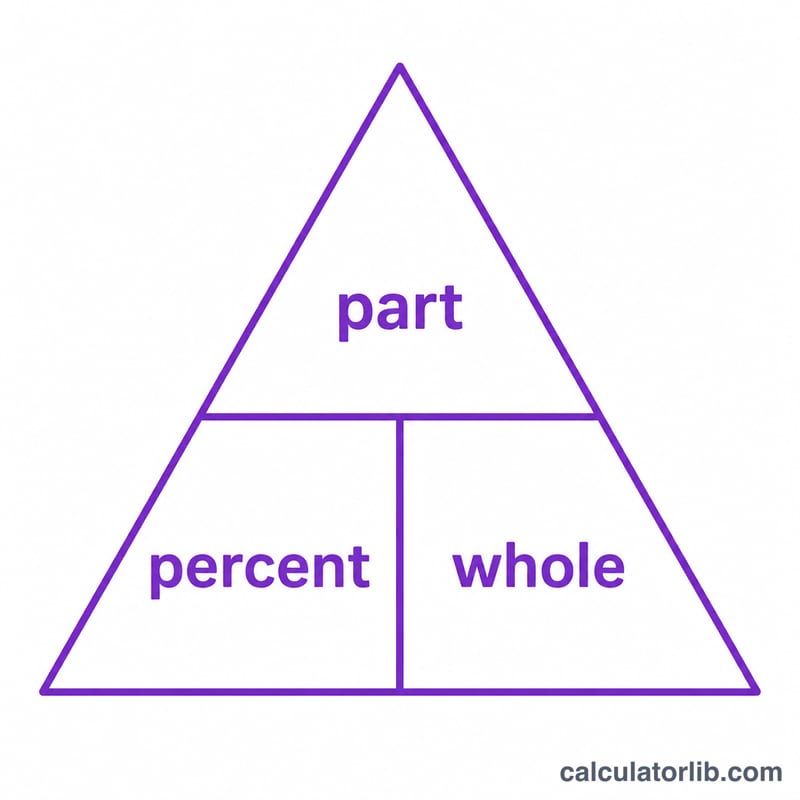
Every percentage problem links three numbers: the whole (the total or base amount), the percent (a fraction of 100), and the part (how much of the whole the percent represents). This calculator lets you supply any two of these and instantly computes the third, so you never have to remember which formula to rearrange.
How to use this calculator
Choose what you want to find — the Part, the Whole, or the Percent. Then enter the two values you know and the calculator solves for the missing one. For example, to find 25% of 200, select "The Part", enter 25 in Percent and 200 in Whole.
The formula explained
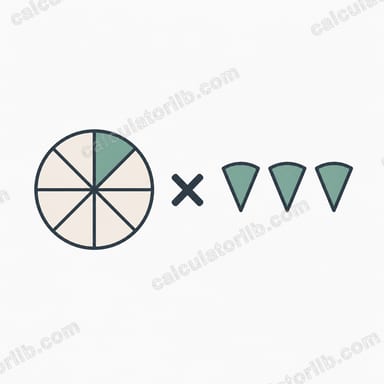
The core relationship is $$\text{part} = \frac{\text{percent}}{100} \times \text{whole}$$. Dividing the percent by 100 converts it to a decimal (25% becomes 0.25), and multiplying by the whole scales it down to the part. Rearranging gives $$\text{whole} = \frac{\text{part}}{\dfrac{\text{percent}}{100}}$$ and $$\text{percent} = \frac{\text{part}}{\text{whole}} \times 100$$.
Worked example
Suppose a class of 40 students has 30 who passed an exam. To find the pass rate, select "The Percent", enter 30 as the Part and 40 as the Whole: $$\text{percent} = \frac{30}{40} \times 100 = \mathbf{75\%}$$ If instead you knew 75% passed and wanted the count, select "The Part": $$\text{part} = \frac{75}{100} \times 40 = 30 \text{ students}$$
FAQ
What if the percent is over 100? That is fine — a percent above 100 simply means the part is larger than the whole, useful for growth or markup problems.
Can the part exceed the whole? Yes, whenever the percent is greater than 100. The math still holds.
Why is my answer zero when solving for the whole? Dividing by a zero percent is undefined, so the calculator returns 0 as a safe guard. Enter a non-zero percent.