
What This Calculator Does
This tool computes the average water velocity inside a circular pipe given the volumetric flow rate in gallons per minute (GPM) and the pipe inside diameter in inches. Velocity is reported in feet per second (ft/s), the standard unit used in plumbing, irrigation, and HVAC pipe sizing.
How to Use It
Enter the flow rate in GPM and the inside (not nominal) diameter of the pipe in inches, then read the resulting velocity. Use the actual internal diameter, since wall thickness reduces the flow area. A common design target is to keep velocity below about 5-8 ft/s to limit noise, erosion, and water hammer.
The Formula Explained
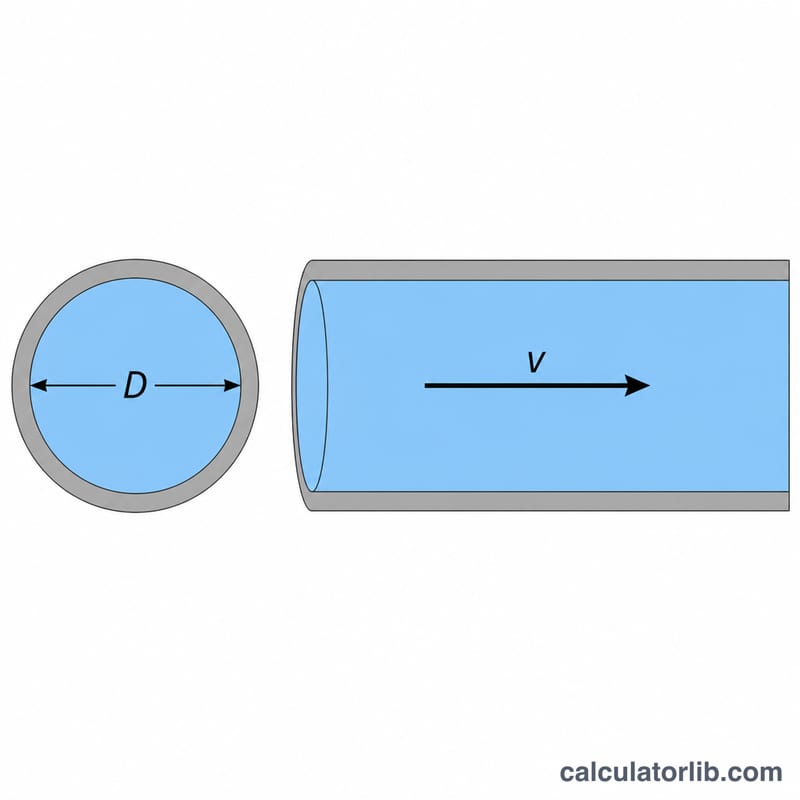
The relationship comes from \(v = Q / A\). Flow area of a circle is \(A = \pi D^2/4\). Converting GPM to cubic feet per second and inches to feet, the constants combine into a single coefficient:
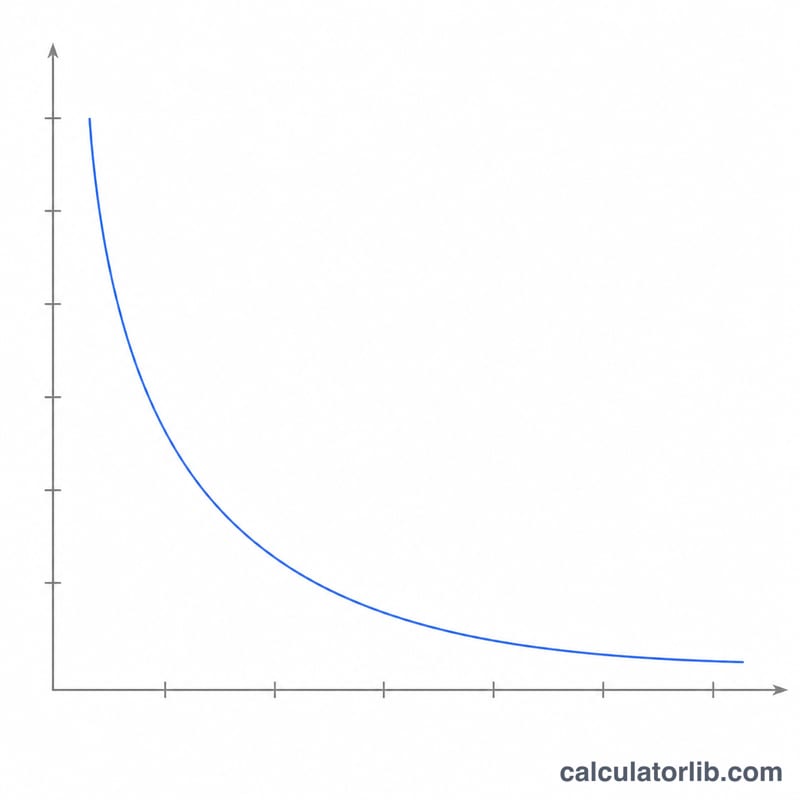
$$v\ (\text{ft/s}) = 0.4085 \times \frac{\text{GPM}}{D^2}$$, where \(D\) is the inside diameter in inches. Because area scales with the square of diameter, doubling the diameter cuts velocity to one quarter for the same flow.
Worked Example
Suppose you push 10 GPM through a pipe with a 1-inch inside diameter. Then $$v = 0.4085 \times \frac{10}{1^2} = 4.085\ \text{ft/s}.$$ If the diameter were 2 inches instead, $$v = 0.4085 \times \frac{10}{4} = 1.02\ \text{ft/s}.$$
FAQ
Should I use nominal or actual diameter? Use the actual inside diameter. Nominal pipe sizes (e.g. "1 inch") often differ from the true bore depending on material and schedule.
What velocity is too high? Many codes recommend keeping water velocity under 5-8 ft/s for cold water and lower for hot water to reduce erosion and noise.
Does this account for friction loss? No. This gives velocity only; friction (head) loss requires the Hazen-Williams or Darcy-Weisbach equations.