
What Is Loan-to-Value (LTV)?
The loan-to-value ratio compares the amount you are borrowing to the appraised value or purchase price of the property securing the loan. Lenders use LTV as a key measure of risk: the more equity you have (the lower the LTV), the less risk the lender takes on. A lower LTV often unlocks better interest rates and can help you avoid extra costs like private mortgage insurance.
How to Use This Calculator
Enter the loan amount you are requesting (or your current mortgage balance) and the property value (purchase price or appraised value). The calculator returns your LTV percentage, your home equity in currency, and the equity as a percentage. Use the lower of purchase price and appraisal if they differ, since most lenders do.
The Formula Explained
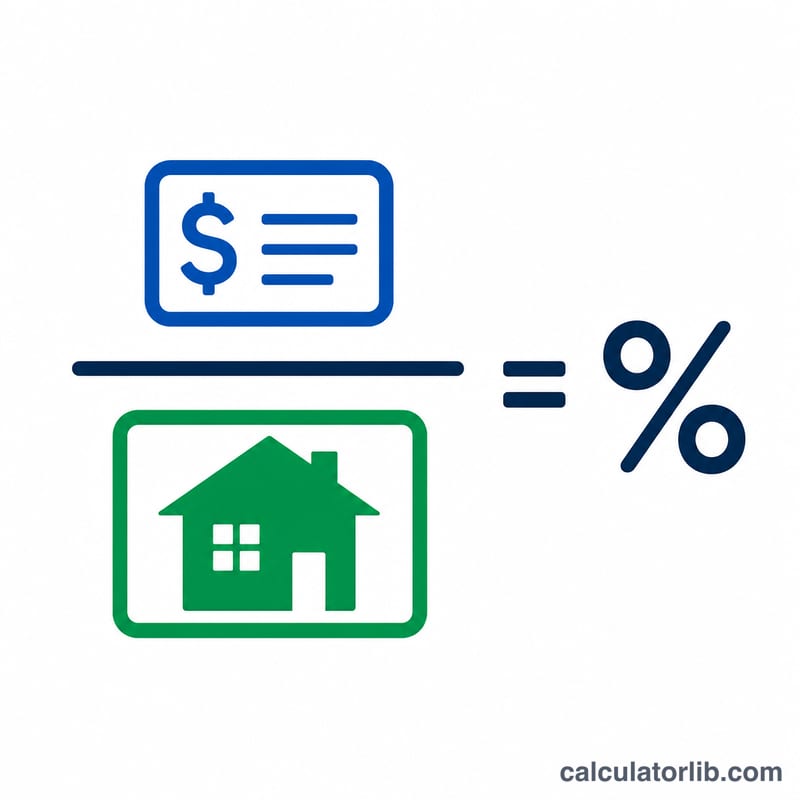
LTV is simply the loan amount divided by the property value, multiplied by 100 to convert it to a percentage.
$$\text{LTV} = \frac{\text{Loan Amount}}{\text{Property Value}} \times 100\%$$For example, a $240,000 loan on a $300,000 home gives \(240{,}000 \div 300{,}000 = 0.8\), or an 80% LTV. The remaining 20% ($60,000) is your equity. Many lenders prefer an LTV of 80% or below; above that, mortgage insurance or a higher rate may apply.
Worked Example
Suppose you buy a property valued at $300,000 with a $240,000 mortgage.
$$\text{LTV} = \left(\frac{240{,}000}{300{,}000}\right) \times 100 = 80\%$$Your equity is \(300{,}000 - 240{,}000 = \$60{,}000\), which is 20% of the property value.
FAQ
What is a good LTV ratio? An LTV of 80% or lower is generally considered strong and typically avoids mortgage insurance requirements.
Does a lower LTV get a better rate? Usually yes. Lower LTV means more borrower equity and less lender risk, often leading to lower interest rates.
Can LTV be over 100%? Yes. If the loan exceeds the property value (for example, after a market decline), you are in negative equity and LTV exceeds 100%.