
What the Path Length from Absorbance Calculator Does
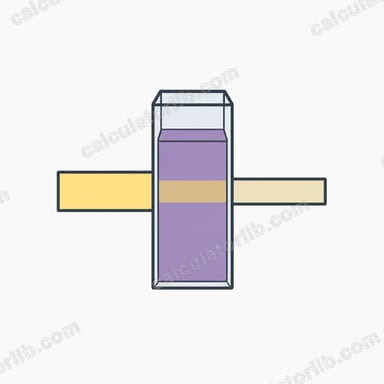
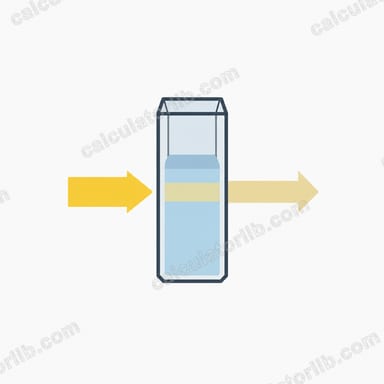
This calculator rearranges the Beer-Lambert law to solve for the optical path length (l) that light travels through a sample. Given a measured absorbance, the molar absorptivity of the absorbing species, and the concentration of the solution, it returns the cuvette or cell path length in centimeters. It is the inverse of the usual "find the concentration" problem and is useful for checking cuvette geometry, validating a custom flow cell, or back-solving an experiment in which the path length is the unknown.
How to Use It
Enter three values: the absorbance (A, a dimensionless reading from your spectrophotometer), the molar absorptivity (ε, in L·mol⁻¹·cm⁻¹ at the wavelength you measured), and the concentration (c, in mol/L). The calculator divides absorbance by the product of ε and c and reports the path length in centimeters, with a millimeter conversion for convenience. Make sure ε and c are quoted for the same wavelength and units used to obtain A.
The Formula Explained
The Beer-Lambert law states that absorbance is the product of molar absorptivity, concentration, and path length:
$$A = \varepsilon \, c \, l$$
Solving for the path length gives:
$$l = \frac{A}{\varepsilon \, c}$$
Here A is dimensionless, ε has units of L·mol⁻¹·cm⁻¹, and c is in mol/L, so the product ε·c has units of cm⁻¹ and l comes out in centimeters. The law assumes monochromatic light and a dilute, non-scattering solution where absorbance stays approximately linear, typically when A is below about 1.
Worked Example
Suppose a solution reads an absorbance of A = 0.63 at a wavelength where the molar absorptivity is ε = 6300 L·mol⁻¹·cm⁻¹, and the concentration is c = 0.0001 mol/L (1 × 10⁻⁴ M). The path length is:
$$l = \frac{0.63}{6300 \times 0.0001} = \frac{0.63}{0.63} = 1\ \text{cm}$$
The result confirms a standard 1 cm cuvette. If the same reading were instead A = 2.0 with ε = 20000 and c = 5 × 10⁻⁵ M, the path length would be l = 2.0 / (20000 × 0.00005) = 2.0 / 1.0 = 2 cm.
Frequently Asked Questions
What units does the path length come out in? When absorbance is dimensionless, molar absorptivity is in L·mol⁻¹·cm⁻¹, and concentration is in mol/L, the path length is in centimeters. The calculator also shows the equivalent value in millimeters.
Why must molar absorptivity and concentration be greater than zero? Path length is found by dividing absorbance by the product ε·c. If either ε or c is zero, that product is zero and the division is undefined, so both must be positive real numbers.
Does this work outside the linear absorbance range? The Beer-Lambert law is reliable only for dilute, non-scattering samples, usually when absorbance is below about 1. At high absorbance, stray light and chemical effects cause deviations, so a path length solved from a very high A may be inaccurate.