What Is the Rent-to-Income Percentage?
The rent-to-income percentage shows how much of your monthly take-home or gross income goes toward paying rent. It is one of the simplest measures of housing affordability and is widely used by landlords, lenders, and budget-conscious renters alike. A lower percentage means more of your income is available for other needs, savings, and emergencies.
How to Use This Calculator
Enter your total monthly rent and your monthly income (gross or net — just be consistent). The calculator divides rent by income and multiplies by 100 to give your rent percentage. It also shows how much money you have left each month after rent is paid.
The Formula Explained
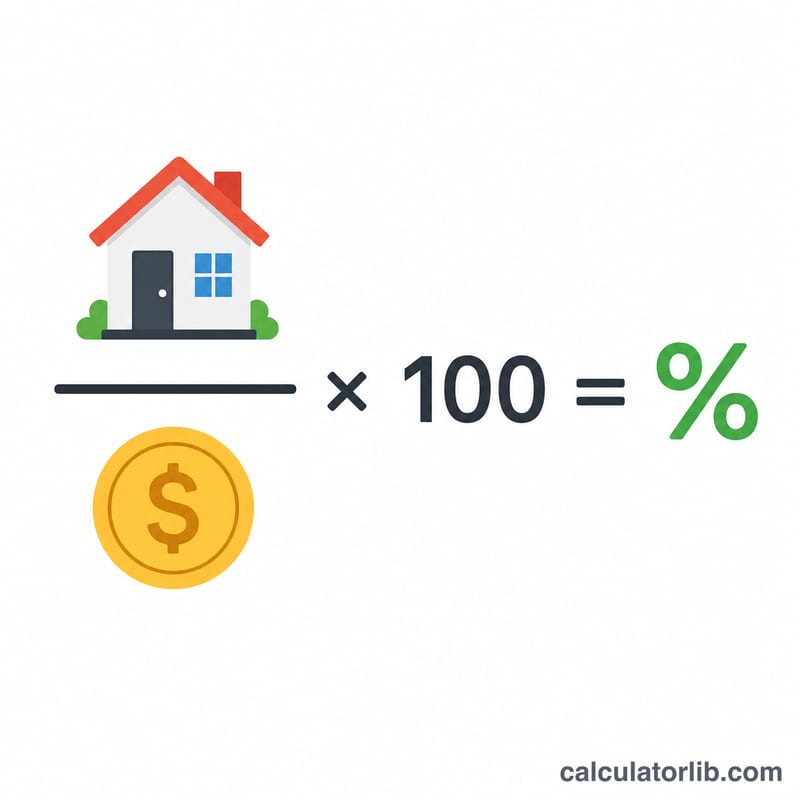
The math is straightforward: $$\text{Rent \%} = \frac{\text{Monthly Rent}}{\text{Monthly Income}} \times 100$$. For example, if you pay $1,200 in rent on a $4,000 monthly income, your rent percentage is \((1200 \div 4000) \times 100 = 30\%\). That puts you right at the popular "30% rule" threshold.
Worked Example
Suppose your rent is $1,500 and you earn $5,000 per month. Dividing 1,500 by 5,000 gives 0.30, and multiplying by 100 gives 30%. After rent, you keep \(\$5,000 - \$1,500 = \$3,500\) each month.
Interpreting Your Rent-to-Income Percentage
The percentage this calculator returns is simply \( \text{Rent \%} = \dfrac{\text{Monthly Rent}}{\text{Monthly Income}} \times 100 \). What makes that number meaningful is the set of thresholds used by the U.S. Department of Housing and Urban Development (HUD) to classify housing cost burden. These are United States administrative definitions — other countries use different affordability benchmarks (for example, measures based on residual income or on 25% or 35% of income), so the bands below should not be read as a universal standard.
| Rent as % of income | HUD classification | What it means |
|---|---|---|
| Under 30% | Not cost burdened | Housing costs are within HUD's affordability standard. |
| 30% – 50% | Cost burdened | More than 30% of income goes to housing. |
| Over 50% | Severely cost burdened | More than half of income goes to housing. |
Where the 30% figure comes from
The 30% line is not an economic law — it is the legacy of a specific policy decision. The Brooke Amendment of 1969 capped rent in federally assisted housing at 25% of a tenant's adjusted income. Amendments enacted in 1981 raised that cap from 25% to 30% of adjusted income, phased in over several years, and 30% subsequently became the default yardstick for affordability in U.S. housing statistics and in everyday budgeting advice.
Why a rent-only percentage understates burden
HUD's cost-burden measures are built on gross housing costs as a share of gross (pre-tax) household income. For renters, gross housing cost means contract rent plus tenant-paid utilities (and, in practice, mandatory fees). Because this calculator divides base rent alone by income, your true burden is higher than the figure shown whenever you pay utilities separately. If you pay, say, $150 a month in electricity, gas and water on top of $1,200 rent at $4,000 income, the rent-only share is 30.0% while the HUD-style gross share is \( \frac{1350}{4000} \times 100 = 33.75\% \) — the difference between "at the threshold" and "cost burdened." To compare yourself against HUD's categories, enter rent plus tenant-paid utilities.
How landlords and lenders use the same number
Screening criteria in the U.S. rental market commonly mirror the 30% rule from the other direction: many landlords and property managers require gross monthly income of at least three times the monthly rent (equivalently, rent no more than about 33.3% of gross income), and some use a stricter 30% cap or require 2.5x in high-cost markets. These are private underwriting policies, not law, and they vary by landlord, city and local regulation — some jurisdictions restrict how income ratios may be applied, particularly to applicants using housing vouchers.
Important: every band above is a statistical and administrative classification used to describe populations and to screen applications. It is not a judgement about your personal budget. A household at 38% with no car payment, no debt and low utilities may be perfectly stable, while a household at 26% with childcare, medical costs and student loans may be stretched. This is general information for context, not financial advice; for decisions about your own situation, consult a qualified housing counselor or financial professional.
Rent Percentage Across Common Income and Rent Scenarios
Each row below is computed as rent ÷ income × 100, rounded to one decimal place, with income left after rent shown as the simple remainder. Income is treated as gross monthly income and rent as base monthly rent, matching the calculator's inputs. HUD burden categories are the U.S. classifications described above.
| Monthly Income | Monthly Rent | Rent % | Income Left After Rent | HUD burden category |
|---|---|---|---|---|
| $2,500 | $900 | 36.0% | $1,600 | Cost burdened |
| $3,000 | $750 | 25.0% | $2,250 | Not cost burdened |
| $4,000 | $1,200 | 30.0% | $2,800 | Exactly at the 30% threshold |
| $5,000 | $2,000 | 40.0% | $3,000 | Cost burdened |
| $6,500 | $1,600 | 24.6% | $4,900 | Not cost burdened |
| $8,000 | $4,200 | 52.5% | $3,800 | Severely cost burdened |
Worked example: the $6,500 row
$$\text{Rent \%} = \frac{\$1{,}600}{\$6{,}500} \times 100 = 0.246153\ldots \times 100 = 24.6\%$$
$$\text{Income left} = \$6{,}500 - \$1{,}600 = \$4{,}900$$
Notice what the table shows about percentages versus dollars. The $2,500 / $900 household spends 36.0% of income on rent and keeps $1,600; the $8,000 / $4,200 household spends 52.5% — a far worse ratio — yet keeps $3,800, more than twice as much. The ratio answers "what share of my income is committed to rent," while the remainder answers "how much is left for everything else." Both matter, and at high incomes the remainder is often the more informative of the two.
Key Terms Defined
- Gross (pre-tax) monthly income
- Total monthly earnings before any deductions — income tax, social insurance, retirement contributions or health premiums. This is the figure HUD's cost-burden statistics use and the one most landlords ask for on an application, so entering gross income is what makes your result comparable to the 30% rule.
- Net (take-home) monthly income
- What actually reaches your bank account after deductions. Because net income is smaller, the same rent produces a higher percentage: $1,200 rent is 30.0% of $4,000 gross but \( \frac{1200}{3100} \times 100 \approx 38.7\% \) of a $3,100 net paycheck. Net income is the more realistic basis for personal budgeting; just don't compare a net-based percentage against HUD bands or landlord thresholds, which assume gross.
- Monthly rent
- Base rent is the contract amount owed to the landlord each month. Rent plus tenant-paid utilities and mandatory fees adds electricity, gas, water, trash, and any required charges such as parking, pet rent, amenity or "technology" fees. HUD's gross-rent concept is closer to the second. Deciding which one you enter determines whether your result is a landlord-style rent ratio or a true housing-cost ratio.
- Rent-to-income ratio
- Monthly rent divided by monthly income, usually expressed as a percentage. It is the single number this calculator returns and the most widely used shorthand for rental affordability.
- The 30% rule
- The guideline that housing should consume no more than 30% of gross income. In the United States it traces to federal rent caps in assisted housing, raised from 25% to 30% of adjusted income by amendments enacted in 1981. It is a rule of thumb, not a budgeting requirement, and it ignores debt, dependents, commuting costs and local price levels.
- Cost burdened (HUD)
- A U.S. classification for households paying more than 30% of gross income for housing, including utilities.
- Severely cost burdened (HUD)
- A U.S. classification for households paying more than 50% of gross income for housing, including utilities.
- The 3x monthly rent rule
- A common U.S. landlord screening standard requiring gross monthly income of at least three times the rent. The two framings are the same arithmetic inverted: if income is exactly 3 × rent, then \( \text{Rent \%} = \frac{\text{rent}}{3 \times \text{rent}} \times 100 = 33.3\% \). So "3x income" permits a slightly higher rent share than a strict 30% cap. It is a private policy that varies by landlord and market, not a legal rule.
- Residual income
- The money left after rent is paid — income minus rent — available for food, transport, utilities, insurance, debt payments and saving. Residual-income analysis asks whether the remainder covers a household's actual needs rather than whether the ratio clears a fixed percentage, which is why it often describes large households and high earners better than a ratio does.
FAQ
What percentage of income should go to rent? A common guideline is to spend no more than 30% of your gross income on rent, though high-cost cities often push this higher.
Should I use gross or net income? The 30% rule traditionally uses gross (pre-tax) income, but using net income gives a more realistic picture of your actual budget.
Is it bad to spend more than 30%? Spending 30–50% is considered "cost-burdened" and may strain your budget, but it can still be manageable depending on your other expenses and savings goals.